. 2020 Nov 17;21(1):800.
doi: 10.1186/s12864-020-07210-9.

Genomic analysis of worldwide sheep breeds reveals PDGFD as a major target of fat-tail selection in sheep

Affiliations

Genomic analysis of worldwide sheep breeds reveals PDGFD as a major target of fat-tail selection in sheep

Kunzhe Dong et al. BMC Genomics. .

Abstract

Background: Fat tail is a unique trait in sheep acquired during domestication. Several genomic analyses have been conducted in sheep breeds from limited geographic origins to identify the genetic factors underlying this trait. Nevertheless, these studies obtained different candidates. The results of these regional studies were easily biased by the breed structures.

Results: To minimize the bias and distinguish the true candidates, we used an extended data set of 968 sheep representing 18 fat-tailed breeds and 14 thin-tailed breeds from around the world, and integrated two statistical tests to detect selection signatures, including Genetic Fixation Index (FST) and difference of derived allele frequency (ΔDAF). The results showed that platelet derived growth factor D (PDGFD) exhibited the highest genetic differentiation between fat- and thin-tailed sheep breeds. Analysis of sequence variation identified that a 6.8-kb region within the first intron of PDGFD is likely the target of positive selection and contains regulatory mutation(s) in fat-tailed sheep. Histological and gene expression analyses demonstrated that PDGFD expression is associated with maturation and hemostasis of adipocytes. Further retrospective analysis of public transcriptomic datasets revealed that PDGFD expression is down-regulated during adipogenesis in both human and mouse, and is higher in fat tissues of obese individuals than that in lean individuals.

Conclusions: These results reveal that PDGFD is the predominant factor for the fat tail phenotype in sheep by contributing to adiopogenesis and maintaining the hemostasis of mature adipocytes. This study provides insights into the selection of fat-tailed sheep and has important application to animal breeding, as well as obesity-related human diseases.

Keywords: Adipogenesis; Fat deposit; Fat-tailed sheep; Genomic scan; PDGFD.


Conflict of interest statement

The authors declare that they have no competing interests.

Figures
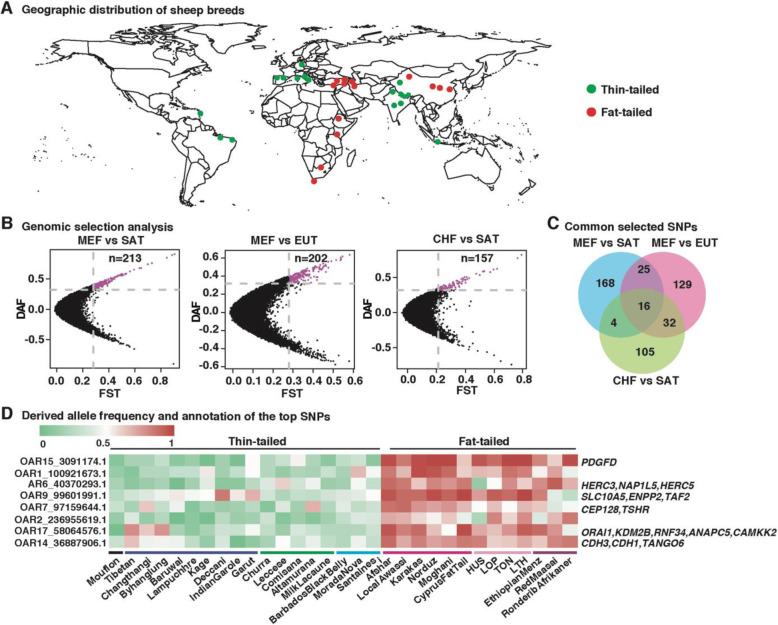
Fig. 1
Fig. 1
Identification of positively selected loci in fat-tailed sheep. a The geographic distribution of the sheep breeds used in this study, each of which is represented by a dot on the world map. The map was generated with R package “rworldmap” (https://cran.r-project.org/web/packages/rworldmap/). b The number of positively selected loci identified in three different group-pair comparisons. MEF: Middle East fat-tailed sheep from Middle East; SAT: South Asian thin-tailed sheep; EUT: European thin-tailed sheep; CHF: Chinese fat-tailed sheep. c The number of positively selected loci identified in all the three group-pair comparisons. d The derived allele frequency (DAF) of the 16 positively selected loci identified in all three group-pair comparisons in all the studied sheep breeds. SNPs were sorted according to the average value of FST and ΔDAF among the three group-pair comparisons indicated in Fig. 1B from high to low. The important annotated genes of each SNP were labeled in the right
Fig. 2
Fig. 2
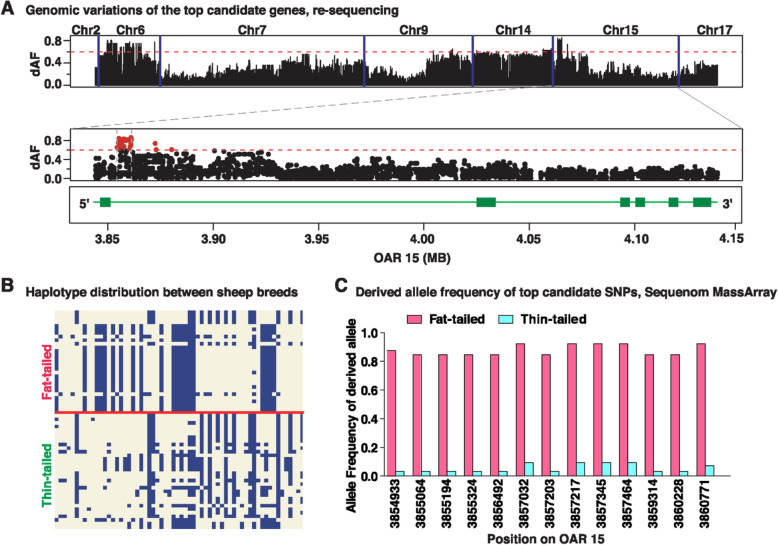
Analysis of sequence variations of PDGFD gene. a The distribution of the absolute difference of allele frequency ΔAF of sequence variation within the 24 identified genes with selection signatures between 13 fat-tailed sheep individuals and 16 thin-tailed sheep individuals from different regions. The sequence variations were downloaded from NextGene project. The red dashed line indicates the threshold value (ΔAF > 0.6). The bottom panel shows the distribution of the absolute difference of allele frequency ΔAF of sequence variation within PDGFD gene. The red dashed line indicates the threshold value (ΔAF > 0.6) and red dots represents SNPs with ΔAF > 0.9. b Haplotype compassion between thin-tailed and fat-tailed sheep obtained based on all the variations within the highly differentiated 6.8-kb genomic interval (Chr15:3,854,063-3,860,894 bp). Each column is a polymorphic genomic location (122 in total), each row is a phased haplotype (16 thin-tailed sheep and 13 fat-tailed sheep individuals), and alternative alleles are labelled in blue. c Derived allele frequency of the 13 top candidate SNPs in additional fat-tailed sheep (Chinese Tan sheep) and thin-tailed sheep (Chinese Tibetan sheep) obtained by Sequenom MassARRAY
Fig. 3
Fig. 3
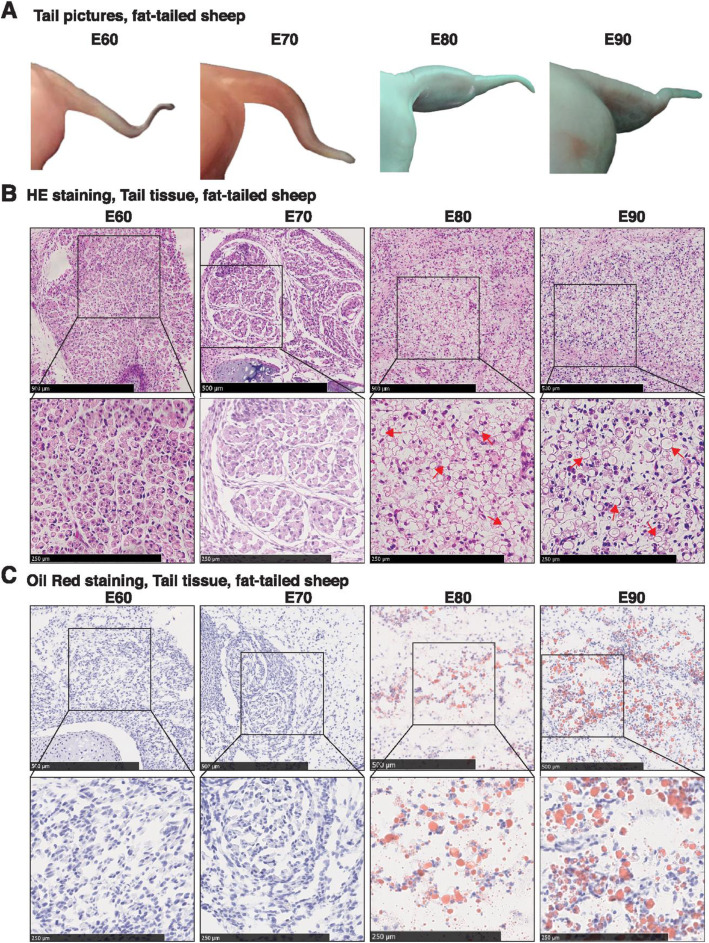
Histological analysis of sheep tail tissues during embryonic development. a Morphological changes of tail tissues from fat-tailed sheep at embryonic day 60 (E60), E70, E80 and E90. b Hematoxylin and Eosin (HE) staining for tail tissues of fat-tailed sheep at E60, E70, E80 and E90. The boxed areas are magnified on the bottom. Red arrows point to representative lipid drops. c Oil Red O staining for tail tissues of fat-tailed sheep at E60, E70, E80 and E90. The boxed areas are magnified on the bottom
Fig. 4
Fig. 4
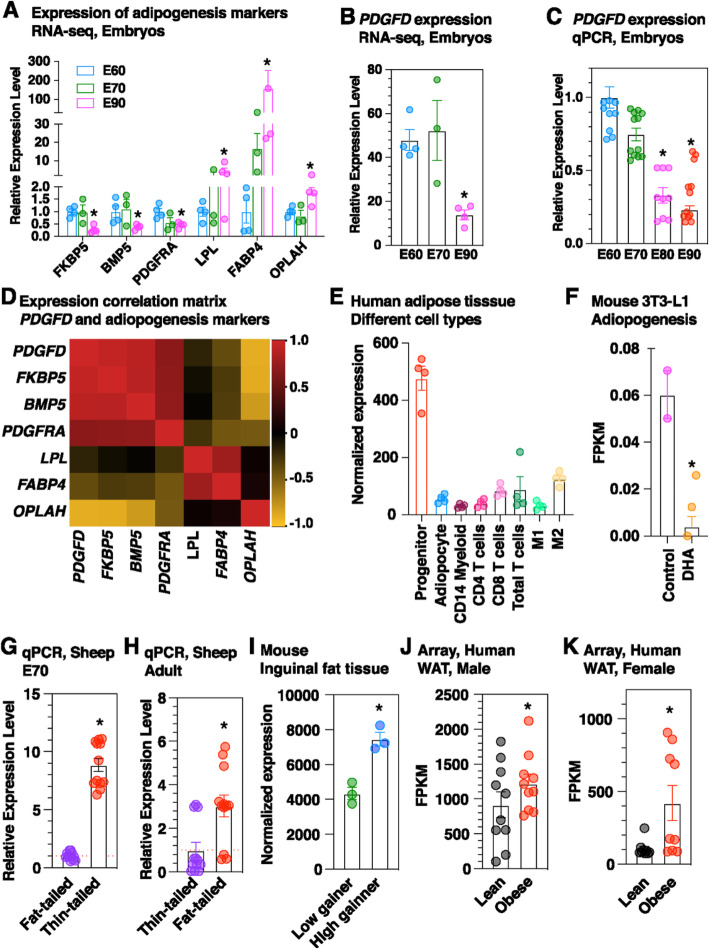
PDGFD expression is associated with adipogenesis and higher in adipose tissues of lean than that in fat individuals in different species. a Expression of several marker genes involved in adipogenesis in tail tissues of fat-tailed sheep at different stages of embryonic development revealed by RNA-seq. PDGFD expression in tail tissues of fat-tailed sheep at different stages of embryonic development revealed by b RNA-seq and c qPCR. d Heatmap showing the correlation matrix between expression of PDGFD and the indicated adipogenesis markers. e Expression of PDGFD in different cell fractions of human subcutaneous adipose tissues. Macrophages were subdivided into M1 and M2 (GSE100795). f Expression of Pdgfd during the adipogenesis of mouse 3 T3-L1 preadiopocytes induced by ω-3 fatty acid DHA revealed by RNA-seq (GSE118471). g PDGFD expression is higher in fat tissues of thin-tailed and fat-tailed sheep at E70 and h adult stage revealed by qPCR. *P < 0.05. i Pdgfd expression is higher in inguinal fat of high weight gaining mice than that of in low weight gaining mice revealed by microArray analysis (GSE4692). *P < 0.05 (n = 3). PDGFD expression is higher in adipocytes from lean than that from obese Indian individuals in both j male and k female subjects revealed by microarray (GSE2508)

References

    1. Calatayud Giner S. The spread of agricultural knowledge and the leading role of elites in the origins of contemporary agriculture: Valencia, 1840–60. Hist Agrar. 1999;17:99–127. - PubMed
    1. Kijas JW, Townley D, Dalrymple BP, Heaton MP, Maddox JF, McGrath A, Wilson P, Ingersoll RG, McCulloch R, McWilliam S, et al. A genome wide survey of SNP variation reveals the genetic structure of sheep breeds. PLoS One. 2009;4(3):e4668. doi: 10.1371/journal.pone.0004668. - DOI - PMC - PubMed
    1. Ryder ML: Sheep & man Sheep & man 1983.
    1. Farid M, El Shinnawy M, Farrag F, Mehrez A, Salem A. Protein requirements for maintenance of Barki desert sheep [Egypt] Mnsoura: Journal of Agricultural Sciences; 1984.
    1. Kridli R, Said S. Libido testing and the effect of exposing sexually naive Awassi rams to estrous ewes on sexual performance. Small Rumin Res. 1999;32(2):149–152. doi: 10.1016/S0921-4488(98)00168-0. - DOI

Substances

LinkOut - more resources