. 2020 Nov 17;20(1):347.
doi: 10.1186/s12906-020-03090-4.

Protocatechuic aldehyde from Salvia miltiorrhiza exhibits an anti-inflammatory effect through inhibiting MAPK signalling pathway

Affiliations

Protocatechuic aldehyde from Salvia miltiorrhiza exhibits an anti-inflammatory effect through inhibiting MAPK signalling pathway

Shuang Wu et al. BMC Complement Med Ther. .

Retraction in

Abstract

Background: The aerial parts of Salvia miltiorrhiza, which was considered to be the waste part and discarded during the root harvest, is rich in protocatechuic aldehyde (PAI). This study investigated the health-promoting effects of extracts and PAI from the aerial parts of Salvia miltiorrhiza, including its anti-inflammatory effects and the underlying mechanisms of action in vitro and in vivo.

Method: Purification of the sample paste of Salvia miltiorrhiza was accomplished using HPLC analysis. TheMTT (Methylthiazolyldiphenyl-tetrazolium bromide) assay was employed to determine the cell viability. The production of inflammatory factors was detected by ELISA assays. The histopathological analysis was used to analyse the lungs and livers of mice treated with PAI. Western blot was performed to reveal the mechanism of PAI in anti-inflammatory.

Results: The extracts and PAI from the aerial parts of Salvia miltiorrhiza inhibited TNF-α, IL-6 production and promoted the production of IL-10 in vivo in mice and in vitro in the macrophage cell line RAW264.7. NF-κB and MAPKs kinase phosphorylation were also suppressed by PAI in vivo and in vitro, indicating that PAI exhibited an anti-inflammatory effect.

Conclusion: These findings suggest that the aerial parts of Salvia miltiorrhiza extract may serve as potential protective agents for inflammatory.

Keywords: Anti-inflammatory; MAPK; NF-κB; Protocatechuic aldehyde; Salvia miltiorrhiza.


Conflict of interest statement

The authors declare that they have no competing interests.

Figures
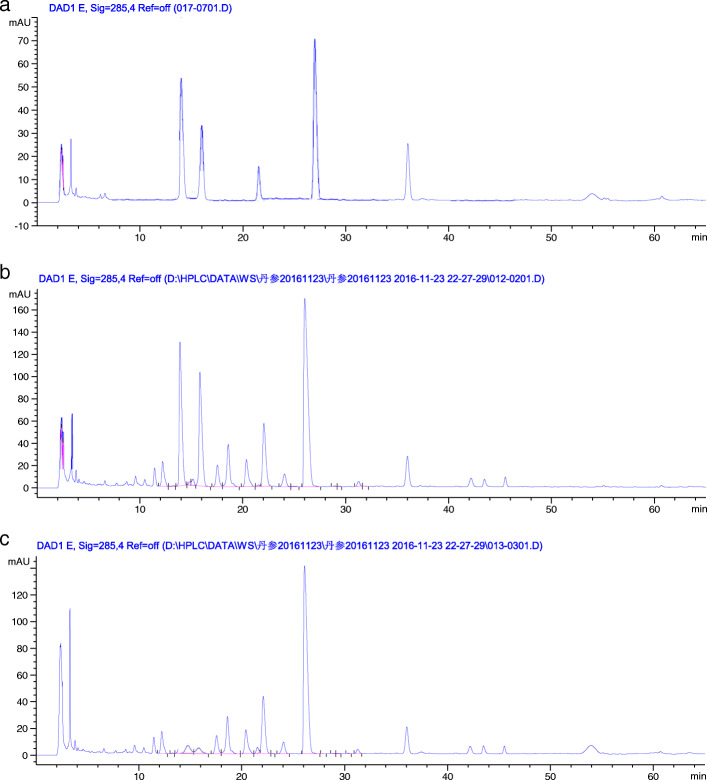
Fig. 1
Fig. 1
High-performance liquid chromatography chromatograms of S. miltiorrhiza’s sample paste. The sample was taken from the aerial part of Salvia miltiorrhiza and mainly contains Ursolic acid, Salvianolic acid A, Salvianolic acid B, Protocatechuic aldehyde, Danshensu five phenolic substances. After purification with chloroform, it mainly contains protocatechuic aldehyde. a Standard mixture, b Purification. c The aerial portions’ extracts of S. miltiorrhiza. Ursolic acid (1), Salvianolic acid A (2), Salvianolic acid B (3), Protocatechuic aldehyde (4), Danshensu (5)
Fig. 2
Fig. 2
Effects of protocatechuic aldehyde on cell viability in RAW 264.7 cells. The cell viability was measured by MTT method, and the cells were 6th-generation RAW264.7 cells. Data are presented as mean ± SD (n = 4). #p < 0.05, ##p < 0.01, ###p < 0.001 vs controls. *p < 0.05, **p < 0.01, ***p < 0.001 vs LPS group
Fig. 3
Fig. 3
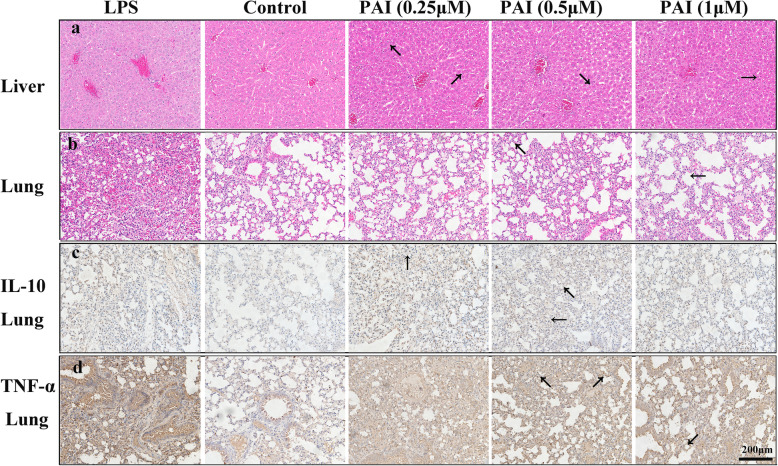
Immunodetection of inflammation markers of mice treated with protocatechuic aldehyde. Sampling from C57 mice, Immunodetection was performed with two pro-inflammatory cytokines (IL-6 and TNF-α) of lung. Histological micrographs of liver and lung. Representative sections for ten mice per group are shown. Scale bar = 200 μm. a Histological micrographs of liver. b Histological micrographs of lung. c Histological micrographs of lung stained with IL-10 antibody. d Histological micrographs of lung stained with TNF-α antibody. Arrows: obvious inflammatory cells
Fig. 4
Fig. 4
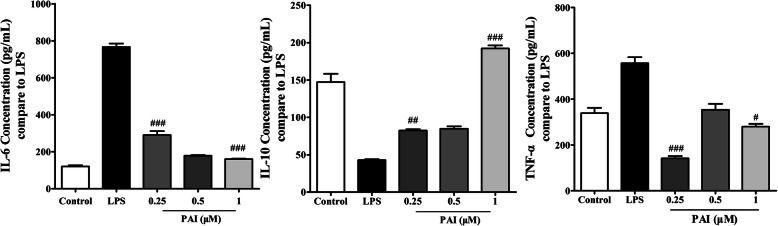
The effect of Protocatechuic aldehyde on IL-6, IL-10, and TNF-α levels in vitro. Sampling from C57 mice, two pro-inflammatory cytokines (IL-6 and TNF-α), and one anti-inflammatory cytokine (IL-10) were measured at the mRNA and/or protein levels and data were presented as percentages of WT values. Eight to five (mRNA) or five (protein) mice per group. Data are presented as mean ± SD (n = 4). #P < 0.05, ##P < 0.01, ###P < 0.001 vs LPS. *P < 0.05, **P < 0.01, ***P < 0.01 vs controls group. $P < 0.05, $$P < 0.01, $$$P < 0.01 LPS vs controls group
Fig. 5
Fig. 5
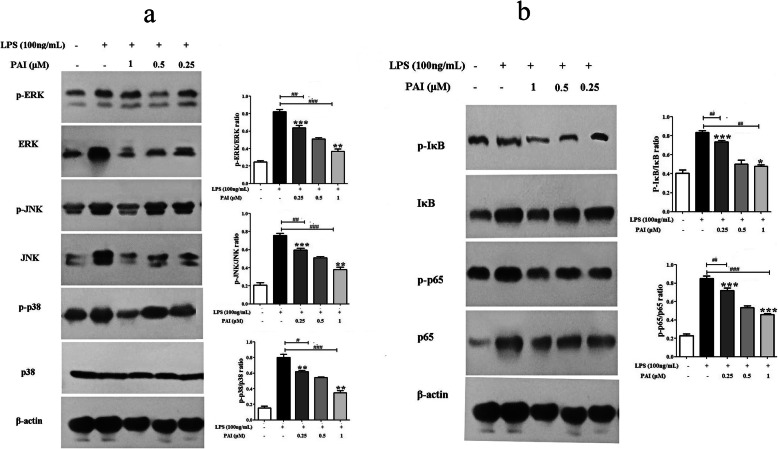
The effects of Protocatechuic aldehyde on NF-κB and MAPK pathways in vivo. Sampling from C57 mice, mainly two signal pathways (NF-κB and MAPK pathways) were detected. Effects of protocatechuic aldehyde on the expression of ERK/P38/JNK protein in the MAPK pathway of RAW264.7 cells. Effects of protocatechuic aldehyde on the expression of IκB / P65 protein in the NF-κB pathway of RAW264.7 cells. a The effects on MAPK pathways in vivo. b The effects on NF-κB pathways in vivo. Data are presented as mean ± SD (n = 4). #P < 0.05, ##P < 0.01, ###P < 0.001 vs LPS. *P < 0.05, **P < 0.01, ***P < 0.01 vs controls group
Fig. 6
Fig. 6
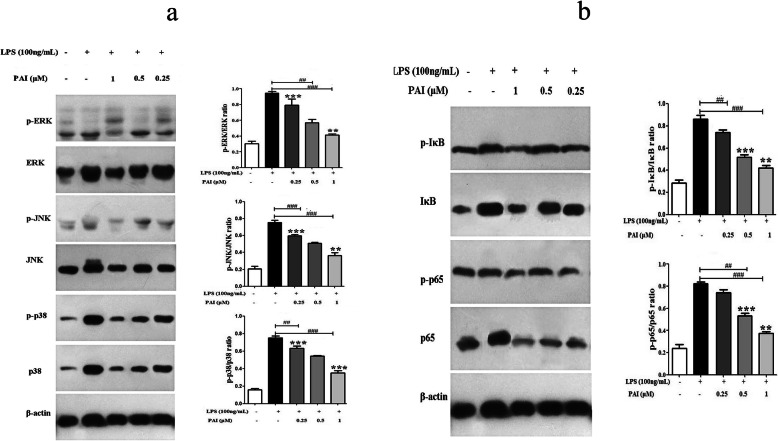
The effects of Protocatechuic aldehyde on NF-κB and MAPK pathways in vitro. Sampling from C57 mice, mainly two signal paths (NF-κB and MAPK pathways) were detected. Effects of protocatechuic aldehyde on the expression of ERK / P38 / JNK protein in the MAPK pathway of RAW264.7 cells. Effects of protocatechuic aldehyde on the expression of IκB / P65 protein in the NF-κB pathway of RAW264.7 cells. a The effects on MAPK pathways in vitro. b The effects on NF-κB pathways in vitro. Data are presented as mean ± SD (n = 4). #P < 0.05, ##P < 0.01, ###P < 0.001 vs LPS. *P < 0.05, **P < 0.01, ***P < 0.01 vs controls group

References

    1. Kamatou GP, Makunga NP, Ramogola WP, Viljoen AM. South African salvia species: a review of biological activities and phytochemistry. J Ethnopharmacol. 2008;119(3):664–672. doi: 10.1016/j.jep.2008.06.030. - DOI - PubMed
    1. Nagase T, Uozumi N, Ishii S, Kume K, Izumi T, Ouchi Y, et al. Acute lung injury by sepsis and acid aspiration: a key role for cytosolic phospholipase A2. Nat Immunol. 2000;1(1):42–46. doi: 10.1038/76897. - DOI - PubMed
    1. Stearns-Kurosawa DJ, Osuchowski MF, Valentine C, Kurosawa S, Remick DG. The pathogenesis of sepsis. Annu Rev Pathol. 2011;6:19–48. doi: 10.1146/annurev-pathol-011110-130327. - DOI - PMC - PubMed
    1. Riedemann NC, Guo RF, Ward PA. The enigma of sepsis. J Clin Invest. 2003;112(4):460–467. doi: 10.1172/JCI200319523. - DOI - PMC - PubMed
    1. Salvia-miltiorrhiza. A first report of acquired haemophilia-A: case report. Reactions Weekly. 2017; 1654(1): 308.

Publication types

LinkOut - more resources