Review
. 2021:20:100006.
doi: 10.1074/mcp.R120.002257. Epub 2020 Dec 8.

Accelerating the Field of Epigenetic Histone Modification Through Mass Spectrometry-Based Approaches

Affiliations
Review

Accelerating the Field of Epigenetic Histone Modification Through Mass Spectrometry-Based Approaches

Congcong Lu et al. Mol Cell Proteomics. 2021.

Abstract

Histone post-translational modifications (PTMs) are one of the main mechanisms of epigenetic regulation. Dysregulation of histone PTMs leads to many human diseases, such as cancer. Because of its high throughput, accuracy, and flexibility, mass spectrometry (MS) has emerged as a powerful tool in the epigenetic histone modification field, allowing the comprehensive and unbiased analysis of histone PTMs and chromatin-associated factors. Coupled with various techniques from molecular biology, biochemistry, chemical biology, and biophysics, MS has been used to characterize distinct aspects of histone PTMs in the epigenetic regulation of chromatin functions. In this review, we will describe advancements in the field of MS that have facilitated the analysis of histone PTMs and chromatin biology.

Keywords: crosslinking MS; epigenetic regulation; histone post-translational modification; hydrogen–deuterium exchange MS; mass spectrometry; middle-down proteomics; multi-omics.


Conflict of interest statement

Conflict of interest Authors declare no competing interests.

Figures
None
Graphical abstract
Fig. 1
Fig. 1
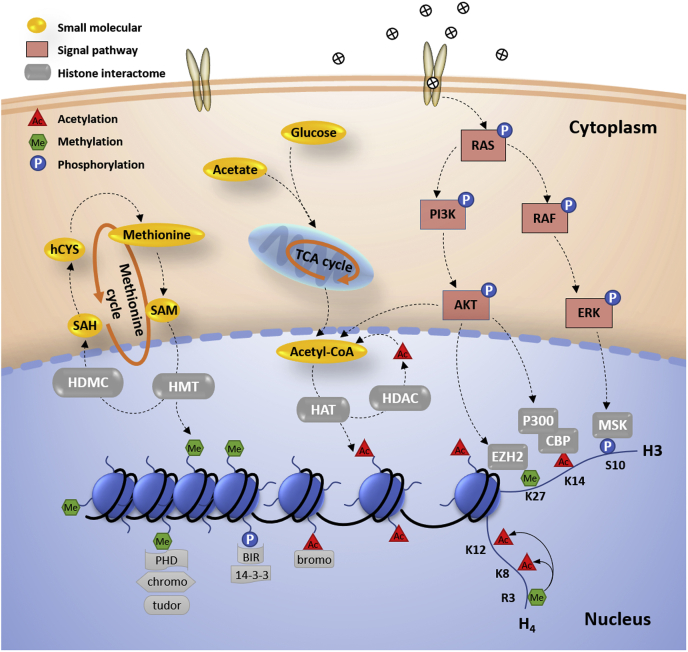
Histone PTMs in epigenetic regulation. (I) Two mechanisms by which histone PTMs regulate chromatin functions: (i) direct alternation of chromatin structure, e.g., acetylation leads to an open chromatin; (ii) histone interactome, e.g., plant homeodomain recognizes and binds to methylation and bromodomain to acetylation. (II) Three mechanisms influencing the expression of histone PTMs: (i) histone PTM crosstalk, e.g., the presentence of histone H4R3me promotes the expression of H4K8ac and H4K12ac; (ii) metabolites as the precursors of modifications, e.g., acetyl-CoA/acetylation, SAM/methylation; (iii) signaling pathways triggered by external stimuli, e.g., PI3K/AKT and RAF/ERK modify histone H3 N-terminal tails. AKT, protein kinase B; BIR, baculovirus IAP repeat domain; CBP, CREB-binding protein; ERK, extracellular signal–regulated kinase; EZH2, histone–lysine N-methyltransferase enzyme; HAT, histone acetyltransferase; hCYS, homocysteine; HDAC, histone deacetylase; HDMC, histone demethylase; HMT, histone methyltransferase; MSK, ribosomal protein S6 kinase; PHD, plant homeodomain; RAF, RAF proto-oncogene serine/threonine-protein kinase; RAS, rat sarcoma; SAH, S-adenosylhomocysteine; TCA, tricarboxylic acid.
Fig. 2
Fig. 2
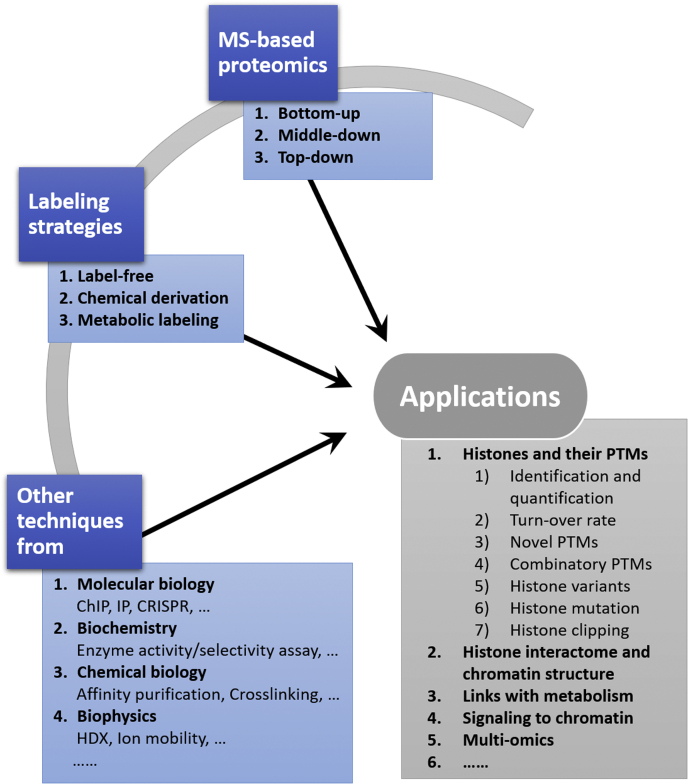
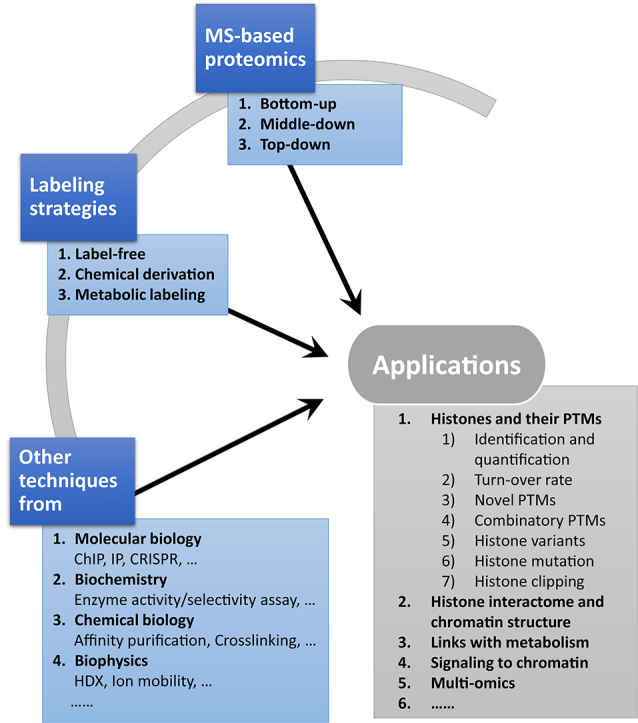
MS-based proteomics approaches coupled with different labeling strategies and other techniques to understand mechanisms of histone regulation and chromatin functions. ChIP, chromatin immunoprecipitation; CRISPR, clusters of regularly interspaced short palindromic repeats; HDX, hydrogen–deuterium exchange; IP, immunoprecipitation; MS, mass spectrometry; PTMs, post-translational modifications.
Fig. 3
Fig. 3
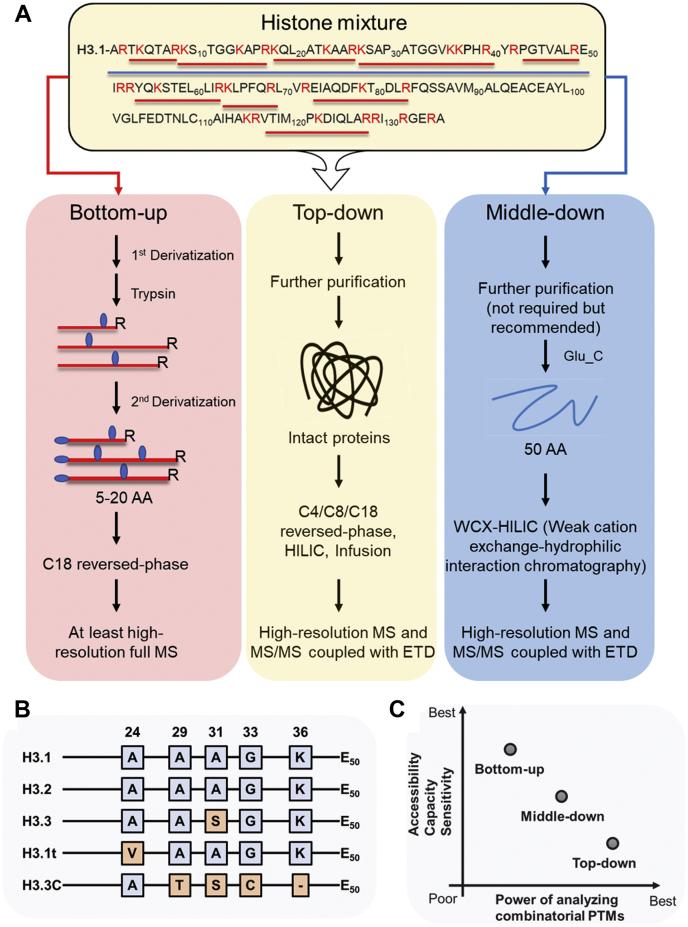
MS-based proteomics analysis of histone PTMs.A, the most used workflow for proteomics analysis of histone PTMs (use H3 as example, lysine and arginine residues are labeled in red. Peptides with red underline are sent for bottom–up and blue for middle–down analysis). B, N-terminal tail sequence differences (1–50 AA) between H3 variant representatives. C, comparison of three proteomics approaches in analyzing histone PTMs. ETD, electron-transfer dissociation; MS, mass spectrometry; WCX-HILIC, weak cation exchange-hydrophilic interaction chromatography.
Fig. 4
Fig. 4
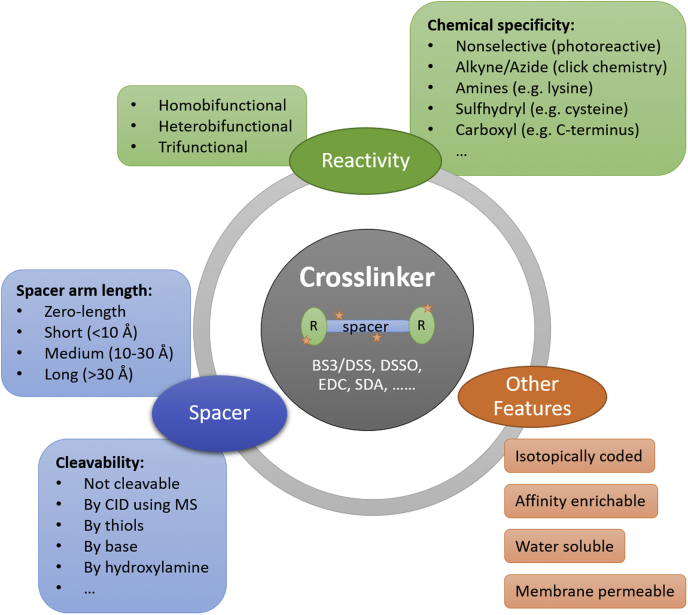
Crosslinker features to consider for certain MS-based experiments. BS3, bissulfosuccinimidyl suberate; CID, collision-induced dissociation; DSS, disuccinimidyl suberate; DSSO, disuccinimidyl sulfoxide; EDC, 1-ethyl-3-(3-dimethylaminopropyl)carbodiimide hydrochloride; MS, mass spectrometry; SDA, succinimidyl 4,4'-azipentanoate.
Fig. 5
Fig. 5
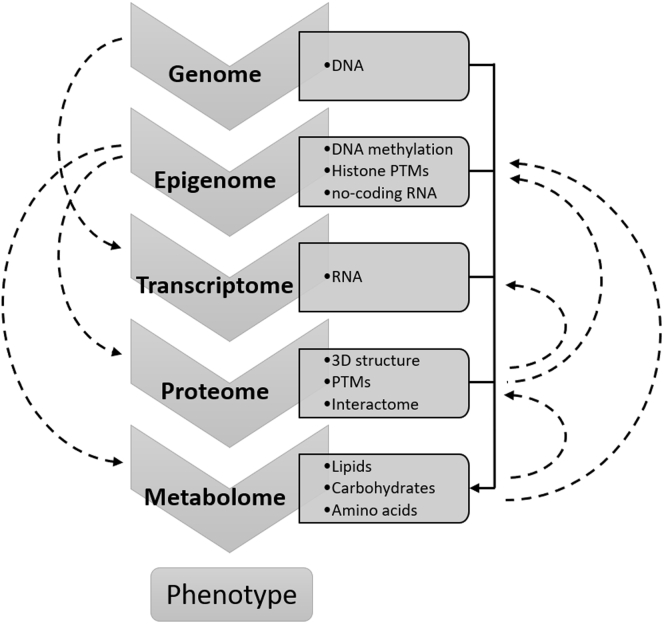
Multiomics data types and their connectivity. For instance, epigenome can change the expression of transcriptome, proteome, and metabolome. On the other hand, epigenome can be modified by proteome and metabolome. PTMs, post-translational modifications.

References

    1. Luger K., Mäder A.W., Richmond R.K., Sargent D.F., Richmond T.J. Crystal structure of the nucleosome core particle at 2.8 Å resolution. Nature. 1997;389:251–260. - PubMed
    1. Delaneau O., Zazhytska M., Borel C., Giannuzzi G., Rey G., Howald C., Kumar S., Ongen H., Popadin K., Marbach D., Ambrosini G., Bielser D., Hacker D., Romano L., Ribaux P. Chromatin three-dimensional interactions mediate genetic effects on gene expression. Science. 2019;364:eaat8266. - PubMed
    1. Bowman G.D., Poirier M.G. Post-translational modifications of histones that influence nucleosome dynamics. Chem. Rev. 2015;115:2274–2295. - PMC - PubMed
    1. Li E. Chromatin modification and epigenetic reprogramming in mammalian development. Nat. Rev. Genet. 2002;3:662–673. - PubMed
    1. Klemm S.L., Shipony Z., Greenleaf W.J. Chromatin accessibility and the regulatory epigenome. Nat. Rev. Genet. 2019;20:207–220. - PubMed

Publication types

LinkOut - more resources