


The use of prostate specific antigen density to predict clinically significant prostate cancer
- PMID: 33203873
- PMCID: PMC7672084
- DOI: 10.1038/s41598-020-76786-9
The use of prostate specific antigen density to predict clinically significant prostate cancer
Abstract
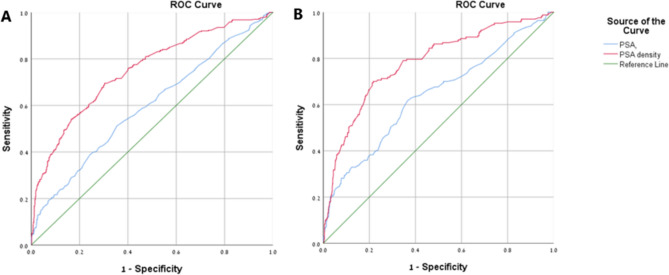
The purpose of this study was to assess the predictive value of prostate specific antigen density (PSAD) for detection of clinically significant prostate cancer in men undergoing systematic transrectal ultrasound (TRUS)-guided prostate biopsy. We retrospectively analyzed data of men who underwent TRUS-guided prostate biopsy because of elevated PSA (≤ 20 ng/ml) or abnormal digital rectal examination. Receiver operating characteristic curve analysis to compare PSA and PSAD performance and chi-square automatic interaction detector methodologies were used to identify predictors of clinically significant cancer (Gleason score ≥ 7 or international society of urological pathology grade group ≥ 2). Nine-hundred and ninety-two consecutive men with a median age of 66 years (IQR 61-71) were included in the study. Median PSAD was 0.10 ng/ml2 (IQR 0.10-0.22). Prostate adenocarcinoma was diagnosed in 338 men (34%). Clinically significant prostate adenocarcinoma was diagnosed in 167 patients (50% of all cancers and 17% of the whole cohort). The AUC to predict clinically significant prostate cancer was 0.64 for PSA and 0.78 for PSAD (P < 0.001). The highest Youden's index for PSAD was at 0.20 ng/ml2 with 70% sensitivity and 79% specificity for the diagnosis of clinically significant cancer. Men with PSAD < 0.09 ng/ml2 had only 4% chance of having clinically significant disease. The detection rate of clinically significant prostate cancer in patients with PSAD between 0.09 and 0.19 ng/ml2 was significantly higher when prostate volume was less than 33 ml. In conclusion, PSAD was a better predictor than PSA alone of clinically significant prostate cancer in patients undergoing TRUS-guided biopsy. Patients with PSAD below 0.09 ng/ml2 were unlikely to harbor clinically significant prostate cancer. Combining PSAD in the gray zone (0.09-0.19) with prostate volume below 33 ml adds diagnostic value of clinically significant prostate cancer.
Conflict of interest statement
The authors declare no competing interests.
Figures
References
MeSH terms
Substances
LinkOut - more resources
Full Text Sources
Medical
Research Materials
Miscellaneous
