


Long-Acting Injectable GLP-1 Receptor Agonists for the Treatment of Adults with Type 2 Diabetes: Perspectives from Clinical Practice
- PMID: 33204129
- PMCID: PMC7665457
- DOI: 10.2147/DMSO.S216054
Long-Acting Injectable GLP-1 Receptor Agonists for the Treatment of Adults with Type 2 Diabetes: Perspectives from Clinical Practice
Abstract
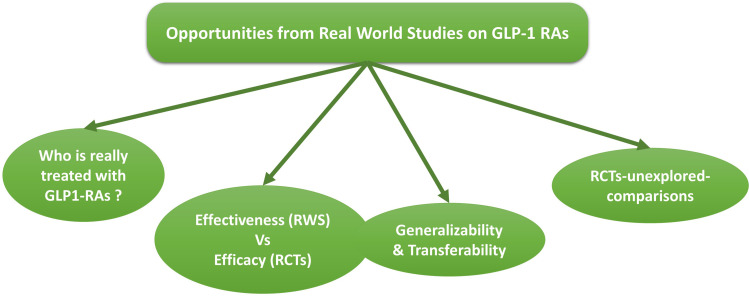
Randomized controlled trials (RCTs) have consistently shown glycemic and extra-glycemic benefits of long-acting injectable glucagon-like-peptide-1 receptor agonists (GLP-1RAs, liraglutide, albiglutide, exenatide once-weekly, dulaglutide, and semaglutide) in terms of reduction in the rates of cardiovascular events and mortality among patients with type 2 diabetes. Recently, the analyses of large datasets collecting routinely-accumulated data from clinical practice (ie, real-world studies, RWS) have provided new opportunities to complement the information obtained from RCTs. In this narrative review, we addressed clinically relevant questions that might be answered by well-conducted RWS: are subjects treated with GLP-1RAs in the "real-world" similar to those included in RCTs? Is the performance of GLP-1RA observed in the RWS (effectiveness) similar to that described in RCTs (efficacy)? Is the effectiveness similar in population of patients generally under-represented in RCTs? Are the cardiovascular benefits of GLP-1RAs confirmed in RWS? We also describe a few comparisons currently un-explored by specific RCTs, such as direct comparison between different administration strategies (eg, fixed- versus flexible-combination with basal-insulin) or between GLP-1RAs versus dipeptidyl-peptidase-4 inhibitor (DDP4i) or versus sodium/glucose cotransporter-2 inhibitors (SGLT-2i) on hard cardio-renal outcomes. Altogether, RWS provide highly informative information on treatment with GLP-1RAs. On the one side, RWS showed different clinical characteristics between subjects enrolled in RCTs versus those attending real-world clinics and receiving a GLP-1RA. On the other hand, RWS showed that GLP-1RA effectiveness is overall consistent in subgroups of patients less represented in RCTs. In addition, RWS allowed the identification of modifiable factors (eg, titration or adherence) that might guide physicians towards better GLP-1RAs use. Finally, multiple RWS reported better cardio-renal outcomes with GLP-1RAs than with DPP-4i, while initial findings from RWS described a weaker cardiovascular protection compared to SGLT-2i. Therefore, there is the need for further RWS and RCTs comparing these different classes of glucose lowering medications.
Keywords: cardiovascular prevention; effectiveness; head-to-head comparisons; innovative; observational studies; real-world evidence.
© 2020 Morieri et al.
Conflict of interest statement
MLM received grant support, lecture or consultant fees from: Servier, Amryt and SLAPharma, not related to the submitted work. . AA received research grants, lecture or advisory board fees from: Merck Sharp & Dome, AstraZeneca, Novartis, Boehringer-Ingelheim, Sanofi, Mediolanum, Janssen, Novo Nordisk, Lilly, Servier, and Takeda, not related to the submitted work. GPF received lecture fees or grant support from: Abbott, AstraZeneca, Boehringer, Lilly, Merck-Sharp-Dome, Mundipharma, Novartis, Novo Nordisk, Sanofi, Servier, not related to the submitted work. The authors report no other potential conflicts of interest for this work.
Figures

References
-
- Heuvelman VD, Van Raalte DH, Smits MM. Cardiovascular effects of glucagon-like peptide 1 receptor agonists: from mechanistic studies in humans to clinical outcomes. Cardiovasc Res. 2020;116(5):916–930. - PubMed
Publication types
LinkOut - more resources
Full Text Sources
