Review
. 2020 Oct 26;10(26):11976-11997.
doi: 10.7150/thno.50663. eCollection 2020.

Novel insights into ferroptosis: Implications for age-related diseases

Affiliations
Review

Novel insights into ferroptosis: Implications for age-related diseases

Ren-Peng Zhou et al. Theranostics. .

Abstract

Rapid increase in aging populations is an urgent problem because older adults are more likely to suffer from disabilities and age-related diseases (ARDs), burdening healthcare systems and society in general. ARDs are characterized by the progressive deterioration of tissues and organs over time, eventually leading to tissue and organ failure. To date, there are no effective interventions to prevent the progression of ARDs. Hence, there is an urgent need for new treatment strategies. Ferroptosis, an iron-dependent cell death, is linked to normal development and homeostasis. Accumulating evidence, however, has highlighted crucial roles for ferroptosis in ARDs, including neurodegenerative and cardiovascular diseases. In this review, we a) summarize initiation, regulatory mechanisms, and molecular signaling pathways involved in ferroptosis, b) discuss the direct and indirect involvement of the activation and/or inhibition of ferroptosis in the pathogenesis of some important diseases, and c) highlight therapeutic targets relevant for ARDs.

Keywords: age-related diseases; ferroptosis; iron; lipid peroxidation; reactive oxygen species.


Conflict of interest statement

Competing Interests: The authors have declared that no competing interest exists.

Figures
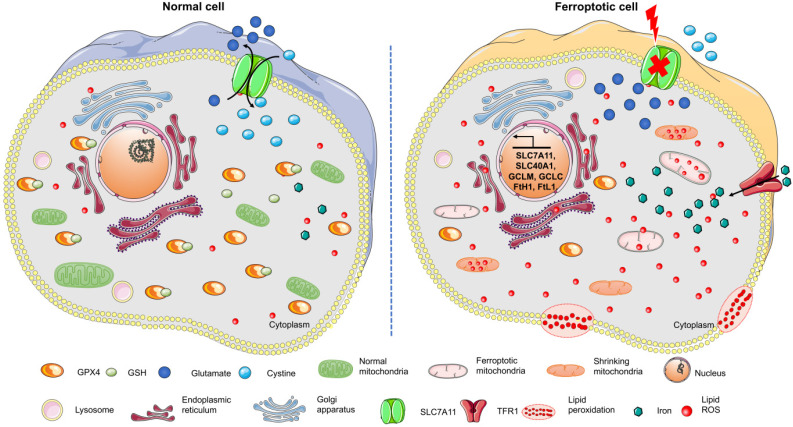
Figure 1
Figure 1
Changes in the morphological and bioenergy characteristics during ferroptosis, including mitochondrial shrinkage, membrane rupture, excess ROS, iron overload, and intracellular GSH depletion. Features of this figure were adapted from Servier Medical Art (http://smart.servier.com/) licensed under a Creative Commons Attribution 3.0 Unported License.
Figure 2
Figure 2
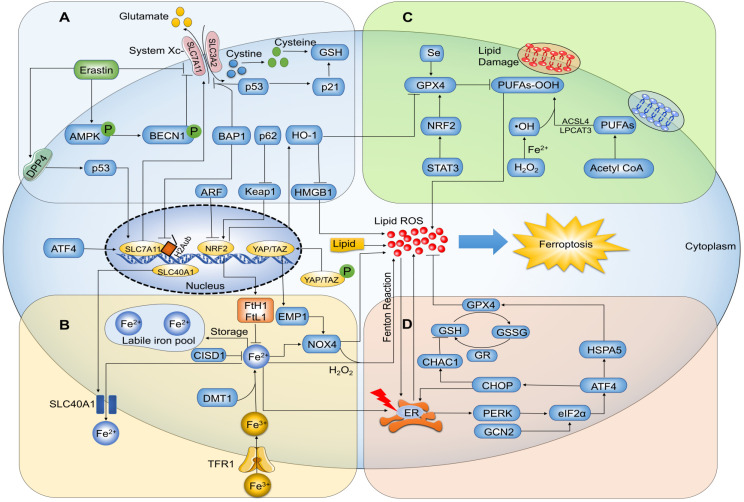
Ferroptosis-related signaling molecules and signaling pathways. (A) Glutamate exchanges for cystine in a 1:1 ratio through the cystine/glutamate antiporter system Xc-, and inhibition of system Xc- by its core part SLC7A11 induces ferroptosis. (B) Ferric iron (Fe3+) bound to transferrin enters cells via membrane protein transferrin receptor 1 (TFR1) and localizes in endosomes, wherein the ferrireductase activity of STEAP3 reduces Fe3+ to redox-active iron (Fe2+). Finally, divalent metal transporter 1 (DMT1) releases Fe2+ from endosomes into a labile iron pool in the cytoplasm. In general, excess iron is stored in ferritin with ferritin heavy chain 1 (FtH1) and ferritin light chain 1 (FtL1). Under the action of H2O2, Fe2+ catalyzes the production of hydroxyl radical (HO∙) by Fenton reaction, triggering a chain reaction of radical lipid peroxidation and eventually leads to ferroptosis. (C) Ferroptosis is trigged by peroxidation (-OOH) of polyunsaturated fatty acids (PUFAs) and aberrant accumulation of lipid reactive oxygen species (ROS), resulting in membrane destabilization and rupture. Acyl-CoA synthetase long-chain family member 4 (ACSL4) and lysophosphatidylcholine acyltransferase 3 (LPCAT3) are necessary for ferroptosis to produce the target lipid pool containing arachidonic acid. GPX4 can hydrolyze lipid peroxides into non-toxic lipid alcohols (-OH). (D) Intracellular glutathione exists as oxidized glutathione (GSSG) and reduced glutathione (GSH); GPX4 requires GSH as a cofactor and reduces GSSG to GSH via glutathione reductase (GR). GPX4 inhibits the formation of Fe2+-dependent ROS by converting lipid hydroperoxides into lipid alcohols, and thus inhibits ferroptosis.

References

    1. Dzau VJ, Balatbat CA. Health and societal implications of medical and technological advances. Sci Transl Med. 2018. 10. - PubMed
    1. Amaya-Montoya M, Perez-Londono A, Guatibonza-Garcia V, Vargas-Villanueva A, Mendivil CO. Cellular Senescence as a Therapeutic Target for Age-Related Diseases: A Review. Adv Ther. 2020;37:1407–24. - PMC - PubMed
    1. Luo J, Mills K, le Cessie S, Noordam R, van Heemst D. Ageing, age-related diseases and oxidative stress: What to do next? Ageing Res Rev. 2020;57:100982. - PubMed
    1. Figueira I, Fernandes A, Mladenovic Djordjevic A, Lopez-Contreras A, Henriques CM, Selman C. et al. Interventions for age-related diseases: Shifting the paradigm. Mech Ageing Dev. 2016;160:69–92. - PubMed
    1. Xu J, Knutson MD, Carter CS, Leeuwenburgh C. Iron accumulation with age, oxidative stress and functional decline. PLoS One. 2008;3:e2865. - PMC - PubMed

Publication types

MeSH terms