


Information technology in emergency management of COVID-19 outbreak
- PMID: 33204821
- PMCID: PMC7661942
- DOI: 10.1016/j.imu.2020.100475
Information technology in emergency management of COVID-19 outbreak
Abstract
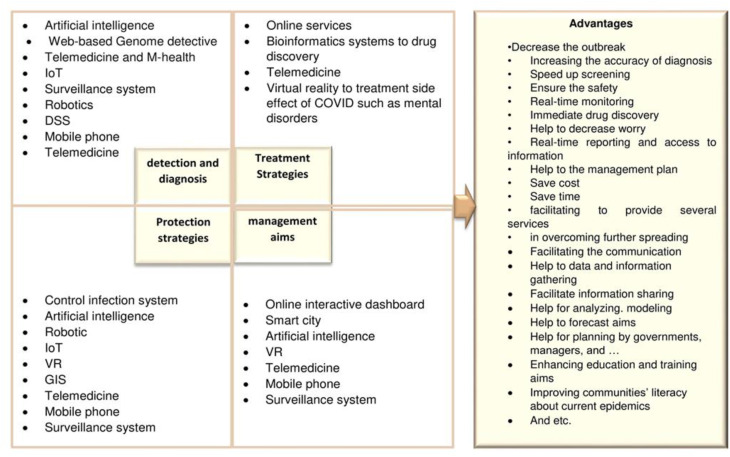
Emergency management of the emerging infectious disease outbreak is critical for public health threats. Currently, control of the COVID-19 outbreak is an international concern and has become a crucial challenge in many countries. This article reviews significant information technologyIT) applications in emergency management of COVID-19 by considering the prevention/mitigation, preparedness, response, and recovery phases of the crisis. This review was conducted using MEDLINE PubMed), Embase, IEEE, and Google Scholar. Expert opinions were collected to show existence gaps, useful technologies for each phase of emergency management, and future direction. Results indicated that various IT-based systems such as surveillance systems, artificial intelligence, computational methods, Internet of things, remote sensing sensor, online service, and GIS geographic information system) could have different outbreak management applications, especially in response phases. Information technology was applied in several aspects, such as increasing the accuracy of diagnosis, early detection, ensuring healthcare providers' safety, decreasing workload, saving time and cost, and drug discovery. We categorized these applications into four core topics, including diagnosis and prediction, treatment, protection, and management goals, which were confirmed by five experts. Without applying IT, the control and management of the crisis could be difficult on a large scale. For reducing and improving the hazard effect of disaster situations, the role of IT is inevitable. In addition to the response phase, communities should be considered to use IT capabilities in prevention, preparedness, and recovery phases. It is expected that IT will have an influential role in the recovery phase of COVID-19. Providing IT infrastructure and financial support by the governments should be more considered in facilitating IT capabilities.
Keywords: COVID-19; Disaster; Emergency management; Epidemic; Information technology; Outbreak.
© 2020 The Author(s).
Conflict of interest statement
The authors declare that they have no known competing financial interests or personal relationships that could have appeared to influence the work reported in this paper.
Figures
References
-
- Khorram-Manesh A. 2017. Handbook of disaster and emergency management.
-
- Waugh W.L., Jr., Streib G. Collaboration and leadership for effective emergency management. Publ Adm Rev. 2006;66:131–140.
-
- Duo E., Trembanis A.C., Dohner S., Grottoli E., Ciavola P. Local-scale post-event assessments with GPS and UAV-based quick-response surveys: a pilot case from the Emilia-Romagna Italy) coast. Nat Hazards Earth Syst. 2018;18(11):2969–2989.
-
- Sakurai M., Murayama Y. Information technologies and disaster management–Benefits and issues. Progress in Disaster Science. 2019;2:100012.
-
- Poser K., Dransch D. Volunteered geographic information for disaster management with application to rapid flood damage estimation. Geomatica. 2010;64(1):89–98.
Publication types
LinkOut - more resources
Full Text Sources