Association of Borderline Personality Disorder Criteria With Suicide Attempts: Findings From the Collaborative Longitudinal Study of Personality Disorders Over 10 Years of Follow-up
- PMID: 33206138
- PMCID: PMC7675214
- DOI: 10.1001/jamapsychiatry.2020.3598
Association of Borderline Personality Disorder Criteria With Suicide Attempts: Findings From the Collaborative Longitudinal Study of Personality Disorders Over 10 Years of Follow-up
Abstract
Importance: Borderline personality disorder (BPD) has been identified as a strong risk factor for suicidal behavior, including suicide attempts. Delineating specific features that increase risk could inform interventions.
Objective: To examine factors associated with prospectively observed suicide attempts among participants in the Collaborative Longitudinal Study of Personality Disorders (CLPS), over 10 years of follow-up, with a focus on BPD and BPD criteria.
Design, setting, and participants: The CLPS is a multisite, naturalistic, prospective study of adult participants with 4 personality disorders (PDs) and a comparison group of adults with major depressive disorder and minimal PD features. Participants were all treatment-seeking and recruited from inpatient, partial, and outpatient treatment settings across New York, New York, Boston, Massachusetts, New Haven, Connecticut, and Providence, Rhode Island. A total of 733 participants were recruited at baseline, with 701 completing at least 1 follow-up assessment. The cohorts were recruited from September 1996 through April 1998 and September 2001 through August 2002. Data for this study using this follow-up sample (N = 701) were analyzed between March 2019 and August 2020.
Main outcomes and measures: Participants were assessed annually using semistructured diagnostic interviews and a variety of self-report measures for up to 10 years. Multiple logistic regression analyses were used to examine baseline demographic and clinical risk factors, including BPD and individual BPD criteria, of suicide attempt assessed over 10 years of prospective follow-up.
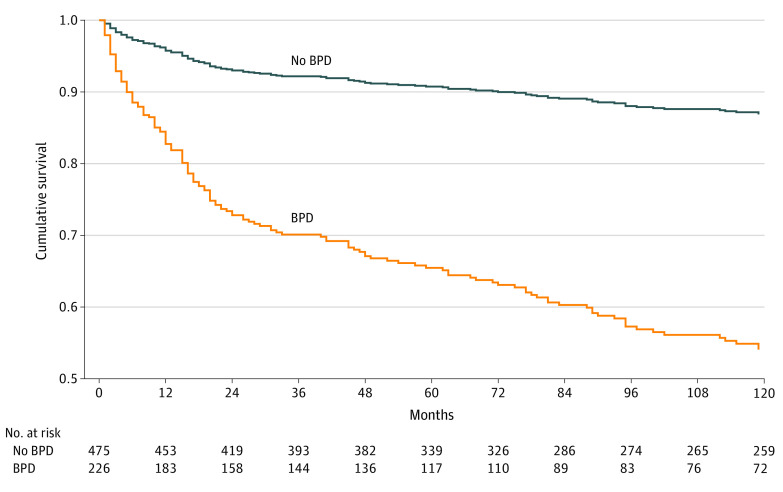
Results: Of the 701 participants, 447 (64%) identified as female, 488 (70%) as White, 527 (75%) as single, 433 (62%) were unemployed, and 512 (73%) reported at least some college education. Of all disorders, BPD emerged as the most robust factor associated with prospectively observed suicide attempt(s) (odds ratio [OR], 4.18; 95% CI, 2.68-6.52), even after controlling for significant demographic (sex, employment, and education) and clinical (childhood sexual abuse, alcohol use disorder, substance use disorder, and posttraumatic stress disorder) factors. Among BPD criteria, identity disturbance (OR, 2.21; 95% CI, 1.37-3.56), chronic feelings of emptiness (OR, 1.63; 95% CI, 1.03-2.57), and frantic efforts to avoid abandonment (OR, 1.93; 95% CI, 1.17-3.16) emerged as significant independent factors associated with suicide attempt(s) over follow-up, when covarying for other significant factors and BPD criteria.
Conclusions and relevance: In the multisite, longitudinal study of adults with personality disorders, identity disturbance, chronic feelings of emptiness, and frantic efforts to avoid abandonment were significantly associated with suicide attempts. Identity disturbance, chronic feelings of emptiness, and frantic efforts to avoid abandonment may be clinically overlooked features of BPD in context of suicide risk assessment. In light of the high rates of BPD diagnostic remission, our findings suggest that these criteria should be independently assessed and targeted for further study as suicide risk factors.
Conflict of interest statement
Figures
References
-
- Suicidal thoughts and behavior among adults: results from the 2015. National Survey on Drug Use and Health. Accessed July 8, 2020. https://www.samhsa.gov/data/sites/default/files/NSDUH-DR-FFR3-2015/NSDUH...
Publication types
MeSH terms
Grants and funding
LinkOut - more resources
Full Text Sources
Other Literature Sources
Miscellaneous