. 2020 Nov 18;5(6):e00813-20.
doi: 10.1128/mSphere.00813-20.

Identification of Spacer and Protospacer Sequence Requirements in the Vibrio cholerae Type I-E CRISPR/Cas System

Affiliations

Identification of Spacer and Protospacer Sequence Requirements in the Vibrio cholerae Type I-E CRISPR/Cas System

Jacob Bourgeois et al. mSphere. .

Abstract

The prokaryotic adaptive immune system CRISPR/Cas serves as a defense against bacteriophage and invasive nucleic acids. A type I-E CRISPR/Cas system has been detected in classical biotype isolates of Vibrio cholerae, the causative agent of the disease cholera. Experimental characterization of this system revealed a functional immune system that operates using a 5'-TT-3' protospacer-adjacent motif (PAM) for interference. However, several designed spacers against the 5'-TT-3' PAM do not interfere as expected, indicating that further investigation of this system is necessary. In this study, we identified additional conserved sequences, including a pyrimidine in the 5' position of the spacer and a purine in the complementary position of the protospacer using 873 unique spacers and 2,267 protospacers mined from CRISPR arrays in deposited sequences of V. cholerae We present bioinformatic evidence that during acquisition the protospacer purine is captured in the prespacer and that a 5'-RTT-3' PAM is necessary for spacer acquisition. Finally, we demonstrate experimentally, by designing and manipulating spacer and cognate PAMs in a plasmid conjugation assay, that a 5'-RTT-3' PAM is necessary for CRISPR interference, and we discover functional consequences for spacer efficacy related to the identity of the 5' spacer pyrimidine.IMPORTANCE Bacterial CRISPR/Cas systems provide immunity by defending against phage and other invading elements. A thorough comprehension of the molecular mechanisms employed by these diverse systems will improve our understanding of bacteriophage-bacterium interactions and bacterial adaptation to foreign DNA. The Vibrio cholerae type I-E system was previously identified in an extinct classical biotype and was partially characterized for its function. Here, using both bioinformatic and functional assays, we extend that initial study. We have found that the type I-E system still exists in modern strains of V. cholerae Furthermore, we defined additional sequence elements both in the CRISPR array and in target DNA that are required for immunity. CRISPR/Cas systems are now commonly used as precise and powerful genetic engineering tools. Knowledge of the sequences required for CRISPR/Cas immunity is a prerequisite for the effective design and experimental use of these systems. Our results greatly facilitate the effective use of one such system. Furthermore, we provide a publicly available software program that assists in the detection and validation of CRISPR/Cas immunity requirements when such a system exists in a bacterial species.

Keywords: CRISPR/Cas; Vibrio cholerae; protospacer-adjacent motif.


Figures

FIG 1
FIG 1
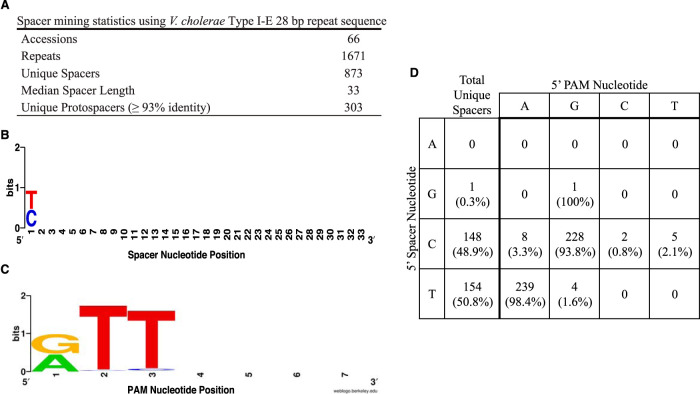
Analysis of spacer and protospacer-adjacent motifs mined from deposited V. cholerae sequences. (A) Overview of spacer mining statistics obtained from detection of repeats. (B) Sequence alignment of unique spacers derived from perfect repeats, shown in the 5′-to-3′ direction. For spacers longer than 33 bp, only the first 33 bp were used in the creation of the Weblogo. (C) Sequence alignment of the PAM retrieved immediately downstream from protospacers, shown in the 5′-to-3′ direction. The first position of the PAM is aligned with the 5′ position of the spacer. (D) Frequency table of 5′ spacer and 5′ PAM nucleotide identity for 487 unique spacer-protospacer pairs. “Total unique spacers” refers to the number of unique spacers with detected cognate protospacers that begin with the specific nucleotide.
FIG 2
FIG 2
Targeting activities of 5′-pyrimidine and 5′-purine spacers against 5′-RTT-3′ and 5′-YTT-3′ PAMs in aad9, respectively. Shown is the conjugation efficiency of mating pDL1301, a conjugatable plasmid containing the aad9 gene, into V. cholerae El Tor possessing Cascade and engineered targeting spacers on a plasmid-based pCRISPR (filled circles). The nontargeting control contains pCRISPR, encoding a spacer with no homology to pDL1301 (filled squares). Open circles show the effect of induction of Cascade and crRNA with 100 μM IPTG on interference. Data represent the conjugation efficiency of a plasmid into three independently obtained V. cholerae exconjugates.
FIG 3
FIG 3
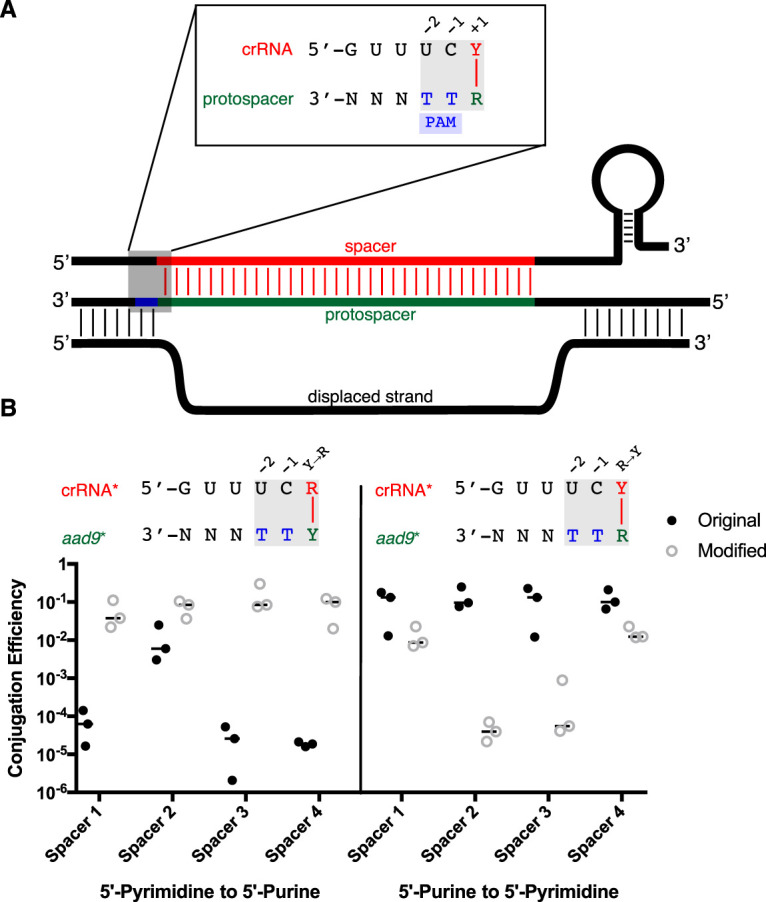
Mutating the 5′ spacer nucleotide and the corresponding aad9 target PAM reverses crRNA targeting efficacy. (A) Schematic of crRNA strand invasion and protospacer binding in V. cholerae. The published protospacer-adjacent motif (PAM), 5′-TT-3′, is shown in blue at the –1 and –2 positions. The 5′ spacer nucleotide is highlighted in red at the +1 position, where it complements the protospacer nucleotide (in green). (B) Effect of a transversion mutation at the +1 site. The aad9 gene in pDL1301 was silently mutated at the +1 site from a purine to a pyrimidine, or vice versa, at targeting sites to create eight variations of donor plasmid (aad9*). The corresponding spacer in targeting strains was then changed to match each new donor plasmid so as to preserve base pairing at the +1 position, creating eight new targeting strains that individually pair to their donor strains (crRNA*). The conjugation efficiencies of these eight new pairs were obtained. Data for the original, unmodified conjugation (filled circles) are reproduced from Fig. 2 for the sake of comparison. The crRNA-PAM diagrams above the graph represent the modified condition. Data represent the mating efficiencies of three independently obtained V. cholerae exconjugates.
FIG 4
FIG 4
Effect of disallowing base pairing at the +1 PAM nucleotide position on interference activity. (Top) Mating modified 5′-pyrimidine* constructs with wild-type aad9 (aad9WT) or mating PAM-modified pDL1301 into corresponding 5′-purine spacer constructs (aad9*) disrupts base pairing with PAM at the +1 position while preserving 5′-RTT-3′ PAM. The crRNA-PAM architecture of the original matched pairs preserving base pairing at the +1 position is shown above, with the architecture of the mismatched pairs below. Each match-mismatch pair corresponds to the conjugation efficiencies plotted at the bottom. (Bottom) Conjugation efficiencies of matings with mismatched pairs compared to those with matched pairs at the +1 position. Data for the conjugation efficiencies of aad9WT into unmodified pyrimidine targeting strains (filled circles) are reproduced from Fig. 2 for the sake of comparison. Data for the matched conjugation pairs of mutated aad9 with corresponding 5′-modified purine targeting strains (open circles) are reproduced from Fig. 3B for the sake of comparison. Data represent conjugation efficiencies from three independent experiments.
FIG 5
FIG 5
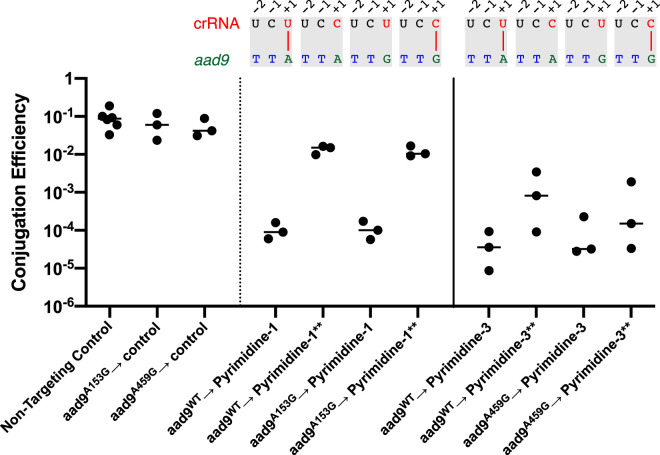
Effects of spacer nucleotide modifications targeting 5′-RTT-3′ PAMs. The +1 spacer nucleotide in targeting constructs pyrimidine-1 and pyrimidine-3 was modified from a T to a C (pyrimidine**), and the corresponding +1 PAM nucleotide in aad9 was modified from an A to a G. All combinations of donor and recipient were then mated, and the conjugation efficiency was obtained. The corresponding crRNA-aad9 architectures are shown above each result. Matings of each donor aad9 plasmid to a nontargeting spacer were obtained as conjugation controls.

References

    1. Barrangou R, Fremaux C, Deveau H, Richards M, Boyaval P, Moineau S, Romero DA, Horvath P. 2007. CRISPR provides acquired resistance against viruses in prokaryotes. Science 315:1709–1712. doi: 10.1126/science.1138140. - DOI - PubMed
    1. Samai P, Pyenson N, Jiang W, Goldberg GW, Hatoum-Aslan A, Marraffini LA. 2015. Co-transcriptional DNA and RNA cleavage during type III CRISPR-Cas immunity. Cell 161:1164–1174. doi: 10.1016/j.cell.2015.04.027. - DOI - PMC - PubMed
    1. Koonin EV, Makarova KS, Zhang F. 2017. Diversity, classification and evolution of CRISPR-Cas systems. Curr Opin Microbiol 37:67–78. doi: 10.1016/j.mib.2017.05.008. - DOI - PMC - PubMed
    1. Jackson SA, McKenzie RE, Fagerlund RD, Kieper SN, Fineran PC, Brouns SJ. 2017. CRISPR-Cas: adapting to change. Science 356:eaal5056. doi: 10.1126/science.aal5056. - DOI - PubMed
    1. Makarova KS, Haft DH, Barrangou R, Brouns SJ, Charpentier E, Horvath P, Moineau S, Mojica FJ, Wolf YI, Yakunin AF, van der Oost J, Koonin EV. 2011. Evolution and classification of the CRISPR-Cas systems. Nat Rev Microbiol 9:467–477. doi: 10.1038/nrmicro2577. - DOI - PMC - PubMed

Publication types

MeSH terms

LinkOut - more resources