


PM2.5 Associated With Gray Matter Atrophy Reflecting Increased Alzheimer Risk in Older Women
- PMID: 33208540
- PMCID: PMC8055348
- DOI: 10.1212/WNL.0000000000011149
PM2.5 Associated With Gray Matter Atrophy Reflecting Increased Alzheimer Risk in Older Women
Abstract
Objective: To examine whether late-life exposure to PM2.5 (particulate matter with aerodynamic diameters <2.5 µm) contributes to progressive brain atrophy predictive of Alzheimer disease (AD) using a community-dwelling cohort of women (age 70-89 years) with up to 2 brain MRI scans (MRI-1, 2005-2006; MRI-2, 2010-2011).
Methods: AD pattern similarity (AD-PS) scores, developed by supervised machine learning and validated with MRI data from the Alzheimer's Disease Neuroimaging Initiative, were used to capture high-dimensional gray matter atrophy in brain areas vulnerable to AD (e.g., amygdala, hippocampus, parahippocampal gyrus, thalamus, inferior temporal lobe areas, and midbrain). Using participants' addresses and air monitoring data, we implemented a spatiotemporal model to estimate 3-year average exposure to PM2.5 preceding MRI-1. General linear models were used to examine the association between PM2.5 and AD-PS scores (baseline and 5-year standardized change), accounting for potential confounders and white matter lesion volumes.
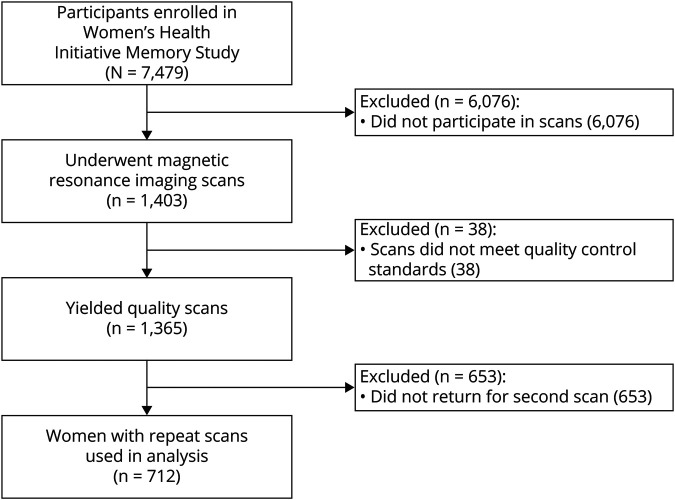
Results: For 1,365 women 77.9 ± 3.7 years of age in 2005 to 2006, there was no association between PM2.5 and baseline AD-PS score in cross-sectional analyses (β = -0.004; 95% confidence interval [CI] -0.019 to 0.011). Longitudinally, each interquartile range increase of PM2.5 (2.82 µg/m3) was associated with increased AD-PS scores during the follow-up, equivalent to a 24% (hazard ratio 1.24, 95% CI 1.14-1.34) increase in AD risk over 5 years (n = 712, age 77.4 ± 3.5 years). This association remained after adjustment for sociodemographics, intracranial volume, lifestyle, clinical characteristics, and white matter lesions and was present with levels below US regulatory standards (<12 µg/m3).
Conclusions: Late-life exposure to PM2.5 is associated with increased neuroanatomic risk of AD, which may not be explained by available indicators of cerebrovascular damage.
© 2020 American Academy of Neurology.
Comment in
-
Luftverschmutzung erhöht Demenzrisiko.MMW Fortschr Med. 2021 Feb;163(2):22. doi: 10.1007/s15006-021-9576-5. MMW Fortschr Med. 2021. PMID: 33527273 German. No abstract available.
References
Grants and funding
- HHSN268201100001I/HL/NHLBI NIH HHS/United States
- P30 ES007048/ES/NIEHS NIH HHS/United States
- P50 AG005142/AG/NIA NIH HHS/United States
- HHSN268201100004I/HL/NHLBI NIH HHS/United States
- P30 AG066515/AG/NIA NIH HHS/United States
- HHSN268201100046C/HL/NHLBI NIH HHS/United States
- K23 AG057760/AG/NIA NIH HHS/United States
- P30 AG066530/AG/NIA NIH HHS/United States
- HHSN271201100004C/AG/NIA NIH HHS/United States
- HHSN268201100002C/WH/WHI NIH HHS/United States
- P50 AG047366/AG/NIA NIH HHS/United States
- HHSN268201100002I/HL/NHLBI NIH HHS/United States
- HHSN268201100001C/WH/WHI NIH HHS/United States
- HHSN268201100004C/WH/WHI NIH HHS/United States
- HHSN268201100003C/WH/WHI NIH HHS/United States
- L30 NS093525/NS/NINDS NIH HHS/United States
- R01 ES025888/ES/NIEHS NIH HHS/United States
- P01 AG055367/AG/NIA NIH HHS/United States
- RF1 AG054068/AG/NIA NIH HHS/United States
- P30 AG049638/AG/NIA NIH HHS/United States
- R01 AG033078/AG/NIA NIH HHS/United States
- HHSN268201100003I/HL/NHLBI NIH HHS/United States
LinkOut - more resources
Full Text Sources
Other Literature Sources
