. 2021 Apr;15(4):1073-1084.
doi: 10.1038/s41396-020-00831-8. Epub 2020 Nov 18.

Elevated CO2 and nitrate levels increase wheat root-associated bacterial abundance and impact rhizosphere microbial community composition and function

Affiliations

Elevated CO2 and nitrate levels increase wheat root-associated bacterial abundance and impact rhizosphere microbial community composition and function

Alla Usyskin-Tonne et al. ISME J. 2021 Apr.

Abstract

Elevated CO2 stimulates plant growth and affects quantity and composition of root exudates, followed by response of its microbiome. Three scenarios representing nitrate fertilization regimes: limited (30 ppm), moderate (70 ppm) and excess nitrate (100 ppm) were compared under ambient and elevated CO2 (eCO2, 850 ppm) to elucidate their combined effects on root-surface-associated bacterial community abundance, structure and function. Wheat root-surface-associated microbiome structure and function, as well as soil and plant properties, were highly influenced by interactions between CO2 and nitrate levels. Relative abundance of total bacteria per plant increased at eCO2 under excess nitrate. Elevated CO2 significantly influenced the abundance of genes encoding enzymes, transporters and secretion systems. Proteobacteria, the largest taxonomic group in wheat roots (~ 75%), is the most influenced group by eCO2 under all nitrate levels. Rhizobiales, Burkholderiales and Pseudomonadales are responsible for most of these functional changes. A correlation was observed among the five gene-groups whose abundance was significantly changed (secretion systems, particularly type VI secretion system, biofilm formation, pyruvate, fructose and mannose metabolism). These changes in bacterial abundance and gene functions may be the result of alteration in root exudation at eCO2, leading to changes in bacteria colonization patterns and influencing their fitness and proliferation.


Conflict of interest statement

The authors declare that they have no conflict of interest.

Figures
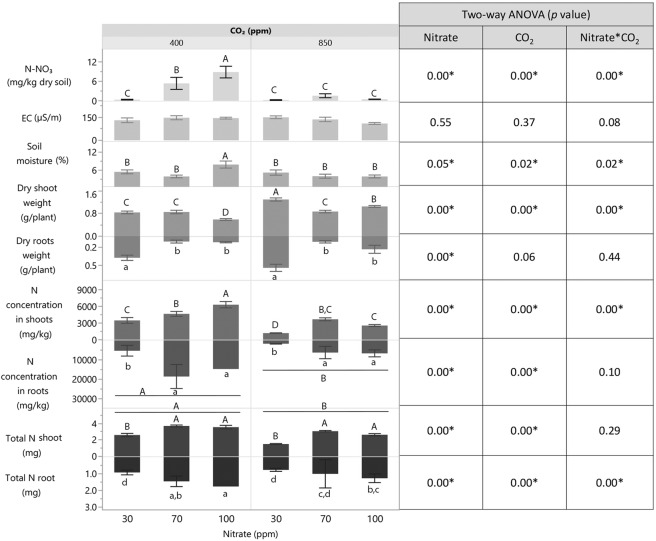
Fig. 1
Fig. 1. Soil and plant properties as influenced by nitrate and CO2 levels in 6-weeks-old wheat.
Each bar represents the average of replicates with standard error (exact number of replicates can be found in Table S6). Different uppercase and lowercase letters indicate significant difference (P ≤ 0.05) by Student’s t test. Two-way ANOVA p values are provided in table on the right. NO-N3 nitrate nitrogen.
Fig. 2
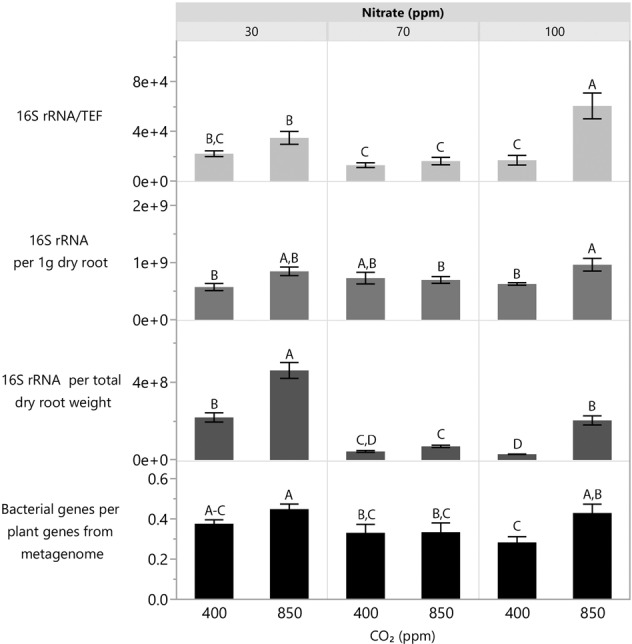
Fig. 2. Effect of CO2 and nitrate levels on abundance of total bacteria per plant in roots of 6-weeks-old wheat.
Gray bars represent measurement using qPCR, where each bar represents the average of nine replicates (three biological replicates, each composed of three technical ones) with standard error. Black bars represent measurement using shotgun sequencing, where each bar represents the average of three replicates (each replicate contains a mix of three technical replicates) with standard error. Different uppercase letters indicate significant difference (P ≤ 0.05) by Student’s t test.
Fig. 3
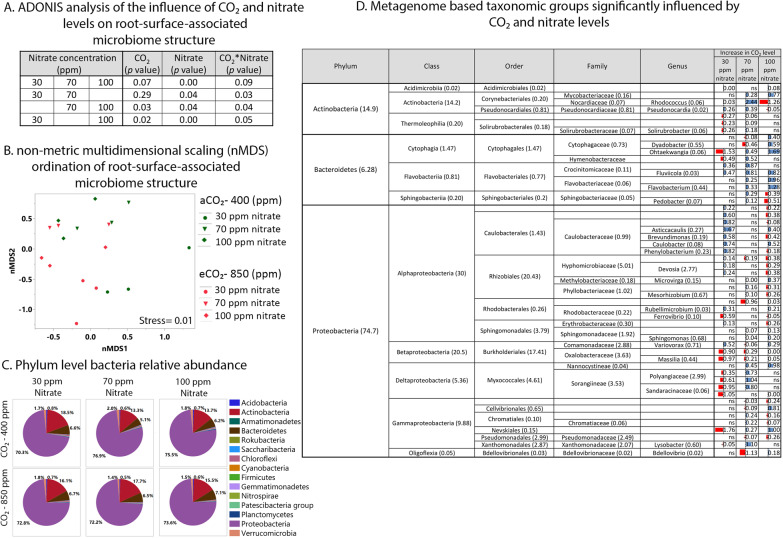
Fig. 3. Combined influence of CO2 and nitrate levels on 6-weeks-old wheat root-surface-associated bacterial community structure.
a ADONIS analysis of the effect of CO2 and different combinations of nitrate on bacterial community structure. b nMDS ordination plot showing clustering patterns of root-surface-associated bacterial community structure as influenced by all nitrate and CO2 levels. Data matrix was transformed using normalized count transformation and batch effect was removed using DESeq2 package, and then ordination was generated using Bray–Curtis dissimilarity. c Bacterial community structure at the phylum level as influenced by nitrate and CO2 level. Changes in microbiome gene abundance were calculated using DESeq2 with cutoff <0.05 of FDR-adjusted P value. d Significantly changed groups with increase in CO2 level at three nitrate levels at all taxonomic levels. Numbers in parentheses indicate relative abundance of this specific taxa out of whole phylogeny assigned from metagenome. Blue indicates positive and red indicates negative log2 fold change. n = 3.
Fig. 4
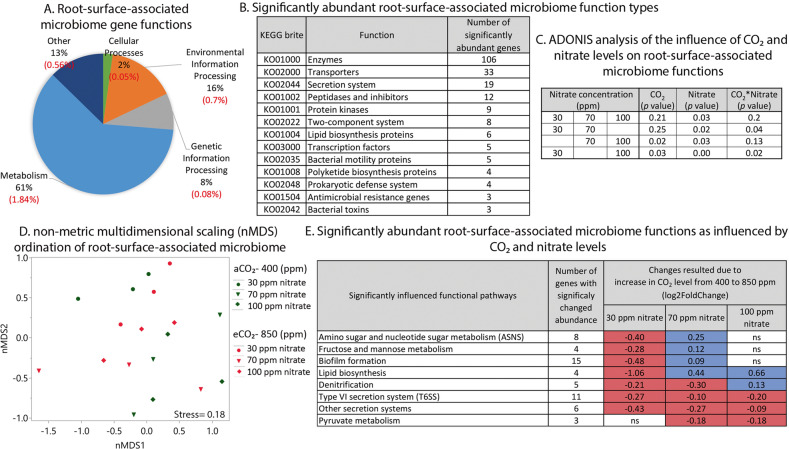
Fig. 4. Changes in root microbiome functions (KEGG) of 6-weeks-old wheat as influenced by nitrate and CO2 levels.
Changes in microbiome gene abundance were calculated using DESeq2 with cutoff < 0.2 of FDR-adjusted P value. a Pie chart of all functional genes in wheat root microbiome. Significantly changed pathways are marked in red. In parentheses is the percentage of that pathway out of whole metagenome which was significantly changed as a function of nitrate and CO2 levels. b Significantly abundant root-surface-associated microbiome function types. c ADONIS analysis of summarized effect of CO2 and different combinations of nitrate supply on bacterial community functional genes. d nMDS ordination plot showing clustering patterns of root-surface-associated microbiome functional genes as influenced by nitrate and CO2 levels. Data matrix was transformed using normalized count transformation and batch effect removal with the DESeq2 package, and then ordination was generated using Euclidean dissimilarity, n = 3. e Significantly abundant root-surface-associated microbiome functional gene pathways with increase in CO2 level. Blue indicates positive and red indicates negative log2 fold change in gene abundance between 850 and 400 ppm CO2. ns not significant.
Fig. 5
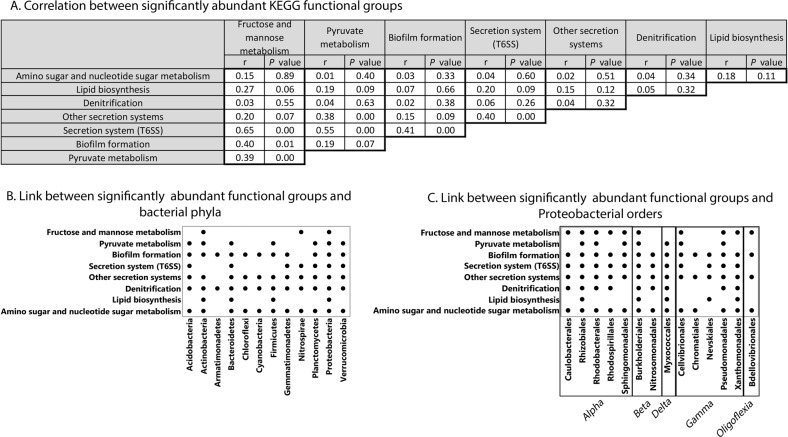
Fig. 5. Correlation between significantly abundant root-surface-associated bacterial functional groups and association to their respective taxonomy.
a Correlation between significantly abundant root-surface-associated bacterial functional groups. Pearson correlation (r) was calculated using Mantel test and P is the significance level. Link between significantly abundant root-surface-associated bacterial functional groups and bacterial phyla (b) and proteobacterial order level (c).
Fig. 6
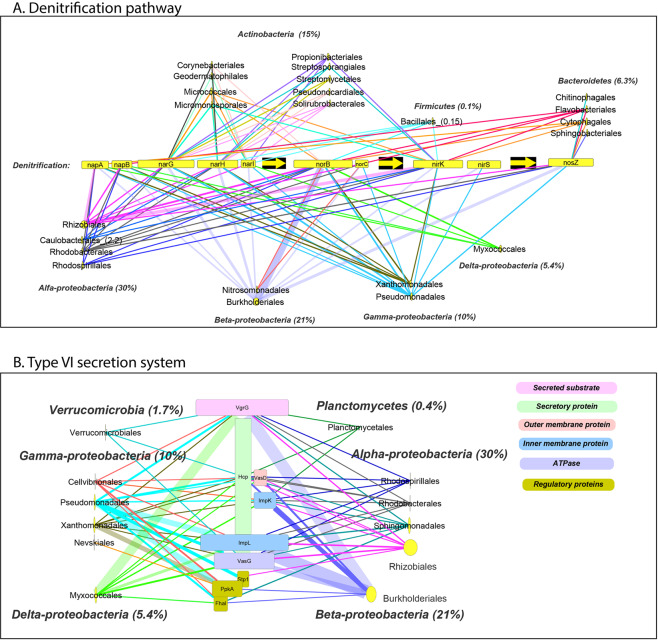
Fig. 6. The link between selected root microbiome functions and their associated taxonomy.
Link between order level root microbiome and genes of denitrification (a) and type VI secretion system (T6SS) (b). Relative abundance of each taxon under aCO2 and 100 ppm nitrate is represented by the size of the yellow node, and relative abundance is indicated in brackets near each taxon. Line width represents amount of gene. Width of gene rectangle indicates relative abundance of this gene in metagenome.

References

    1. Plattner G-K. IPCC Climate change 2014. Synthesis report. Versión inglés. Contribution of Working Groups I, II and III to the Fifth Assessment Report of the Intergovernmental Panel on Climate Change. 2014.
    1. Ainsworth EA, Long SP. What have we learned from 15 years of free-air CO2 enrichment (FACE)? A meta-analytic review of the responses of photosynthesis, canopy properties and plant production to rising CO2. N. Phytol. 2004;165:351–72. doi: 10.1111/j.1469-8137.2004.01224.x. - DOI - PubMed
    1. Paterson E, Hall JMM, Rattray EASAS, Griffiths BSS, Ritz K, Killham K. Effect of elevated CO2 on rhizosphere carbon flow and soil microbial processes. Glob Chang Biol. 1997;3:363–77. doi: 10.1046/j.1365-2486.1997.t01-1-00088.x. - DOI
    1. de Graaff MA, van Groenigen KJ, Six J, Hungate B, van Kessel C. Interactions between plant growth and soil nutrient cycling under elevated CO2: a meta-analysis. Glob Chang Biol. 2006;12:2077–91. doi: 10.1111/j.1365-2486.2006.01240.x. - DOI

    1. de Graaff MA, Six J, van Kessel C. Elevated CO2 increases nitrogen rhizodeposition and microbial immobilization of root-derived nitrogen. N. Phytol. 2007;173:778–86. doi: 10.1111/j.1469-8137.2006.01974.x. - DOI - PubMed

Publication types