


Future directions for screening and treatment in congenital hearing loss
- PMID: 33209510
- PMCID: PMC7653508
- DOI: 10.1093/pcmedi/pbaa025
Future directions for screening and treatment in congenital hearing loss
Abstract
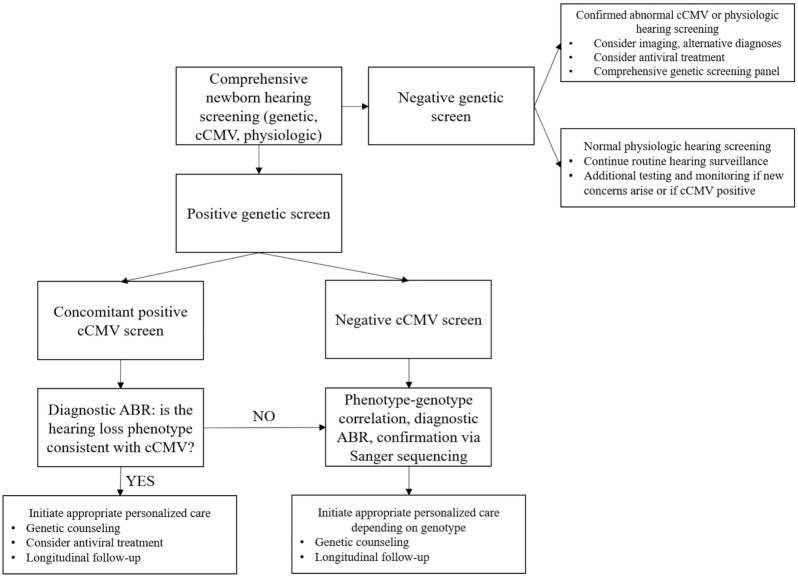
Hearing loss is the most common neurosensory deficit. It results from a variety of heritable and acquired causes and is linked to multiple deleterious effects on a child's development that can be ameliorated by prompt identification and individualized therapies. Diagnosing hearing loss in newborns is challenging, especially in mild or progressive cases, and its management requires a multidisciplinary team of healthcare providers comprising audiologists, pediatricians, otolaryngologists, and genetic counselors. While physiologic newborn hearing screening has resulted in earlier diagnosis of hearing loss than ever before, a growing body of knowledge supports the concurrent implementation of genetic and cytomegalovirus testing to offset the limitations inherent to a singular screening modality. In this review, we discuss the contemporary role of screening for hearing loss in newborns as well as future directions in its diagnosis and treatment.
Keywords: cytomegalovirus; deafness; genetic hearing loss; newborn screening; precision medicine.
© The Author(s) 2020. Published by Oxford University Press on behalf of the West China School of Medicine & West China Hospital of Sichuan University.
Figures
References
-
- Morton NE. Genetic epidemiology of hearing impairment. Ann N Y Acad Sci. 1991;630:16–31. doi:10.1111/j.1749-6632.1991.tb19572.x - PubMed
-
- Shearer AE, Hildebrand MS, Smith RJ. Hereditary Hearing Loss and Deafness Overview. 1993. http://www.ncbi.nlm.nih.gov/pubmed/20301607.
-
- Ling D, Ling AH, Doehring DG. Stimulus, response, and observer variables in the auditory screening of newborn infants. J Speech Hear Res. 1970;13:9–18. doi:10.1044/jshr.1301.09. - PubMed
-
- Gans DP, Flexer C. Observer bias in the hearing testing of profoundly involved multiply handicapped children. Ear Hear. 1982;3:309–13. doi:10.1097/00003446-198211000-00004. - PubMed
-
- Russ SA, Poulakis Z, Wake M, et al. The distraction test: The last word?. J Paediatr Child Health. 2005;41:197–200. doi:10.1111/j.1440-1754.2005.00587.x. - PubMed
Grants and funding
LinkOut - more resources
Full Text Sources
Other Literature Sources