


Alcohol-attributed disease burden in four Nordic countries between 2000 and 2017: Are the gender gaps narrowing? A comparison using the Global Burden of Disease, Injury and Risk Factor 2017 study
- PMID: 33210443
- PMCID: PMC7983874
- DOI: 10.1111/dar.13217
Alcohol-attributed disease burden in four Nordic countries between 2000 and 2017: Are the gender gaps narrowing? A comparison using the Global Burden of Disease, Injury and Risk Factor 2017 study
Abstract
Introduction and aims: The gender difference in alcohol use seems to have narrowed in the Nordic countries, but it is not clear to what extent this may have affected differences in levels of harm. We compared gender differences in all-cause and cause-specific alcohol-attributed disease burden, as measured by disability-adjusted life-years (DALY), in four Nordic countries in 2000-2017, to find out if gender gaps in DALYs had narrowed.
Design and methods: Alcohol-attributed disease burden by DALYs per 100 000 population with 95% uncertainty intervals were extracted from the Global Burden of Disease database.
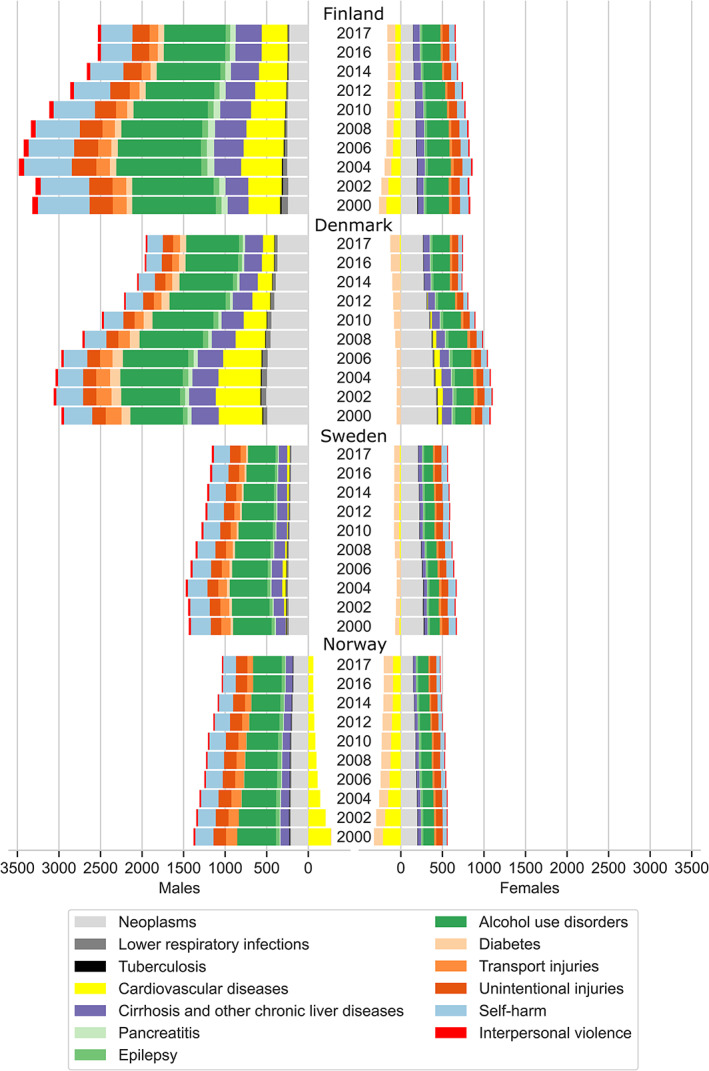
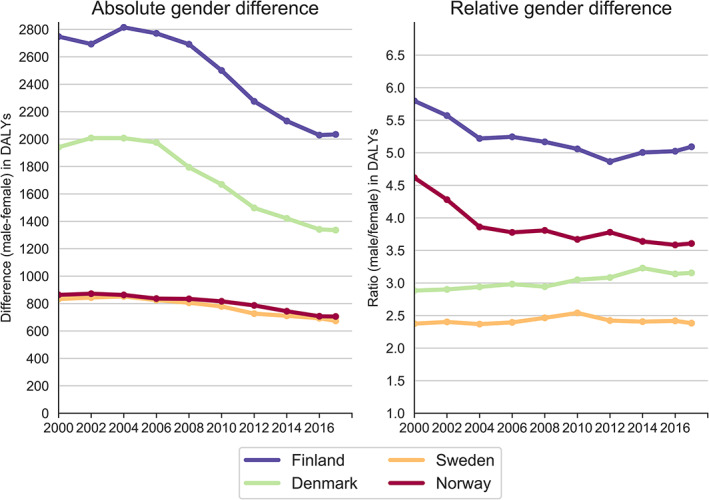
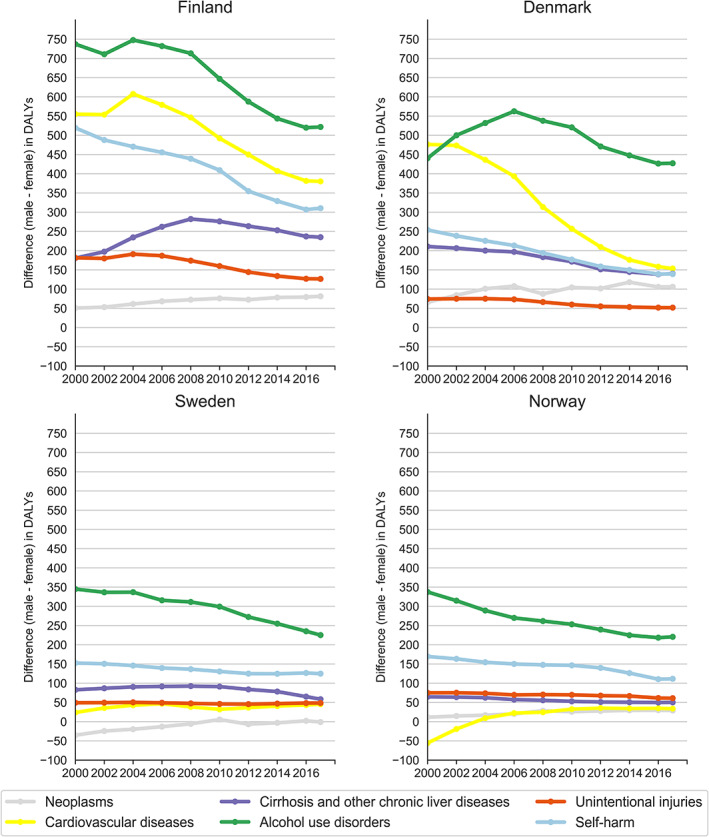
Results: In 2017, all-cause DALYs in males varied between 2531 in Finland and 976 in Norway, and in females between 620 in Denmark and 270 in Norway. Finland had the largest gender differences and Norway the smallest, closely followed by Sweden. During 2000-2017, absolute gender differences in all-cause DALYs declined by 31% in Denmark, 26% in Finland, 19% in Sweden and 18% in Norway. In Finland, this was driven by a larger relative decline in males than females; in Norway, it was due to increased burden in females. In Denmark, the burden in females declined slightly more than in males, in relative terms, while in Sweden the relative decline was similar in males and females.
Discussion and conclusions: The gender gaps in harm narrowed to a different extent in the Nordic countries, with the differences driven by different conditions. Findings are informative about how inequality, policy and sociocultural differences affect levels of harm by gender.
Keywords: Nordic countries; alcohol; disease burden; global burden of disease.
© 2020 The Authors. Drug and Alcohol Review published by John Wiley & Sons Australia, Ltd on behalf of Australasian Professional Society on Alcohol and other Drugs.
Conflict of interest statement
The authors have no conflicts of interest.
Figures
References
-
- GBD Compare ; Viz Hub. Available at: https://vizhub.healthdata.org/gbd-compare/# (accessed October 2019).
-
- Erol A, Karpyak VM. Sex and gender‐related differences in alcohol use and its consequences: contemporary knowledge and future research considerations. Drug Alcohol Depend 2015;156:1–13. - PubMed
-
- Bloomfield K, Gmel G, Wilsnack S. Introduction to special issue ‘gender, culture and alcohol problems: a multinational study’. Alcohol Alcohol Suppl 2006;41:i3–7. - PubMed
-
- Kuntsche S, Gmel G, Knibbe RA et al. Gender and cultural differences in the association between family roles, social stratification, and alcohol use: a European cross‐cultural analysis. Alcohol Alcohol Suppl 2006;41:i37–46. - PubMed
Publication types
MeSH terms
LinkOut - more resources
Full Text Sources
