


Cognitive impairments are independently associated with shorter survival in diffuse glioma patients
- PMID: 33211158
- PMCID: PMC7990824
- DOI: 10.1007/s00415-020-10303-w
Cognitive impairments are independently associated with shorter survival in diffuse glioma patients
Abstract
Background: Diffuse gliomas (WHO grade II-IV) are progressive primary brain tumors with great variability in prognosis. Cognitive deficits are of important prognostic value for survival in diffuse gliomas. Until now, few studies focused on domain-specific neuropsychological assessment and rather used MMSE as a measure for cognitive functioning. Additionally, these studies did not take WHO 2016 diagnosis into account. We performed a retrospective cohort study with the aim to investigate the independent relationship between cognitive functioning and survival in treatment-naive patients undergoing awake surgery for a diffuse glioma.
Methods: In patients undergoing awake craniotomy between 2010 and 2017, we performed pre-operative neuropsychological assessments in five cognitive domains, with special attention for the domains executive functioning and memory. We evaluated the independent relation between these domains and survival, in a Cox proportional hazards model that included state-of-the-art integrated histomolecular ('layered' or WHO-2016) classification of the gliomas and other known prognostic factors.
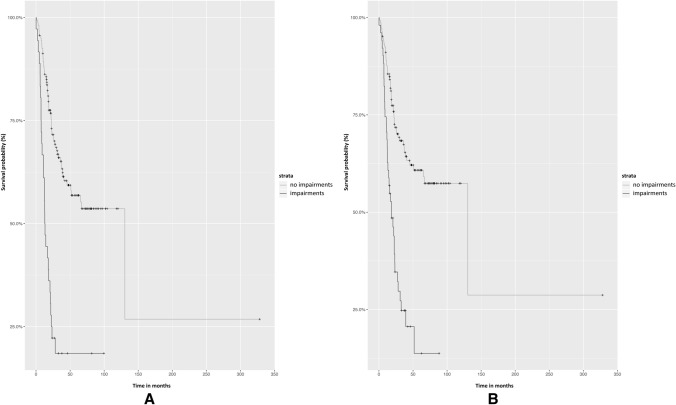
Results: We included 197 patients. Cognitive impairments (Z-values ≦ - 2.0) were most frequent in the domains memory (18.3%) and executive functioning (25.9%). Impairments in executive functioning and memory were significantly correlated with survival, even after correcting for the possible confounders. Analyses with the domains language, psychomotor speed, and visuospatial functioning yielded no significant results. Extensive domain-specific neuropsychological assessment was more strongly correlated to survival than MMSE.
Conclusion: Cognitive functioning is independently related to survival in diffuse glioma patients. Possible mechanisms underlying this relationship include the notion of cognitive functioning as a marker for diffuse infiltration of the tumor and the option that cognitive functioning and survival are determined by overlapping genetic pathways and biomarkers.
Keywords: Cognition; Diffuse glioma; Etiologic; Prognosis; Survival.
Conflict of interest statement
The authors declare that they have no conflict of interest.
Figures
References
-
- Gorlia T, van den Bent MJ, Hegi ME, Mirimanoff RO, Weller M, Cairncross JG, Eisenhauer E, Belanger K, Brandes AA, Allgeier A, Lacombe D, Stupp R. Nomograms for predicting survival of patients with newly diagnosed glioblastoma: prognostic factor analysis of EORTC and NCIC trial 26981–22981/CE.3. Lancet Oncol. 2008;9(1):29–38. doi: 10.1016/S1470-2045(07)70384-4. - DOI - PubMed
-
- Pignatti F, van den Bent M, Curran D, Debruyne C, Sylvester R, Therasse P, Afra D, Cornu P, Bolla M, Vecht C, Karim AB, European Organization for R, Treatment of Cancer Brain Tumor Cooperative G, European Organization for R, Treatment of Cancer Radiotherapy Cooperative G Prognostic factors for survival in adult patients with cerebral low-grade glioma. J Clin Oncol. 2002;20(8):2076–2084. doi: 10.1200/JCO.2002.08.121. - DOI - PubMed
-
- van Kessel E, Baumfalk AE, van Zandvoort MJE, Robe PA, Snijders TJ. Tumor-related neurocognitive dysfunction in patients with diffuse glioma: a systematic review of neurocognitive functioning prior to anti-tumor treatment. J Neurooncol. 2017;134(1):9–18. doi: 10.1007/s11060-017-2503-z. - DOI - PMC - PubMed
-
- van Kessel E, Emons MAC, Wajer IH, van Baarsen KM, Broekman ML, Robe PA, Snijders TJ, Van Zandvoort MJE. Tumor-related neurocognitive dysfunction in patients with diffuse glioma: a retrospective cohort study prior to antitumor treatment. Neurooncol Pract. 2019 doi: 10.1093/nop/npz008. - DOI - PMC - PubMed
MeSH terms
LinkOut - more resources
Full Text Sources
Medical
