. 2020 Nov 19;17(11):e1003429.
doi: 10.1371/journal.pmed.1003429. eCollection 2020 Nov.

Mode of birth and risk of infection-related hospitalisation in childhood: A population cohort study of 7.17 million births from 4 high-income countries

Affiliations

Mode of birth and risk of infection-related hospitalisation in childhood: A population cohort study of 7.17 million births from 4 high-income countries

Jessica E Miller et al. PLoS Med. .

Abstract

Background: The proportion of births via cesarean section (CS) varies worldwide and in many countries exceeds WHO-recommended rates. Long-term health outcomes for children born by CS are poorly understood, but limited data suggest that CS is associated with increased infection-related hospitalisation. We investigated the relationship between mode of birth and childhood infection-related hospitalisation in high-income countries with varying CS rates.

Methods and findings: We conducted a multicountry population-based cohort study of all recorded singleton live births from January 1, 1996 to December 31, 2015 using record-linked birth and hospitalisation data from Denmark, Scotland, England, and Australia (New South Wales and Western Australia). Birth years within the date range varied by site, but data were available from at least 2001 to 2010 for each site. Mode of birth was categorised as vaginal or CS (emergency/elective). Infection-related hospitalisations (overall and by clinical type) occurring after the birth-related discharge date were identified in children until 5 years of age by primary/secondary International Classification of Diseases, 10th Revision (ICD-10) diagnosis codes. Analysis used Cox regression models, adjusting for maternal factors, birth parameters, and socioeconomic status, with results pooled using meta-analysis. In total, 7,174,787 live recorded births were included. Of these, 1,681,966 (23%, range by jurisdiction 17%-29%) were by CS, of which 727,755 (43%, range 38%-57%) were elective. A total of 1,502,537 offspring (21%) had at least 1 infection-related hospitalisation. Compared to vaginally born children, risk of infection was greater among CS-born children (hazard ratio (HR) from random effects model, HR 1.10, 95% confidence interval (CI) 1.09-1.12, p < 0.001). The risk was higher following both elective (HR 1.13, 95% CI 1.12-1.13, p < 0.001) and emergency CS (HR 1.09, 95% CI 1.06-1.12, p < 0.001). Increased risks persisted to 5 years and were highest for respiratory, gastrointestinal, and viral infections. Findings were comparable in prespecified subanalyses of children born to mothers at low obstetric risk and unchanged in sensitivity analyses. Limitations include site-specific and longitudinal variations in clinical practice and in the definition and availability of some data. Data on postnatal factors were not available.

Conclusions: In this study, we observed a consistent association between birth by CS and infection-related hospitalisation in early childhood. Notwithstanding the limitations of observational data, the associations may reflect differences in early microbial exposure by mode of birth, which should be investigated by mechanistic studies. If our findings are confirmed, they could inform efforts to reduce elective CS rates that are not clinically indicated.


Conflict of interest statement

The authors have declared that no competing interests exist.

Figures
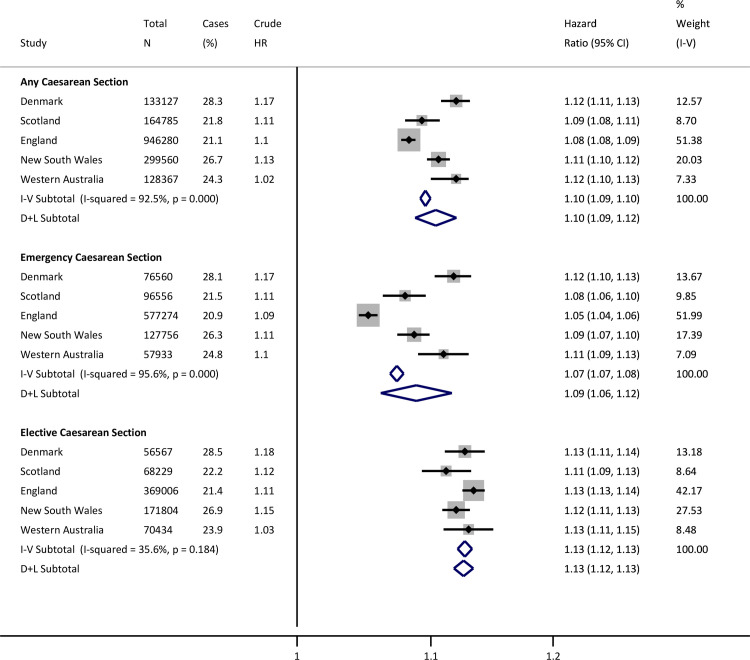
Fig 1
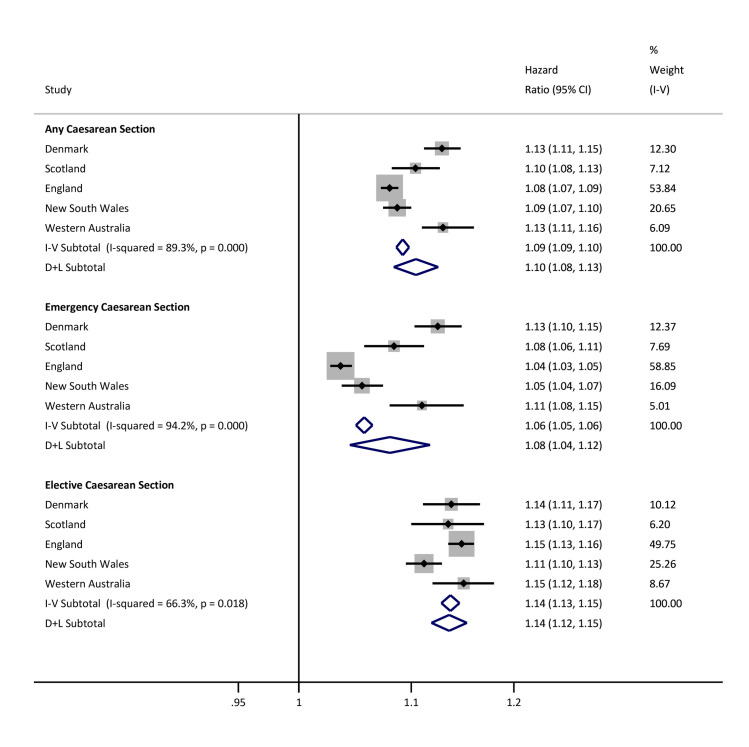
Fig 1. Site-specific and meta-analysis HRs for infection-related hospitalisations.
Estimates are from recurrent events models fitted for total time. Models adjusted for sex, gestational age, birth weight z-score, smoking during pregnancy, maternal age at birth, parity, area level deprivation, birth year, medical indication for type of delivery, and season of birth. Reference is vaginal births. CI, confidence interval; D+L, DerSimonian and Laird random effects model; HR, hazard ratio; I-V, inverse-variance weighted fixed effects model.
Fig 2
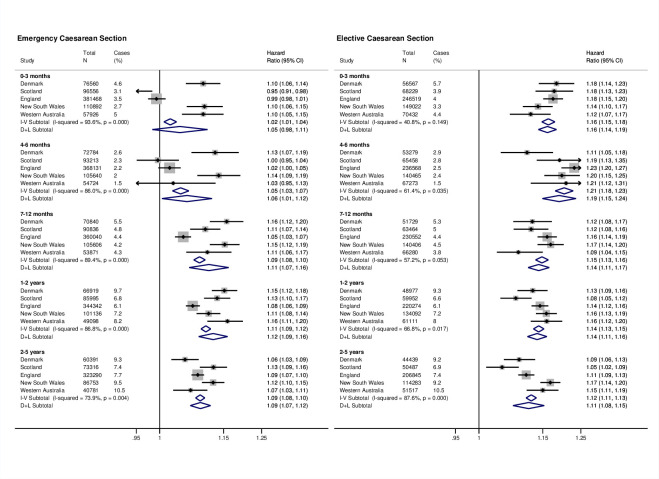
Fig 2. Site-specific and meta-analysis HRs for infection-related hospitalisations by age at first occurrence.
Estimates are from first event models adjusted for sex, gestational age, birth weight z-score, smoking during pregnancy, maternal age at birth, parity, area level deprivation, birth year, medical indication for type of delivery, and season of birth. Reference is vaginal births. Estimates for England based on follow-up time until first infection-related hospitalisation admission as data on exact date of birth were not available. CI, confidence interval; D+L, DerSimonian and Laird random effects model; HR, hazard ratio; I-V, inverse-variance weighted fixed effects model.
Fig 3
Fig 3. Site-specific and meta-analysis HRs for infection-related hospitalisations in children born to a low-risk population of mothers.
Estimates are from recurrent events models fitted for total time. Models adjusted for sex, gestational age, birth weight z-score, smoking during pregnancy, maternal age at birth, parity, area level deprivation, birth year, medical indication for type of delivery, and season of birth. Reference is vaginal births. Low-risk population of births defined as cephalic presenting infants born ≥37 weeks gestational age, with birth weight between the 10th and 90th percentiles for gestational age and sex, born to women aged 20 to 34 years without any reported medical conditions during pregnancy. CI, confidence interval; D+L, DerSimonian and Laird random effects model; HR, hazard ratio; I-V, inverse-variance weighted fixed effects model.
Fig 4
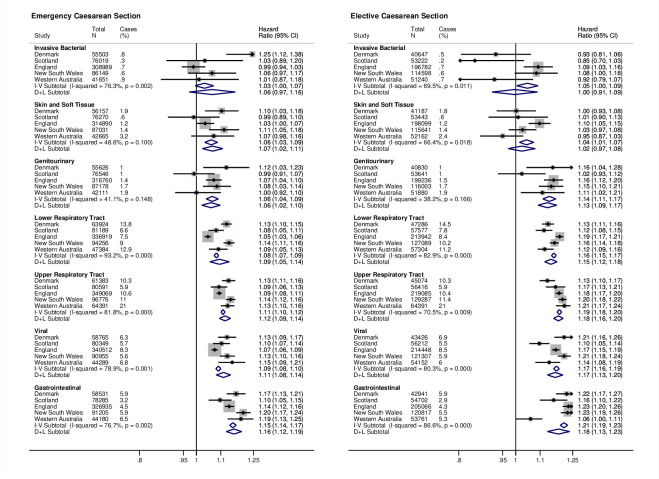
Fig 4
Site-specific and meta-analysis HRs for infection-related hospitalisations by clinical infection group. Estimates are from recurrent events models fitted for total time. Models adjusted for sex, gestational age, birth weight z-score, smoking during pregnancy, maternal age at birth, parity, area level deprivation, birth year, medical indication for type of delivery, and season of birth. Reference is vaginal births. CI, confidence interval; D+L, DerSimonian and Laird random effects model; HR, hazard ratio; I-V, inverse-variance weighted fixed effects model.

Comment in

References

    1. Boerma T, Ronsmans C, Melesse DY, Barros AJD, Barros FC, Juan L, et al. Global epidemiology of use of and disparities in caesarean sections. Lancet. 2018;392(10155):1341–8. Epub 2018/10/17. 10.1016/S0140-6736(18)31928-7 . - DOI - PubMed
    1. Sandall J, Tribe RM, Avery L, Mola G, Visser GH, Homer CS, et al. Short-term and long-term effects of caesarean section on the health of women and children. Lancet. 2018;392(10155):1349–57. Epub 2018/10/17. 10.1016/S0140-6736(18)31930-5 . - DOI - PubMed
    1. Occhi GM, de Lamare Franco Netto T, Neri MA, Rodrigues EAB, de Lourdes Vieira Fernandes A. Strategic measures to reduce the caesarean section rate in Brazil. Lancet. 2018;392(10155):1290–1. 10.1016/S0140-6736(18)32407-3 . - DOI - PubMed
    1. Betran AP, Ye J, Moller AB, Zhang J, Gulmezoglu AM, Torloni MR. The increasing trend in caesarean section rates: global, regional and national estimates: 1990–2014. PLoS ONE. 2016;11(2):e0148343 Epub 2016/02/06. 10.1371/journal.pone.0148343 - DOI - PMC - PubMed
    1. Giang HTN, Ulrich S, Tran HT, Bechtold-Dalla Pozza S. Monitoring and interventions are needed to reduce the very high Caesarean section rates in Vietnam. Acta Paediatr. 2018. 10.1111/apa.14376 . - DOI - PubMed

Publication types