


Virological surveillance of influenza viruses in the WHO European Region in 2019/20 - impact of the COVID-19 pandemic
- PMID: 33213683
- PMCID: PMC7678039
- DOI: 10.2807/1560-7917.ES.2020.25.46.2001822
Virological surveillance of influenza viruses in the WHO European Region in 2019/20 - impact of the COVID-19 pandemic
Abstract
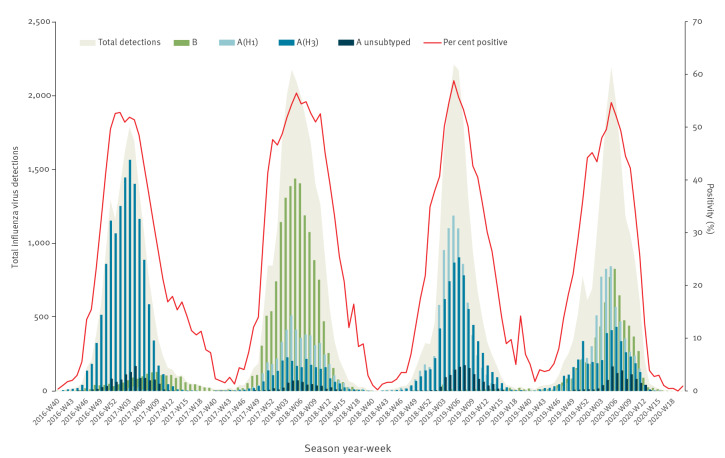
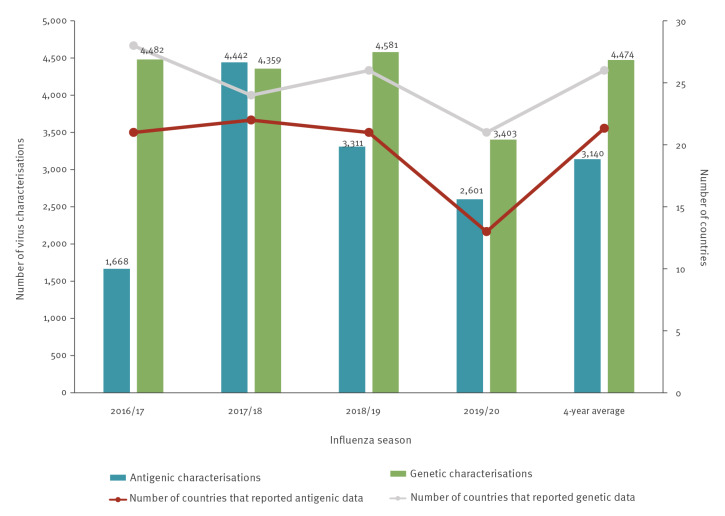
The COVID-19 pandemic negatively impacted the 2019/20 WHO European Region influenza surveillance. Compared with previous 4-year averages, antigenic and genetic characterisations decreased by 17% (3,140 vs 2,601) and 24% (4,474 vs 3,403). Of subtyped influenza A viruses, 56% (26,477/47,357) were A(H1)pdm09, 44% (20,880/47,357) A(H3). Of characterised B viruses, 98% (4,585/4,679) were B/Victoria. Considerable numbers of viruses antigenically differed from northern hemisphere vaccine components. In 2020/21, maintaining influenza virological surveillance, while supporting SARS-CoV-2 surveillance is crucial.
Keywords: COVID-19; Europe; SARS-CoV-2; influenza virus; pandemic; surveillance; virus characterization.
Conflict of interest statement
Figures
References
-
- European Centre for Disease Prevention and Control (ECDC) and World Health Organization. (WHO). FluNewsEurope. Joint ECDC-WHO/Europe weekly influenza update. Stockholm and Geneva: WHO and ECDC. [Accessed Oct 2020]. Available from: https://flunewseurope.org/
-
- Mook P, Meerhoff T, Olsen SJ, Snacken R, Adlhoch C, Pereyaslov D, et al. Collective of the WHO European Region, European Influenza Surveillance Network Alternating patterns of seasonal influenza activity in the WHO European Region following the 2009 pandemic, 2010-2018. Influenza Other Respir Viruses. 2020;14(2):150-61. 10.1111/irv.12703 - DOI - PMC - PubMed
-
- European Centre for Disease Prevention and Control (ECDC) and WHO Regional Office for Europe. (WHO/Europe). European external quality assessment programme for influenza virus 2018. Stockholm and Copenhagen: ECDC and WHO/Europe; 2019. Available from: https://www.ecdc.europa.eu/sites/portal/files/documents/influenza-virus-...
-
- European Centre for Disease Prevention and Control (ECDC). Influenza virus characterisation - Summary Europe, July 2020. Stockholm: ECDC; 2020. Available from: https://www.ecdc.europa.eu/en/publications-data/influenza-virus-characte...
-
- Worldwide Influenza Centre (WIC), World Health Organisation Collaborating Centre for Reference and Research on Influenza. Report prepared for the WHO annual consultation on the composition of influenza vaccine for the Southern Hemisphere 2021. London: WIC; Sep 2020. Available from: https://www.crick.ac.uk/sites/default/files/2020-10/Crick_SH2021%20repor...
MeSH terms
Substances
Grants and funding
LinkOut - more resources
Full Text Sources
Medical
Miscellaneous