


A compound plant extract and its antibacterial and antioxidant properties in vitro and in vivo
- PMID: 33214979
- PMCID: PMC7666253
- DOI: 10.1007/s13205-020-02529-2
A compound plant extract and its antibacterial and antioxidant properties in vitro and in vivo
Abstract
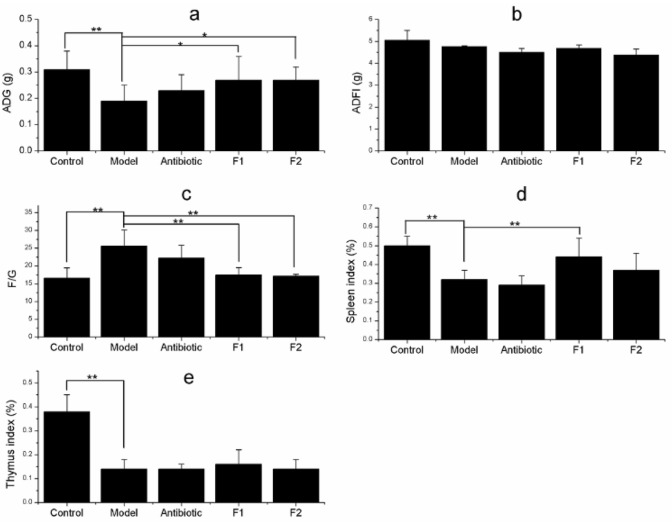
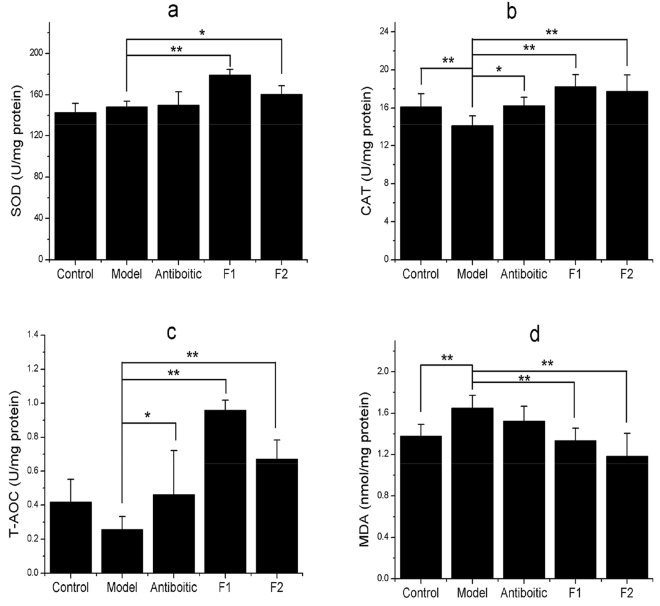
The present study was conducted to prepare a compound plant extract as a candidate animal feed additive. Firstly, Evodia rutaecarpa (ER), Schisandra sphenanthera (SS), Punica granatum (PG) and Artemisia argyi (AA) were screened out from 17 plants as materials of candidate compound plant extracts by measuring the antibacterial rate on Escherichia coli and Salmonella paratyphoid, and the scavenging capability on 2,2 diphenyl-1-picrylhydrazine radical in vitro. Secondly, proportions of the four materials were optimized with an L9 (43) orthogonal experiment. By range analysis of experimental results, two compound extracts (named as F1 and F2) with the strongest antibacterial and antioxidant functions were obtained. The ratio of ER: SS: PG: AA is 9:9:1:3 in F1 and 9:9:9:3 in F2, respectively. Finally, the effects of F1 and F2 on security and efficacy in vivo were evaluated. In healthy mice, F1 had no significant effects (p > 0.05) on all blood parameters and viscera indices, and at 1000 mg/kg bw dose significantly increased (p < 0.05) the average daily gain (ADG). F2 decreased (p < 0.05) white blood cell count at 3000 mg/kg bw and increased (p < 0.05) red blood cell count at 333 mg/kg bw. In immunosuppressed mice, both F1 and F2 improved ADG (p < 0.05) and the feed intake to gain ratio (p < 0.01), and increased the activities of hepatic superoxide dismutase (p < 0.05), catalase (p < 0.05) and total antioxygen capacity (p < 0.05), and the content of malonaldehyde (p < 0.01). In mice challenged with Escherichia coli, the antidiarrhea and reducing mortality effects of F1 were equivalent to the antibiotic. F2 failed to protect the experimental mice. These results suggested F1, a compound plant extract, show a great potential as a substitute for antibiotics in animal feed.
Keywords: Antibacterial activity; Antioxidant activity; Mice; Plant extracts.
© King Abdulaziz City for Science and Technology 2020.
Conflict of interest statement
Conflict of interestThe authors declare that they have no competing interests.
Figures
References
-
- Aluko RE, Monu E. Functional and bioactive properties of quinoa seed protein hydrolysates. J Food Sci. 2003;68:1254–1258. doi: 10.1111/j.1365-2621.2003.tb09635.x. - DOI
-
- CLSI (2010) performance standards for antimicrobial susceptibility testing: 20th informational supplement. CLSI document M100-S20. Clinical and Laboratory Standards Institute, Wayne, PA.
-
- Guan X, Ge D, Li S, Huang K, Liu J, Li F (2019) Chemical composition and antimicrobial activities of Artemisia argyi lévl. et vant essential oils extracted by simultaneous distillation-extraction, subcritical extraction and hydrodistillation. Molecules 24:483. 10.3390/molecules24030483 - PMC - PubMed
-
- Han B, Xin Z, Ma S, Liu W, Zhang B, Ran L, Yi L, Ren D. Comprehensive characterization and identification of antioxidants in folium Artemisiae argyi using high-resolution tandem mass spectrometry. J Chromatogr B Analyt Technol Biomed Life Sci. 2017;1063:84–92. doi: 10.1016/j.jchromb.2017.08.021. - DOI - PubMed
LinkOut - more resources
Full Text Sources
Miscellaneous
