40 days and 40 nights: Clinical characteristics of major trauma and orthopaedic injury comparing the incubation and lockdown phases of COVID-19 infection
- PMID: 33215121
- PMCID: PMC7659656
- DOI: 10.1302/2633-1462.17.BJO-2020-0068.R1
40 days and 40 nights: Clinical characteristics of major trauma and orthopaedic injury comparing the incubation and lockdown phases of COVID-19 infection
Abstract
Aims: The first death in the UK caused by COVID-19 occurred on 5 March 2020. We aim to describe the clinical characteristics and outcomes of major trauma and orthopaedic patients admitted in the early COVID-19 era.
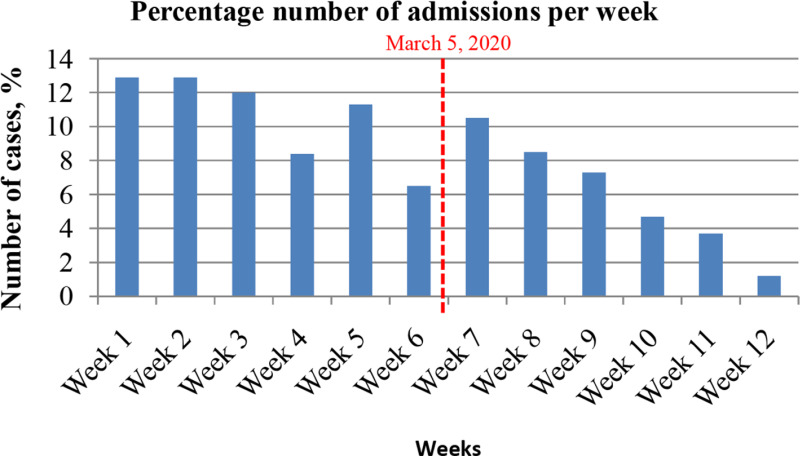
Methods: A prospective trauma registry was reviewed at a Level 1 Major Trauma Centre. We divided patients into Group A, 40 days prior to 5 March 2020, and into Group B, 40 days after.
Results: A total of 657 consecutive trauma and orthopaedic patients were identified with a mean age of 55 years (8 to 98; standard deviation (SD) 22.52) and 393 (59.8%) were males. In all, 344 (approximately 50%) of admissions were major trauma. Group A had 421 patients, decreasing to 236 patients in Group B (36%). Mechanism of injury (MOI) was commonly a fall in 351 (52.4%) patients, but road traffic accidents (RTAs) increased from 56 (13.3%) in group A to 51 (21.6%) in group B (p = 0.030). ICU admissions decreased from 26 (6.2%) in group A to 5 (2.1%) in group B. Overall, 39 patients tested positive for COVID-19 with mean age of 73 years (28 to 98; SD 17.99) and 22 (56.4%) males. Common symptoms were dyspnoea, dry cough, and pyrexia. Of these patients, 27 (69.2%) were nosocomial infections and two (5.1%) of these patients required intensive care unit (ICU) admission with 8/39 mortality (20.5%). Of the patients who died, 50% were older and had underlying comorbidities (hypertension and cardiovascular disease, dementia, arthritis).
Conclusion: Trauma admissions decreased in the lockdown phase with an increased incidence of RTAs. Nosocomial infection was common in 27 (69.2%) of those with COVID-19. Symptoms and comorbidities were consistent with previous reports with noted inclusion of dementia and arthritis. The mortality rate of trauma and COVID-19 was 20.5%, mainly in octogenarians, and COVID-19 surgical mortality was 15.4%.Cite this article: Bone Joint Open 2020;1-7:330-338.
Keywords: COVID-19; Nosocomial infection; Orthopaedics; Surgery; Trauma.
© 2020 Author(s) et al.
Conflict of interest statement
ICMJE COI statement: A. Trompeter reports consultancy from Stryker, expert testimony for medicolegal work, payment for lectures (including service on speakers bureaus) and development of educational presentations from Stryker, Smith & Nephew, and Orthofix, royalties from Oxford University Press and JP Medical, all of which are unrelated to this article. D. F. Lui reports consultancy from Stryker and Zimmer Biomet, which are unrelated to this article.
Figures
References
-
- Mahase E. Covid-19: UK records first death, as world’s cases exceed 100 000. BMJ. 2020:m943. - PubMed
-
- Strengthening the health system response to COVID-19. World Health Organization. 2020. https://www.euro.who.int/__data/assets/pdf_file/0007/436354/strengthenin... (date last accessed 1 July 2020).
-
- No authors listed Management of patients with urgent orthopaedic conditions and trauma during the coronavirus pandemic [Internet]. 2020. https://www.england.nhs.uk/coronavirus/publication/specialty-guides/ (date last accessed 12 May 2020).