


Normative Cardiopulmonary Exercise Test Responses at the Ventilatory Threshold in Canadian Adults 40 to 80 Years of Age
- PMID: 33217419
- PMCID: PMC8579317
- DOI: 10.1016/j.chest.2020.11.009
Normative Cardiopulmonary Exercise Test Responses at the Ventilatory Threshold in Canadian Adults 40 to 80 Years of Age
Abstract
Background: Physiologic and symptom responses at the ventilatory threshold (Tvent) during incremental cardiopulmonary exercise testing (CPET) can provide important prognostic information.
Research question: This study aimed to develop an updated normative reference set for physiologic and symptom responses at Tvent during cycle CPET (primary aim) and to evaluate previously recommended reference equations from a 1985 study for predicting Tvent responses (secondary aim).
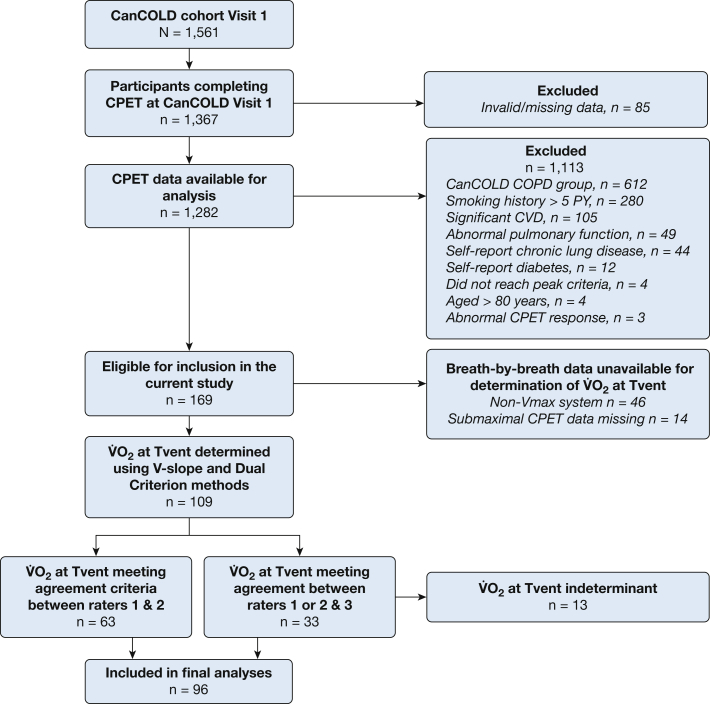
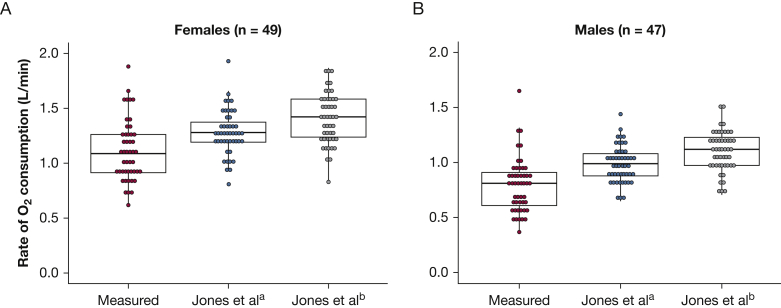
Study design and methods: Participants were adults 40 to 80 years of age who were free of clinically relevant disease from the Canadian Cohort Obstructive Lung Disease. Rate of oxygen consumption (V˙O2) at Tvent was identified by two independent raters; physiologic and symptom responses corresponding to V˙O2 at Tvent were identified by linear interpolation. Reference ranges (5th-95th percentiles) for responses at Tvent were calculated according to participant sex and age for 29 and eight variables, respectively. Prediction models were developed for nine variables (oxygen pulse, V˙O2, rate of CO2 production, minute ventilation, tidal volume, inspiratory capacity, end-inspiratory lung volume [in liters and as percentage of total lung capacity], and end-expiratory lung volume) using quantile regression, estimating the 5th (lower limit of normal), 50th (normal), and 95th (upper limit of normal) percentiles based on readily available participant characteristics. The two one-sided test of equivalence for paired samples evaluated the measured and 1985-predicted V˙O2 at Tvent for equivalence.
Results: Reference ranges and equations were developed based on 96 participants (49% men) with a mean ± SD age of 63 ± 9 years. Mean V˙O2 at Tvent was 50% of measured V˙O2 peak; the normal range was 33% to 66%. The 1985 reference equations overpredicted V˙O2 at Tvent: mean difference in men, -0.17 L/min (95% CI, -0.25 to -0.09 L/min); mean difference in women, -0.19 L/min (95% CI, -0.27 to -0.12 L/min).
Interpretation: A contemporary reference set of CPET responses at Tvent from Canadian adults 40 to 80 years of age is presented that differs from the previously recommended and often used reference set from 1985.
Trial registry: ClinicalTrials.gov; No.: NCT00920348; URL: www.clinicaltrials.gov.
Keywords: CPET; anaerobic threshold; cardiopulmonary exercise testing; exercise responses; normal values; reference set; ventilatory threshold.
Copyright © 2020 American College of Chest Physicians. Published by Elsevier Inc. All rights reserved.
Figures
References
-
- ATS/ACCP statement on cardiopulmonary exercise testing. Am J Respir Crit Care Med. 2003;167(2):211–277. - PubMed
-
- Gitt A.K., Wasserman K., Kilkowski C., et al. Exercise anaerobic threshold and ventilatory efficiency identify heart failure patients for high risk of early death. Circulation. 2002;106(24):3079–3084. - PubMed
-
- Carriere C., Corra U., Piepoli M., et al. Anaerobic threshold and respiratory compensation point identification during cardiopulmonary exercise tests in chronic heart failure. Chest. 2019;156(2):338–347. - PubMed
-
- Moran J., Wilson F., Guinan E., McCormick P., Hussey J., Moriarty J. Role of cardiopulmonary exercise testing as a risk-assessment method in patients undergoing intra-abdominal surgery: a systematic review. Br J Anaesth. 2016;116(2):177–191. - PubMed
Publication types
MeSH terms
Associated data
Grants and funding
LinkOut - more resources
Full Text Sources
Other Literature Sources
Medical
