


Performance of Severe Acute Respiratory Syndrome Coronavirus 2 Real-Time RT-PCR Tests on Oral Rinses and Saliva Samples
- PMID: 33217552
- PMCID: PMC7670901
- DOI: 10.1016/j.jmoldx.2020.10.018
Performance of Severe Acute Respiratory Syndrome Coronavirus 2 Real-Time RT-PCR Tests on Oral Rinses and Saliva Samples
Abstract
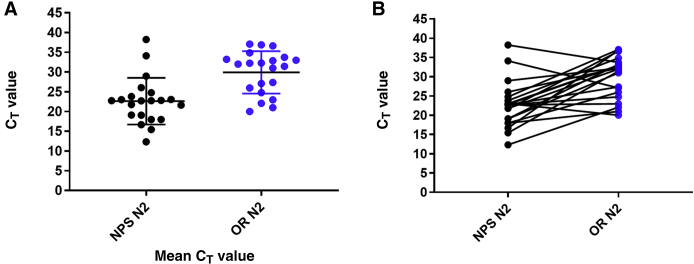
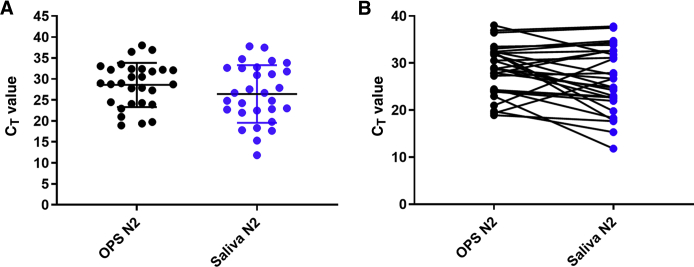
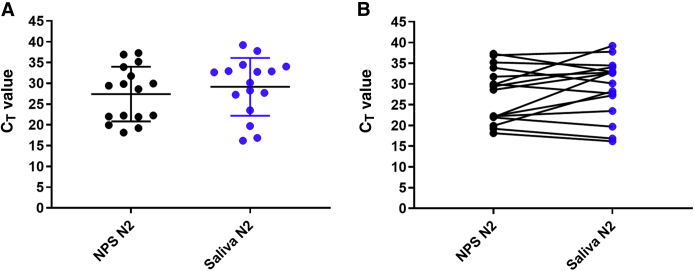
Access to rapid and accurate detection of the severe acute respiratory syndrome coronavirus 2 (SARS-CoV-2) RNA is essential for controlling the current global pandemic of coronavirus disease 2019. In this study, the use of oral rinses (ORs) and posterior oropharyngeal saliva as an alternative to swab collection methods from symptomatic and asymptomatic health care workers for the detection of SARS-CoV-2 RNA by RT-PCR was evaluated. For saliva samples, the overall agreement with oropharyngeal swabs was 93% (Ƙ = 0.84), with a sensitivity of 96.7% (95% CI, 83.3%-99.8%). The agreement between saliva and nasopharyngeal swabs was 97.7% (Ƙ = 0.93), with a sensitivity of 94.1% (95% CI, 73.0%-99.7%). ORs were compared with nasopharyngeal swabs only, with an overall agreement of 85.7% (Ƙ = 0.65), and a sensitivity of 63% (95% CI, 46.6%-77.8%). The agreement between a laboratory-developed test based on the CDC RT-PCR and two commercial assays, the Xpert Xpress SARS-CoV-2 and the Cobas SARS-CoV-2, was also evaluated. The overall agreement was >90%. Finally, SARS-CoV-2 RNA in saliva samples was shown to be stable, with no changes in viral loads over 24 hours at both room temperature and 4°C. Although the dilution of SARS-CoV-2 in ORs precluded its acceptability as a sample type, posterior oropharyngeal saliva was an acceptable alternative sample type for SARS-CoV-2 RNA detection.
Copyright © 2021 Association for Molecular Pathology and American Society for Investigative Pathology. Published by Elsevier Inc. All rights reserved.
Figures
References
-
- To K.K., Tsang O.T., Chik-Yan Yip C., Chan K.H., Wu T.C., Chan J.M.C., Leung W.S., Chik T.S., Choi C.Y., Kandamby D.H., Lung D.C., Tam A.R., Poon R.W., Fung A.Y., Hung I.F., Cheng V.C., Chan J.F., Yuen K.Y. Consistent detection of 2019 novel coronavirus in saliva. Clin Infect Dis. 2020;71:841–843. - PMC - PubMed
-
- To K.K., Tsang O.T., Leung W.S., Tam A.R., Wu T.C., Lung D.C., Yip C.C., Cai J.P., Chan J.M., Chik T.S., Lau D.P., Choi C.Y., Chen L.L., Chan W.M., Chan K.H., Ip J.D., Ng A.C., Poon R.W., Luo C.T., Cheng V.C., Chan J.F., Hung I.F., Chen Z., Chen H., Yuen K.Y. Temporal profiles of viral load in posterior oropharyngeal saliva samples and serum antibody responses during infection by SARS-CoV-2: an observational cohort study. Lancet Infect Dis. 2020;20:565–574. - PMC - PubMed
Publication types
MeSH terms
Substances
Grants and funding
LinkOut - more resources
Full Text Sources
Other Literature Sources
Medical
Miscellaneous
