Review
. 2021 Apr;15(4):939-948.
doi: 10.1038/s41396-020-00832-7. Epub 2020 Nov 20.

Ecology and evolution of antimicrobial resistance in bacterial communities

Affiliations
Review

Ecology and evolution of antimicrobial resistance in bacterial communities

Michael J Bottery et al. ISME J. 2021 Apr.

Abstract

Accumulating evidence suggests that the response of bacteria to antibiotics is significantly affected by the presence of other interacting microbes. These interactions are not typically accounted for when determining pathogen sensitivity to antibiotics. In this perspective, we argue that resistance and evolutionary responses to antibiotic treatments should not be considered only a trait of an individual bacteria species but also an emergent property of the microbial community in which pathogens are embedded. We outline how interspecies interactions can affect the responses of individual species and communities to antibiotic treatment, and how these responses could affect the strength of selection, potentially changing the trajectory of resistance evolution. Finally, we identify key areas of future research which will allow for a more complete understanding of antibiotic resistance in bacterial communities. We emphasise that acknowledging the ecological context, i.e. the interactions that occur between pathogens and within communities, could help the development of more efficient and effective antibiotic treatments.


Conflict of interest statement

The authors declare that they have no conflict of interest.

Figures
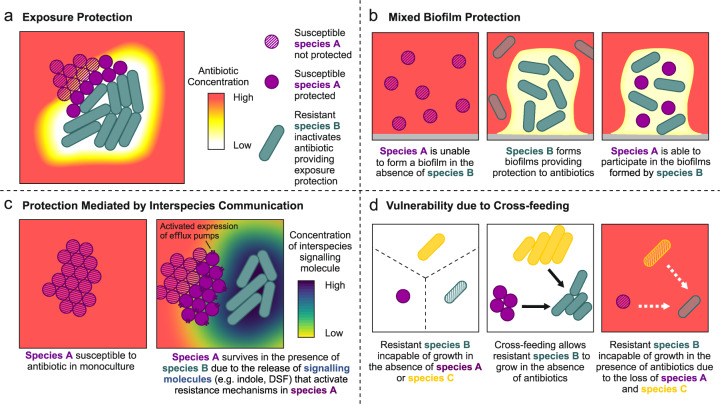
Fig. 1
Fig. 1. Community interactions, as well as resistance genotype, affect the response to antibiotic exposure.
In all panels, cell growth state is represented by either hatched (unable to grow) or solid fill (able to grow). a Resistant bacteria that inactivate antibiotics reduce the local antibiotic concentration, providing exposure protection to surrounding sensitive species. This benefit is dependent upon the density and spatial structure of the population, as well as the diffusion rate and rate of inactivation of the antibiotic. b Some species are unable to form biofilms in isolation but are able to gain improved antibiotic tolerance by participating in established biofilms of other species. c The receipt of secreted signalling molecules, such as indole and DSF, can trigger antibiotic resistance states in otherwise susceptible community members through increasing the expression of resistance genes. d Reliance upon cross-feeding networks can be detrimental for a resistant species if its growth depends on cross-feeding on secretions of susceptible community members. In this scenario, tolerance to antibiotics is lowered to the level of the most susceptible community member as cross-feeding interactions are lost due to antibiotic killing (dashed white arrows) thus the resistant species is unable to grow due to the loss of essential recourses.
Fig. 2
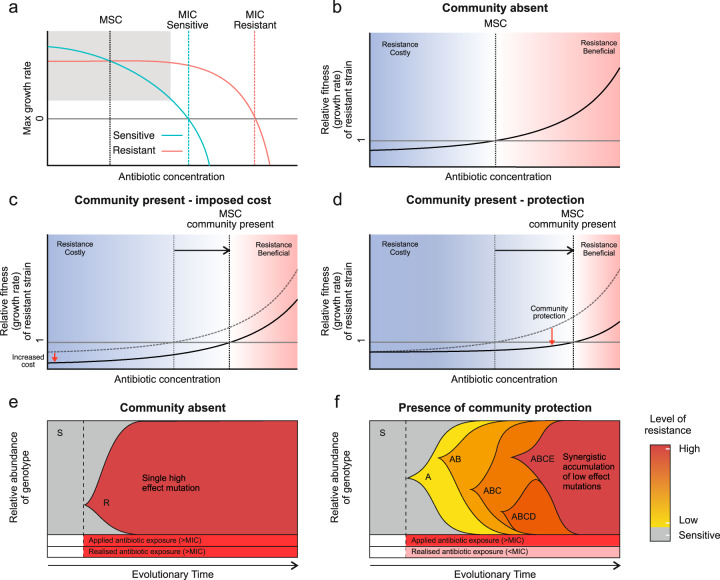
Fig. 2. Fitness and selection consequences of differential effects of antibiotic concentration on growth rate.
a Theoretical max growth rates in pure culture of ‘isogenic’ strains differing only in resistance or sensitivity to antibiotic. Shaded area represents the range of antibiotic concentrations in subsequent panels (bd) exploring competition outcomes and minimal selective concentration (MSC) based on these relative growth rates. b The MSC is defined as the antibiotic concentration at which growth rate of the resistant strain exceeds that of the sensitive strain (relative fitness >1). c, d In a community, the MSC can be increased by two basic mechanisms. One is increased costs of resistance, which may arise by increased competition for nutrients (c) and the other is reduced antibiotic effect upon sensitive strains, which may arise by community protection (d). e, f The emergence of de novo resistance mutations can be altered by community protection. e In the absence of a protective community antibiotic exposure above the MIC acts upon standing genetic variation, often selecting for a single high resistance, high cost mutation. e Communities that provide exposure protection may reduce the realised antibiotic exposure to sub-MIC levels, allowing for the sequential accumulation of low cost, low resistance mutations that together provide high levels of resistance for example via epistasis. Letters inside panels (S, R, A, AB, etc.) represent the accumulation of different mutations during selective sweeps.

References

    1. Maiden MCJ. Horizontal genetic exchange, evolution, and spread of antibiotic resistance in bacteria. Clin Infect Dis. 1998;27:S12–S20. doi: 10.1086/514917. - DOI - PubMed
    1. Aminov RI. Horizontal gene exchange in environmental microbiota. Front Microbiol. 2011;2:158. doi: 10.3389/fmicb.2011.00158. - DOI - PMC - PubMed
    1. Cooper RM, Tsimring L, Hasty J. Inter-species population dynamics enhance microbial horizontal gene transfer and spread of antibiotic resistance. eLife Sci. 2017;6:e25950. doi: 10.7554/eLife.25950. - DOI - PMC - PubMed
    1. Andrews JM. Determination of minimum inhibitory concentrations. J Antimicrob Chemother. 2001;48:5–16. doi: 10.1093/jac/48.suppl_1.5. - DOI - PubMed
    1. Brook I. Inoculum effect. Rev Infect Dis. 1989;11:361–8. doi: 10.1093/clinids/11.3.361. - DOI - PubMed

Publication types

Substances