Risk for Hepatitis E Virus Transmission by Solvent/Detergent-Treated Plasma
- PMID: 33219652
- PMCID: PMC7706953
- DOI: 10.3201/eid2612.191482
Risk for Hepatitis E Virus Transmission by Solvent/Detergent-Treated Plasma
Abstract
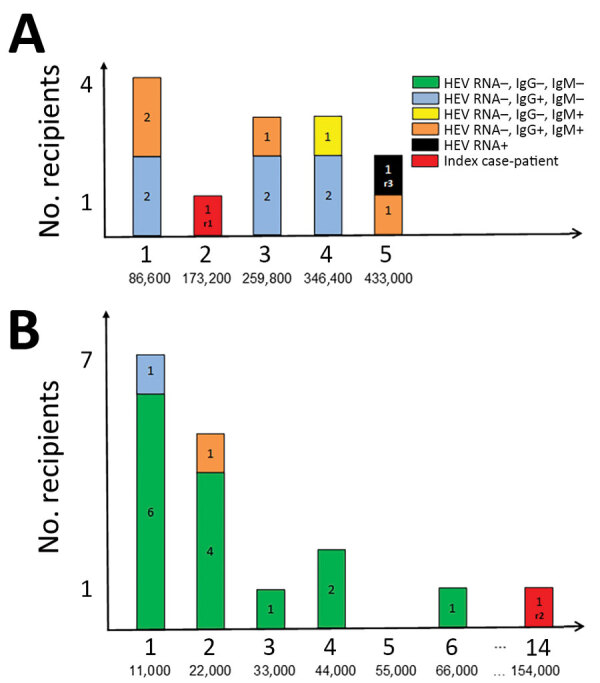
Hepatitis E has emerged as a major transfusion-transmitted infectious risk. Two recipients of plasma from 2 lots (A and B) of pooled solvent/detergent-treated plasma were found to be infected by hepatitis E virus (HEV) that was determined to have been transmitted by the solvent/detergent-treated plasma. HEV RNA viral loads were 433 IU in lot A and 55 IU in lot B. Retrospective studies found that 100% (13/13) of evaluable lot A recipients versus 18% (3/17) of evaluable lot B recipients had been infected by HEV (p<0.001), albeit not necessarily at time of transfusion. Among evaluable recipients, 86% with a transfused HEV RNA load >50,000 IU were infected, most likely by the HEV-containing solvent/detergent-treated plasma, versus only 7% with a transfused HEV RNA load <50,000 IU (p<0.001). Overall, solvent/detergent-treated plasma might harbor HEV. Such an occurrence might result in a dose-dependent risk for transfusion-transmitted hepatitis E.
Keywords: France; HEV; blood donors; hepatitis E virus; infectious dose; plasma; retrospective study; solvent/detergent–treated plasma; transmission; viruses; zoonoses.
Figures
References
MeSH terms
Substances
LinkOut - more resources
Full Text Sources
Medical