


A directed acyclic graph for interactions
- PMID: 33221880
- PMCID: PMC8128466
- DOI: 10.1093/ije/dyaa211
A directed acyclic graph for interactions
Abstract
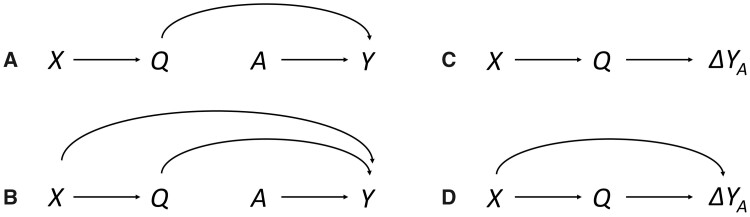
Background: Directed acyclic graphs (DAGs) are of great help when researchers try to understand the nature of causal relationships and the consequences of conditioning on different variables. One fundamental feature of causal relations that has not been incorporated into the standard DAG framework is interaction, i.e. when the effect of one variable (on a chosen scale) depends on the value that another variable is set to. In this paper, we propose a new type of DAG-the interaction DAG (IDAG), which can be used to understand this phenomenon.
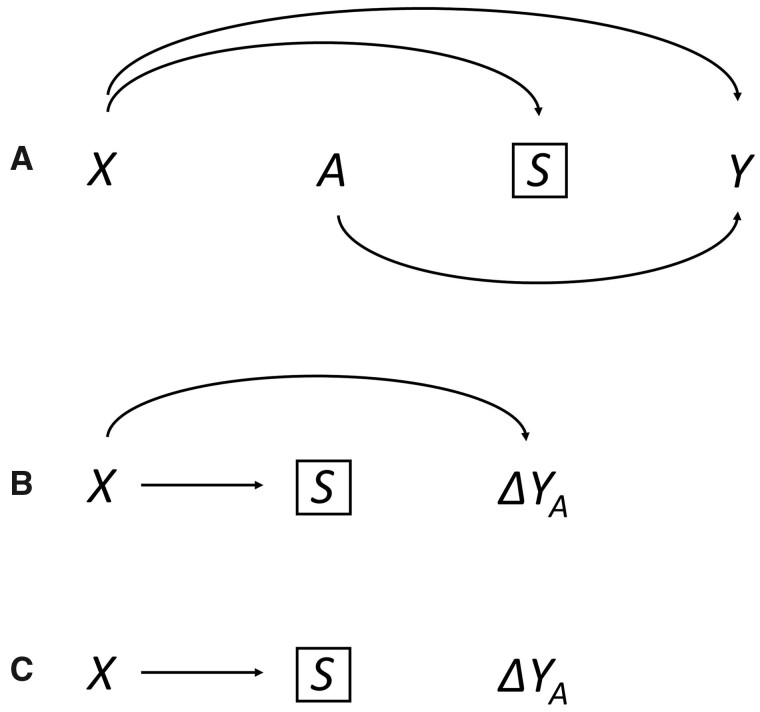
Methods: The IDAG works like any DAG but instead of including a node for the outcome, it includes a node for a causal effect. We introduce concepts such as confounded interaction and total, direct and indirect interaction, showing that these can be depicted in ways analogous to how similar concepts are depicted in standard DAGs. This also allows for conclusions on which treatment interactions to account for empirically. Moreover, since generalizability can be compromised in the presence of underlying interactions, the framework can be used to illustrate threats to generalizability and to identify variables to account for in order to make results valid for the target population.
Conclusions: The IDAG allows for a both intuitive and stringent way of illustrating interactions. It helps to distinguish between causal and non-causal mechanisms behind effect variation. Conclusions about how to empirically estimate interactions can be drawn-as well as conclusions about how to achieve generalizability in contexts where interest lies in estimating an overall effect.
Keywords: Causal inference; external validity; generalizability; interaction; internal validity; mediation.
© The Author(s) 2020. Published by Oxford University Press on behalf of the International Epidemiological Association.
Figures


References
-
- Pearl J. Causal diagrams for empirical research. Biometrika 1995;82:669–710.
-
- Greenland S, Pearl J, Robins JM.. Causal diagrams for epidemiologic research. Epidemiology 1999;10:37–48. - PubMed
-
- Robins JM. Data, design, and background knowledge in etiologic inference. Epidemiology 2001;12:313–20. - PubMed
-
- VanderWeele TJ, Knol MJ.. A tutorial on interaction. Epidemiol Methods 2014;3:33–72.
Publication types
MeSH terms
LinkOut - more resources
Full Text Sources
Other Literature Sources
