Review
. 2020 Nov 22;19(1):196.
doi: 10.1186/s12933-020-01163-9.

Renoprotection with SGLT2 inhibitors in type 2 diabetes over a spectrum of cardiovascular and renal risk

Affiliations
Review

Renoprotection with SGLT2 inhibitors in type 2 diabetes over a spectrum of cardiovascular and renal risk

Francesco Giorgino et al. Cardiovasc Diabetol. .

Abstract

Approximately half of all patients with type 2 diabetes (T2D) develop a certain degree of renal impairment. In many of them, chronic kidney disease (CKD) progresses over time, eventually leading to end-stage kidney disease (ESKD) requiring dialysis and conveying a substantially increased risk of cardiovascular morbidity and mortality. Even with widespread use of renin-angiotensin system blockers and tight glycemic control, a substantial residual risk of nephropathy progression remains. Recent cardiovascular outcomes trials investigating sodium-glucose cotransporter 2 (SGLT2) inhibitors have suggested that these therapies have renoprotective effects distinct from their glucose-lowering action, including the potential to reduce the rates of ESKD and acute kidney injury. Although patients in most cardiovascular outcomes trials had higher prevalence of existing cardiovascular disease compared with those normally seen in clinical practice, the proportion of patients with renal impairment was similar to that observed in a real-world context. Patient cardiovascular risk profiles did not relevantly impact the renoprotective benefits observed in these studies. Benefits were observed in patients across a spectrum of renal risk, but were evident also in those without renal damage, suggesting a role for SGLT2 inhibition in the prevention of CKD in people with T2D. In addition, recent studies such as CREDENCE and DAPA-CKD offer a greater insight into the renoprotective effects of SGLT2 inhibitors in patients with moderate-to-severe CKD. This review outlines the evidence that SGLT2 inhibitors may prevent the development of CKD and prevent and delay the worsening of CKD in people with T2D at different levels of renal risk.

Keywords: Diabetes mellitus; Renal dysfunction; Renal protection; cardiovascular risk.


Conflict of interest statement

FG has received research support from Eli Lilly, Lifescan, and Takeda, and consultant fees from AstraZeneca, Boehringer-Ingelheim, Eli Lilly, Merck Sharp and Dohme, NovoNordisk, Roche Diabetes Care, and Sanofi. JV was a contractor acting as Chief Medical Advisor for cardiovascular, renal, and metabolic diseases at AstraZeneca at the time of manuscript development. PF is an employee of AstraZeneca. AS has received research grants from AstraZeneca and advisory board and speaker’s fees from AstraZeneca, Boehringer Ingelheim, Lilly, Mundipharma, NovoNordisk, and Sanofi.

Figures
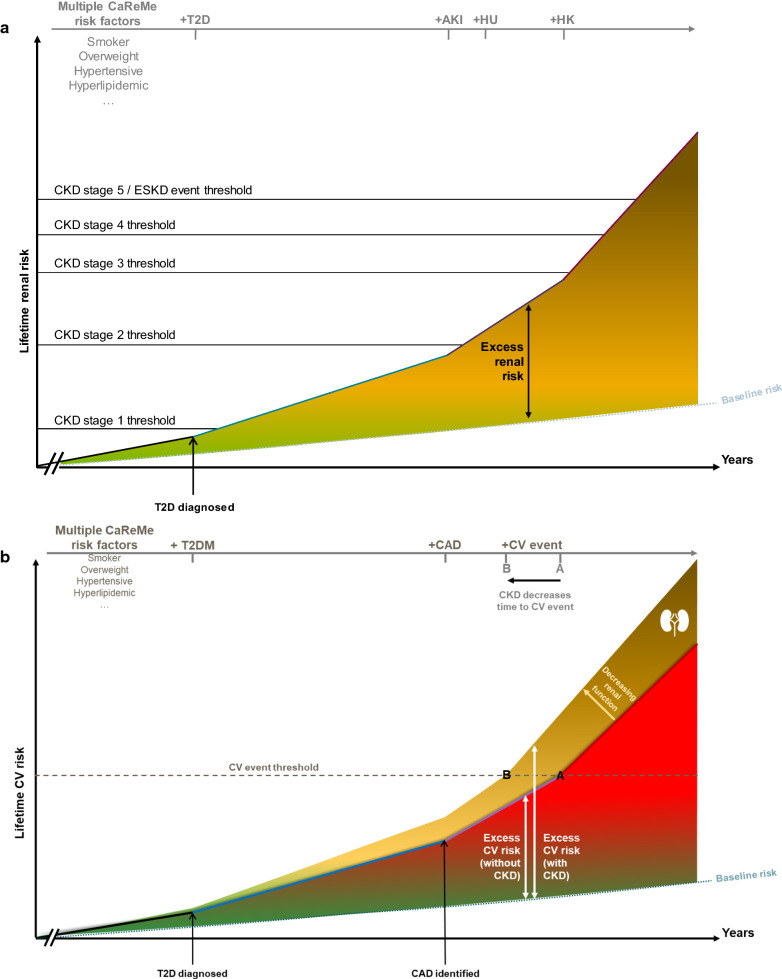
Fig. 1
Fig. 1
The renal risk spectrum in T2D. a In addition to hyperglycemia, a range of other conditions can increase the risk of adverse renal events in T2D, such as AKI incidents, HU, and prolonged HK. b CKD amplifies the risk of adverse CV outcomes at any stage. In addition to developing along its own continuum, CKD acts as an amplifier of CV risk, as shown in the rear projection, which highlights that the presence of CKD of any stage increases a person’s CV risk, and that the more advanced the CKD, the greater the increase in CV risk. In effect, this decreases the time taken to cross the CV event threshold (denoted by the leftward shift from A, B). AKI acute kidney injury, CAD coronary artery disease, CaReMe cardio-renal-metabolic, CKD chronic kidney disease, CV cardiovascular, ESKD end-stage kidney disease, HK hyperkalemia, HU hyperuricemia, T2D type 2 diabetes
Fig. 2
Fig. 2
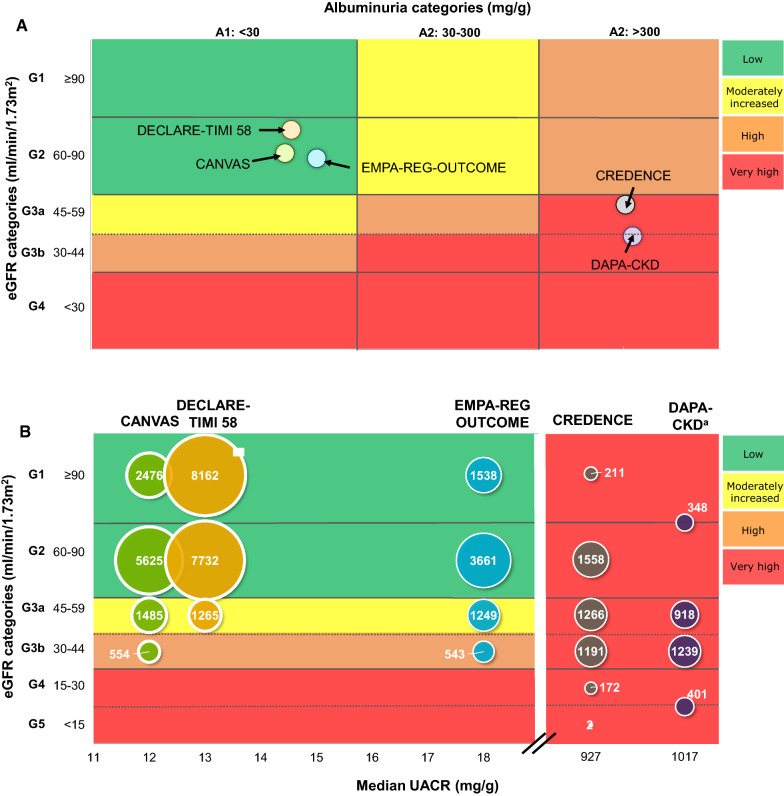
Renal risk in CV and renal outcomes trials with SGLT2 inhibitors. a Overall populations; b EMPA-REG OUTCOME, CANVAS program, DECLARE-TIMI 58, CREDENCE and DAPA-CKD baseline populations by eGFR group and median UACR. In DECLARE-TIMI 58, people with CrCl of ≤ 60 mL/min were excluded, which led to very few participants with eGFR at baseline < 60 mL/min/1.73 m2. aDAPA-CKD T2D subpopulation only. VERTIS CV excluded from this figure because a median UACR was not reported [32]. CrCl creatinine clearance, CV cardiovascular, eGFR estimated glomerular filtration rate, SGLT2 sodium–glucose cotransporter 2, UACR urine albumin to creatinine ratio
Fig. 3
Fig. 3
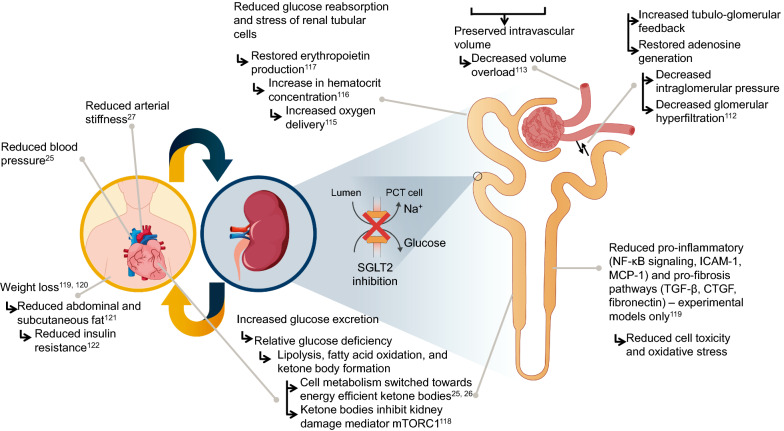
Proposed renal-protective pathways with SGLT2 inhibitors. CTCF connective tissue growth factor; ICAM-1, intercellular adhesion molecule 1; NF-κB nuclear factor kappa-light-chain-enhancer of activated B cells; MCP-1 monocyte chemoattractant protein 1; SGLT2 sodium–glucose cotransporter 2; TGF-β transforming growth factor beta

References

    1. Thomas MC, Cooper ME, Zimmet P. Changing epidemiology of type 2 diabetes mellitus and associated chronic kidney disease. Nat Rev Nephrol. 2016;12(2):73–81. doi: 10.1038/nrneph.2015.173. - DOI - PubMed
    1. Arnold SV, Kosiborod M, Wang J, Fenici P, Gannedahl G, LoCasale RJ. Burden of cardio-renal-metabolic conditions in adults with type 2 diabetes within the Diabetes Collaborative Registry. Diabetes Obes Metab. 2018;20(8):2000–2003. doi: 10.1111/dom.13303. - DOI - PubMed
    1. Sattar N. Revisiting the links between glycaemia, diabetes and cardiovascular disease. Diabetologia. 2013;56(4):686–695. doi: 10.1007/s00125-012-2817-5. - DOI - PubMed
    1. Giorgino F, Vora J, Fenici P, Solini A. Cardiovascular protection with sodium-glucose co-transporter-2 inhibitors in type 2 diabetes: does it apply to all patients? Diabetes Obes Metab. 2020;12:68. - PMC - PubMed
    1. Adler AI, Stevens RJ, Manley SE, Bilous RW, Cull CA, Holman RR, et al. Development and progression of nephropathy in type 2 diabetes: the United Kingdom Prospective Diabetes Study (UKPDS 64) Kidney Int. 2003;63(1):225–232. doi: 10.1046/j.1523-1755.2003.00712.x. - DOI - PubMed

MeSH terms

Substances