


Political polarization in US residents' COVID-19 risk perceptions, policy preferences, and protective behaviors
- PMID: 33223612
- PMCID: PMC7672261
- DOI: 10.1007/s11166-020-09336-3
Political polarization in US residents' COVID-19 risk perceptions, policy preferences, and protective behaviors
Abstract
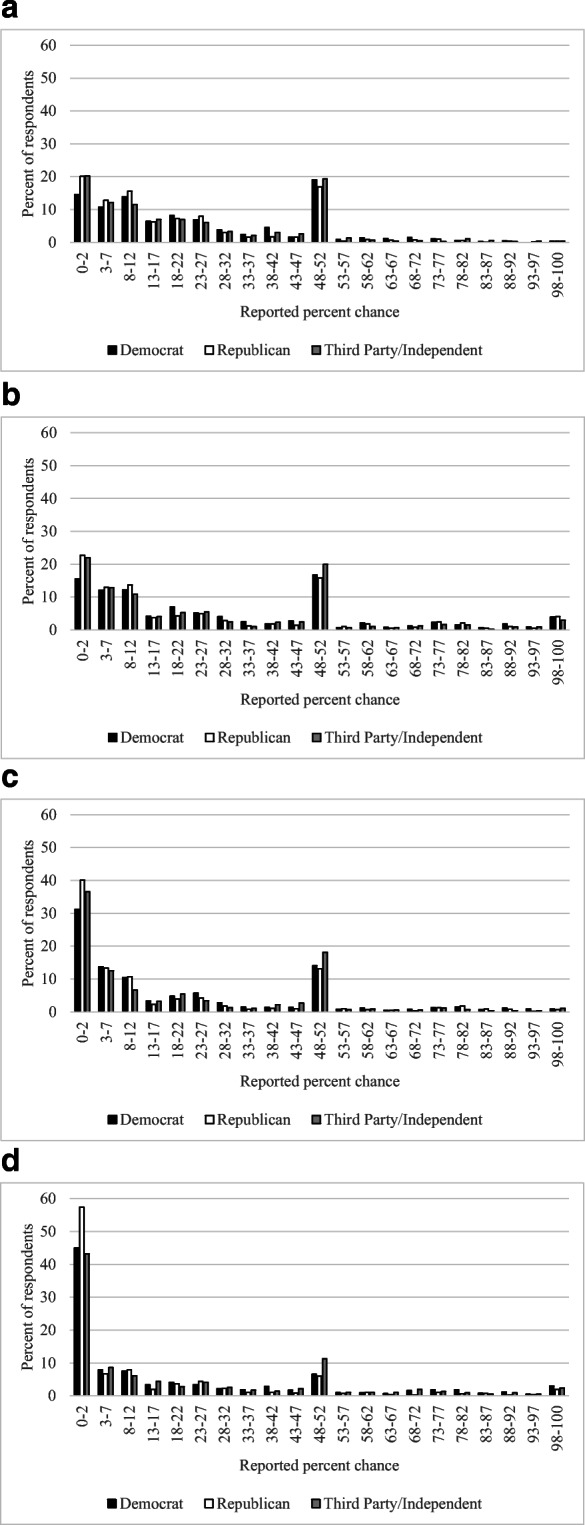
When the novel coronavirus entered the US, most US states implemented lockdown measures. In April-May 2020, state governments started political discussions about whether it would be worth the risk to reduce protective measures. In a highly politicized environment, risk perceptions and preferences for risk mitigation may vary by political inclinations. In April-May 2020, we surveyed a nationally representative sample of 5517 members of the University of Southern California's Understanding America Study. Of those, 37% identified as Democrats, 32% as Republican, and 31% as Third Party/Independent. Overall, Democrats perceived more risk associated with COVID-19 than Republicans, including for getting infected, being hospitalized and dying if infected, as well as running out of money as a result of the pandemic. Democrats were also more likely than Republicans to express concerns that states would lift economic restrictions too quickly, and to report mask use and social distancing. Generally, participants who identified as Third Party/Independent fell in between. Democrats were more likely to report watching MSNBC or CNN (vs. not), while Republicans were more likely to report watching Fox News (vs. not), and Third Party/Independents tended to watch neither. However, political inclinations predicted reported policy preferences, mask use, and social distancing, in analyses that accounted for differences in use of media sources, risk perceptions, and demographic background. In these analyses, participants' reported media use added to the partisan divide in preferences for the timing of lifting economic restrictions and reported protective behaviors. Implications for risk communication are discussed.
Supplementary information: The online version of this article (10.1007/s11166-020-09336-3) contains supplementary material, which is available to authorized users.
Keywords: COVID-19 risk perceptions; Health policy; Pandemic preparedness; Political beliefs and polarization; Probability-based internet panel.
© Springer Science+Business Media, LLC, part of Springer Nature 2020.
Conflict of interest statement
Conflict of interest/competing interestsNone
Figures
References
-
- Alattar L, Messel M, Rogofsky D. An introduction to the Understanding America Study Internet Panel. Social Security Bulletin. 2018;78:13–28.
-
- American Bankruptcy Institute. (2020). July 2020 Bankruptcy Statistics. https://www.abi.org/newsroom/bankruptcy-statistics.
-
- Barabas J, Jerit J. Estimating the causal effects of media coverage on policy-specific knowledge. American Journal of Political Science. 2009;53(1):73–89. doi: 10.1111/j.1540-5907.2008.00358.x. - DOI
LinkOut - more resources
Full Text Sources
Miscellaneous