


Contribution to the knowledge of Neanurinae of north-western Iran with description of seven new species (Collembola, Neanuridae)
- PMID: 33223907
- PMCID: PMC7677293
- DOI: 10.3897/zookeys.992.56921
Contribution to the knowledge of Neanurinae of north-western Iran with description of seven new species (Collembola, Neanuridae)
Abstract
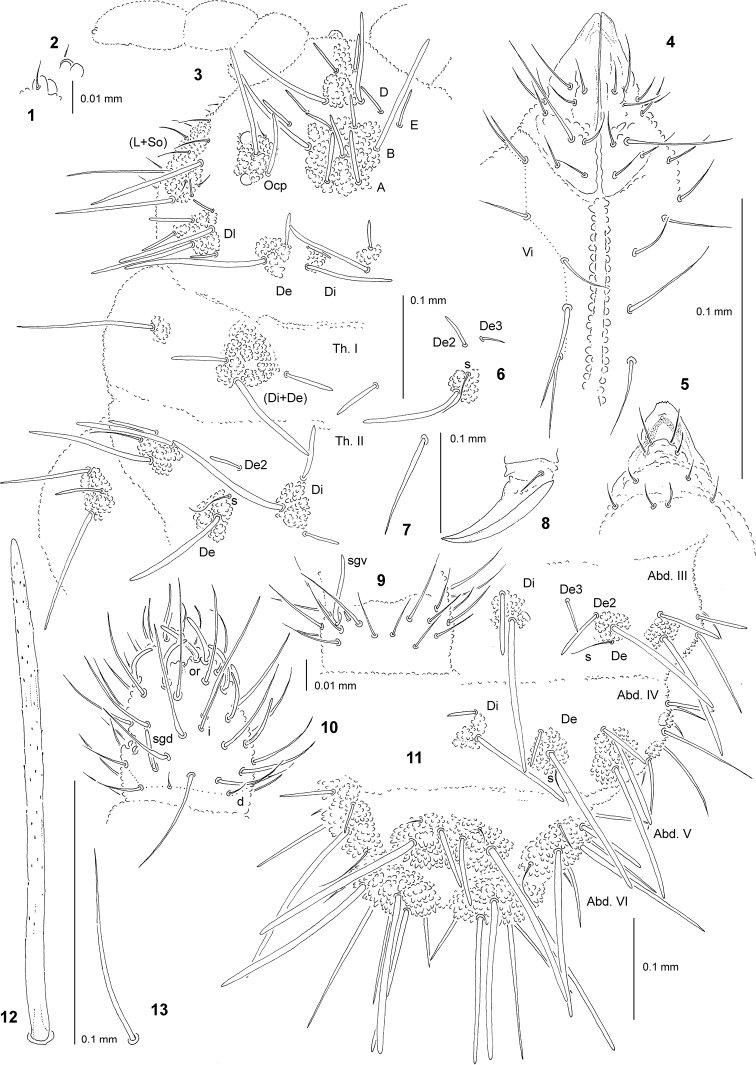
Seven new species of the subfamily Neanurinae from north-western Iran are described and illustrated in detail. Endonura agnieskae sp. nov. differs from the most similar congener, E. reticulata (Axelson, 1905), in chaetotaxic details and the arrangement of tubercles on the dorsal side of the body. Endonura annae sp. nov. can be easily recognised by its wide labrum, the absence of chaetae C on the head and the presence of a toothed claw. Endonura schwendingeri sp. nov. is especially distinctive due to the absence of chaetae A and Ocp on the head and the presence of the male ventral organ. Deutonura breviseta sp. nov. is related and most similar to D. persica Smolis, Shayanmehr & Yoosefi-Lafooraki, 2018, described recently and known from Mazandran Province in Iran. The new species can be easily distinguished by the following set of features: dark pigmented body, presence of chaetae C and Dl3 on the head, absence of microchaetae on the furca rudimentary, presence of thickened macrochaetae on dorsal side of body and absence of cryptopygy. The main characteristics of Deutonura sengleti sp. nov. include a white body with dark pigmented eyes, the fusion of tubercles Di and De on the first thoracic segment and the presence of the male ventral organ. Deutonura iranica sp. nov. is superficially similar to D. gibbosa Porco, Bedos & Deharveng, 2010, a species known from the Alps and Jura in Europe, but it differs in the body colour and the number of labial chaetae and chaetae (L+So) on the head. Paravietnura rostrata sp. nov., the first member of this enigmatic and intriguing genus known from Iran, is characterised by an unusually elongate ogival labrum and extreme reduction of dorsal chaetotaxy. Furthermore, new records of several other species of the subfamily: Cryptonura maxima Smolis, Falahati & Skarżyński, 2012; C. persica Smolis, Falahati & Skarżyński, 2012; Deutonura persica; Endonura longirostris Smolis, Shayanmehr, Kuznetsova & Yoosefi-Lafooraki, 2017; E. paracentaurea Smolis, Shayanmehr, Kuznetsova & Yoosefi-Lafooraki, 2017; Neanura deharvengi Smolis, Shayanmehr & Yoosefi-Lafooraki, 2018; N. muscorum (Templeton, 1835) and Protanura papillata Cassagnau & Delamare Deboutteville, 1955 are given. The present study is based on the rich material collected by Antoine Senglet and loaned by Peter J. Schwendinger.
Keywords: Asia; new records; springtails; taxonomy; western Palearctic.
Adrian Smolis, Dariusz Skarżyński.
Figures


References
-
- Axelson WM. (1905) Einige neue Collembolen aus Finland. Zoologisher Anzeiger 28: 788–794.
-
- Bellinger PF, Christiansen KA, Janssens F. (2020) Checklist of the Collembola of the world. http://www.collembola.org [Accessed 13 July 2020]
-
- Börner C. (1906) Das System der Collembolen nebst Beschreibung neuer Collembolen des Hamburger Naturhistorischen Museums. Mitteilungen aus den Naturhistorischen Museum in Hamburg, XXIII. Jahrgang, 2. Beiheft zum Jahrbuch der Hamburgischen Wissenschaftlichen Austalten, XXIII, 1905, Hamburg 1906, 147–188.
-
- Börner C. (1932) Apterygota. In: Brohmer P. (Ed.) Fauna von Deutschland, 4th ed.Auflage 4, Leipzig, 136–143.
-
- Bussler H. (2017) Cucujus muelleri sp. nov. aus den kaspischen Gebirgswäldern des Iran (Coleoptera: Cucujidae). Nachrichtenblatt der Bayerischen Entomologen 66(3/4): 54–58.
LinkOut - more resources
Full Text Sources