


Accurate Noninvasive Assessment of Myocardial Iron Load in Advanced Heart Failure Patients
- PMID: 33224316
- PMCID: PMC7669354
- DOI: 10.1155/2020/8885189
Accurate Noninvasive Assessment of Myocardial Iron Load in Advanced Heart Failure Patients
Abstract
Background: Heart failure patients presenting with iron deficiency can benefit from systemic iron supplementation; however, there is the potential for iron overload to occur, which can seriously damage the heart. Therefore, myocardial iron (M-Iron) content should be precisely balanced, especially in already failing hearts. Unfortunately, the assessment of M-Iron via repeated heart biopsies or magnetic resonance imaging is unrealistic, and alternative serum markers must be found. This study is aimed at assessing M-Iron in patients with advanced heart failure (HF) and its association with a range of serum markers of iron metabolism.
Methods: Left ventricle (LV) myocardial biopsies and serum samples were collected from 33 consecutive HF patients (25 males) with LV dysfunction (LV ejection fraction 22 (11) %; NT-proBNP 5464 (3308) pg/ml) during heart transplantation. Myocardial ferritin (M-FR) and soluble transferrin receptor (M-sTfR1) were assessed by ELISA, and M-Iron was determined by Instrumental Neutron Activation Analysis in LV biopsies. Nonfailing hearts (n = 11) were used as control/reference tissue. Concentrations of serum iron-related proteins (FR and sTfR1) were assessed.
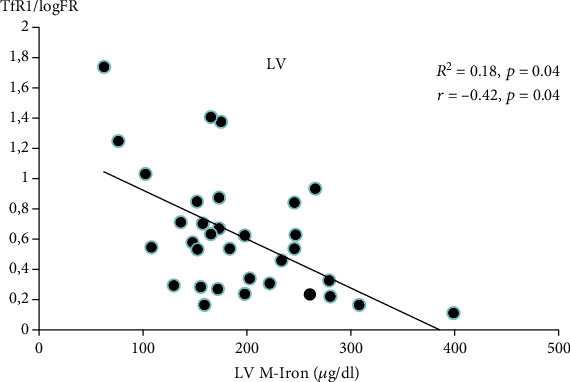
Results: LV M-Iron load was reduced in all HF patients and negatively associated with M-FR (r = -0.37, p = 0.05). Of the serum markers, sTfR1/logFR correlated with (r = -0.42; p = 0.04) and predicted (in a step-wise analysis, R 2 = 0.18; p = 0.04) LV M-Iron. LV M-Iron load (μg/g) can be calculated using the following formula: 210.24-22.869 × sTfR1/logFR.
Conclusions: The sTfR1/logFR ratio can be used to predict LV M-Iron levels. Therefore, serum FR and sTfR1 levels could be used to indirectly assess LV M-Iron, thereby increasing the safety of iron repletion therapy in HF patients.
Copyright © 2020 Przemysław Leszek et al.
Conflict of interest statement
There are no potential conflicts of interest, including related consultancies, shareholdings, and funding grants.
Figures
References
-
- Moliner P., Jankowska E. A., van Veldhuisen D. J., et al. Clinical correlates and prognostic impact of impaired iron storage versus impaired iron transport in an international cohort of 1821 patients with chronic heart failure. International Journal of Cardiology. 2017;243:360–366. doi: 10.1016/j.ijcard.2017.04.110. - DOI - PubMed
-
- Ponikowski P., van Veldhuisen D. J., Comin-Colet J., et al. Beneficial effects of long-term intravenous iron therapy with ferric carboxymaltose in patients with symptomatic heart failure and iron deficiency†. European Heart Journal. 2015;36(11):657–668. doi: 10.1093/eurheartj/ehu385. - DOI - PMC - PubMed
MeSH terms
Substances
LinkOut - more resources
Full Text Sources
Medical
Research Materials
Miscellaneous
