


A New Perspective for Isolated Coronary Artery Ectasia: Cystatin C
- PMID: 33224650
- PMCID: PMC7676437
- DOI: 10.7759/cureus.11053
A New Perspective for Isolated Coronary Artery Ectasia: Cystatin C
Abstract
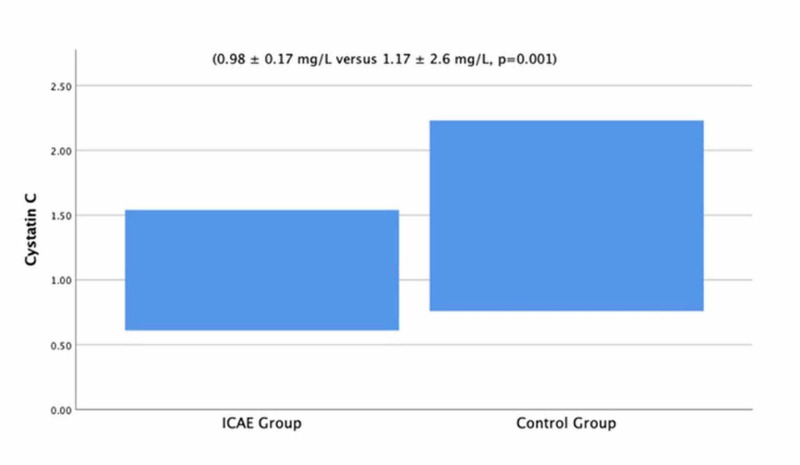
Introduction The pathophysiology of isolated coronary artery ectasia (iCAE) has not been clearly identified, although multiple abnormalities, including arteritis, endothelial dysfunction, and vascular destruction, have been reported. In this study, we aimed to analyze serum cystatin C concentrations in patients with iCAE and controls. Methods Forty-seven patients with iCAE (mean age: 55.9 ± 11.5) and 32 individuals with normal coronary angiography (mean age: 57.8.1 ± 9.6) were included in the study. Plasma cystatin C levels were measured by using the principle of particle-enhanced turbidimetric immunoassay (PETIA). Results Serum cystatin C concentrations were significantly lower in patients with iCAE compared with the control group (0.98 ± 0.17 mg/L versus 1.17 ± 2.6 mg/L, p-value = 0.001). A significantly positive relationship was found between serum cystatin C levels and creatinine and high-sensitivity C-reactive protein (hs-CRP) levels in both groups (r-value = 0.288, p-value = 0.005, r-value = 0.143, p-value = 0.007, respectively). In multivariate logistic regression analysis, serum cystatin C level found to be a significant predictor for the presence of iCAE (OR: 0.837, CI: 95% (0.341 - 1.637), p-value = 0.013). Receiver operating characteristic (ROC) analysis determined that a cystatin C value < 1.02 mg/L had a sensitivity of 56% and a specificity of 78% for the prediction of ectasia. Conclusion We conclude that cystatin C independently can be a useful predictor for the presence of iCAE.
Keywords: aneurysm; coronary ectasia; dilating vascular disease; endothelial dysfunction; positive arterial remodeling.
Copyright © 2020, Karakus et al.
Conflict of interest statement
The authors have declared that no competing interests exist.
Figures


References
-
- Aneurysmal coronary artery disease. Swaye PS, Fisher LD, Litwin P, et al. Circulation. 1983;67:134–138. - PubMed
-
- Frequency of coronary artery ectasia among patients undergoing cardiac catheterization. Akçay S, Türker Y, Ozaydin M, Yücel H, Altinbaş A. https://jag.journalagent.com/anatoljcardiol/pdfs/AnatolJCardiol_10_2_191.... Anadolu Kardiyol Derg . 2010;10:191. - PubMed
-
- Coronary artery ectasia: remains a clinical dilemma. Boles U, Eriksson P, Zhao Y, Henein MY. Coron Artery Dis. 2010;21:318–320. - PubMed
-
- Molecular regulation of human cathepsin B: implication in pathologies. Yan S, Sloane BF. Biol Chem. 2003;384:845–854. - PubMed
-
- Lysosomal cysteine proteases: more than scavengers. Turk B, Turk D, Turk V. Biochim Biophys Acta. 2000;1477:98–111. - PubMed
LinkOut - more resources
Full Text Sources
Research Materials
Miscellaneous