Review
. 2020 Nov 3:7:569413.
doi: 10.3389/fmed.2020.569413. eCollection 2020.

Portopulmonary Hypertension: From Bench to Bedside

Affiliations
Review

Portopulmonary Hypertension: From Bench to Bedside

Christopher Thomas et al. Front Med (Lausanne). .

Abstract

Portopulmonary hypertension (PoPH) is defined as pulmonary arterial hypertension (PAH) associated with portal hypertension and is a subset of Group 1 pulmonary hypertension (PH). PoPH is a cause of significant morbidity and mortality in patients with portal hypertension with or without liver disease. Significant strides in elucidating the pathogenesis, effective screening algorithms, accurate diagnoses, and treatment options have been made in past 20 years. Survival of PoPH has remained poor compared to IPAH and other forms of PAH. Recently, the first randomized controlled trial was done in this patient population and showed promising results with PAH specific therapy. Despite positive effects on hemodynamics and functional outcomes, it is unclear whether PAH specific therapy has a beneficial effect on long term survival or transplant outcomes. In this review, we will discuss the epidemiology, pathophysiology, clinical and hemodynamic characteristics of PoPH. Additionally, this review will highlight the lacunae in our current management strategy, challenges faced and will provide direction to potentially useful futuristic management strategies.

Keywords: MELD exception; liver transplant; portal hypertension; portopulmonary hypertension; pulmonary arterial hypertension.


Figures

Figure 1
Figure 1
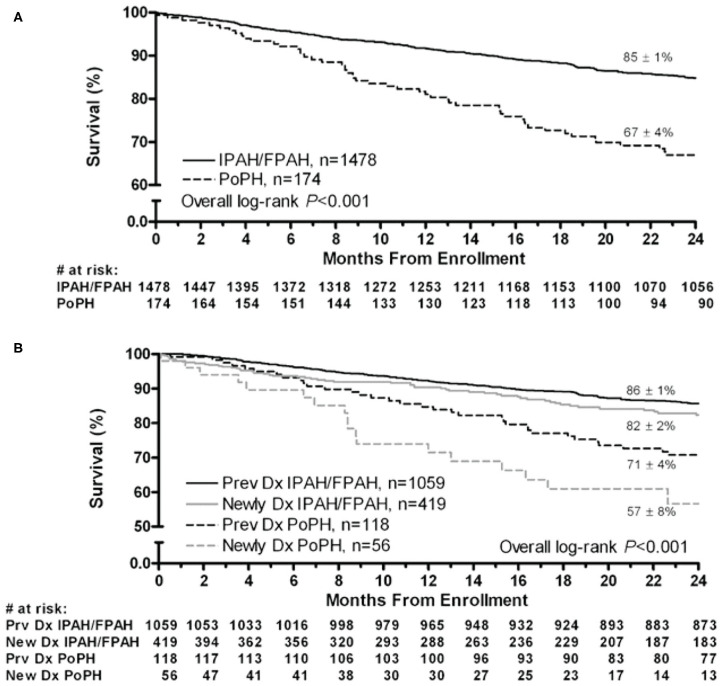
Two-year survival from enrollment. (A) Patients with PoPH and IPAH/FPAH. (B) Stratified by duration of disease from enrollment. Dx, diagnosis; FPAH, familial pulmonary arterial hypertension; IPAH, idiopathic pulmonary arterial hypertension; PoPH, portopulmonary hypertension. Reproduced with permission of Elsevier: Chest 141 (4) 906-915; doi: 10.1378/chest.11-0160 Epub 21 July 2011.
Figure 2
Figure 2
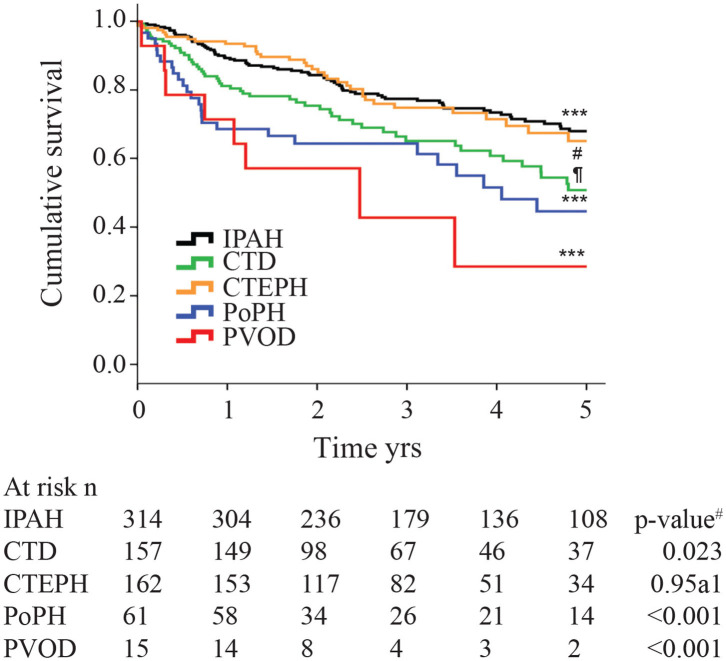
Kaplan-Meier estimates of 5-years survival from time of diagnosis in different pulmonary hypertension subtypes. IPAH, Idiopathic Pulmonary arterial hypertension; CTD, connective tissue disease; CTEPH, chronic thromboembolic pulmonary hypertension; PoPH, portopulmonary hypertension; PVOD, pulmonary veno-occlusive disease. The p-value for the overall comparison is <0.001. # compared with IPAH. Reproduced with permission of the © ERS 2020: European Respiratory Journal 40 (3) 596-603; doi: 10.1183/09031936.00101211 Published 31 August 2012.
Figure 3
Figure 3
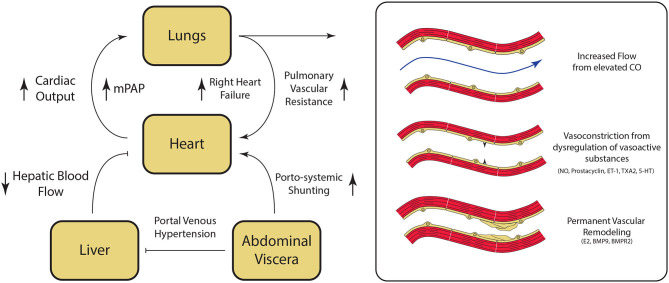
Pathogenesis of Portopulmonary Hypertension (PoPH). Hepatic fibrosis results in portal venous hypertension, increased resistance to hepatic blood flow, and splanchnic vasodilation. Splanchnic vasodilation results in increase in overal circulating volume. and the diversion of blood flow from the liver to the heart via porto-systemic shunting resulting in an overall hyperdynamic state. Dysregulation of key regulator of pulmonary vascular tone associated with cirrhosis results in pulmonary vasoconstriction. At the same time, damage to the pulmonary endothelium and the underlying smooth muscle results in permanent vascular remodeling, which ultimately leads to the development of pulmonary hypertension. CO, cardiac output; NO, nitric oxide; ET-1, endothelin-1; TXA2, thromboxane A2; 5-HT, serotonin; E2, estrogen; BMP9, Bone Morphogenic Protein 9; BMPR2, Bone Morphogenic Receptor 2. Please refer to the text for additional details.
Figure 4
Figure 4
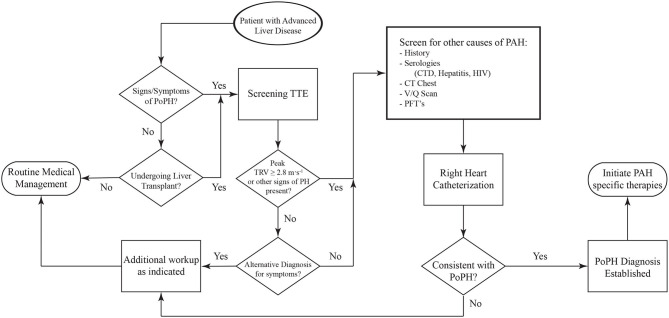
Algorithm for the diagnosis of PoPH. PoPH, Portopulmonary Hypertension; TTE, Transthoracic Echocardiogram; TRV, Tricuspid Regurgitant Velocity; CTD, Connective Tissue Diseases; PFT's, Pulmonary Function Tests.
Figure 5
Figure 5
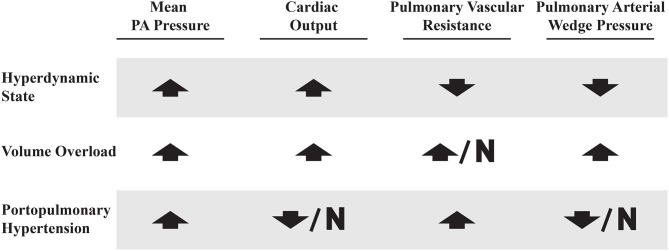
Right heart catheterization profiles in patients with elevated mean PA pressures. Up arrow, increased; Down arrow, decreased; N, normal.

References

    1. Simonneau G, Montani D, Celermajer DS, Denton CP, Gatzoulis MA, Krowka M, et al. . Haemodynamic definitions and updated clinical classification of pulmonary hypertension. Eur Respir J. (2019) 53:1801913. 10.1183/13993003.01913-2018 - DOI - PMC - PubMed
    1. Jonigk D, Golpon H, Bockmeyer CL, Maegel L, Hoeper MM, Gottlieb J, et al. . Plexiform lesions in pulmonary arterial hypertension composition, architecture, and microenvironment. Am J Pathol. (2011) 179:167–79. 10.1016/j.ajpath.2011.03.040 - DOI - PMC - PubMed
    1. Edwards BS, Weir EK, Edwards WD, Ludwig J, Dykoski RK, Edwards JE. Coexistent pulmonary and portal hypertension: morphologic and clinical features. J Am Coll Cardiol. (1987) 10:1233–8. 10.1016/S0735-1097(87)80123-7 - DOI - PubMed
    1. Humbert M, Guignabert C, Bonnet S, Dorfmuller P, Klinger JR, Nicolls MR, et al. . Pathology and pathobiology of pulmonary hypertension: state of the art and research perspectives. Eur Respir J. (2019) 53:1801887. 10.1183/13993003.01887-2018 - DOI - PMC - PubMed
    1. Krowka MJ. Portopulmonary hypertension. Semin Respir Crit Care Med. (2012) 33:17–25. 10.1055/s-0032-1301731 - DOI - PubMed