


Lifetime risk of diabetes in metropolitan cities in India
- PMID: 33225415
- PMCID: PMC7864818
- DOI: 10.1007/s00125-020-05330-1
Lifetime risk of diabetes in metropolitan cities in India
Abstract
Aims/hypothesis: We aimed to estimate the lifetime risk of diabetes and diabetes-free life expectancy in metropolitan cities in India among the population aged 20 years or more, and their variation by sex, age and BMI.
Methods: A Markov simulation model was adopted to estimate age-, sex- and BMI-specific lifetime risk of developing diabetes and diabetes-free life expectancy. The main data inputs used were as follows: age-, sex- and BMI-specific incidence rates of diabetes in urban India taken from the Centre for Cardiometabolic Risk Reduction in South Asia (2010-2018); age-, sex- and urban-specific rates of mortality from period lifetables reported by the Government of India (2014); and prevalence of diabetes from the Indian Council for Medical Research INdia DIABetes study (2008-2015).
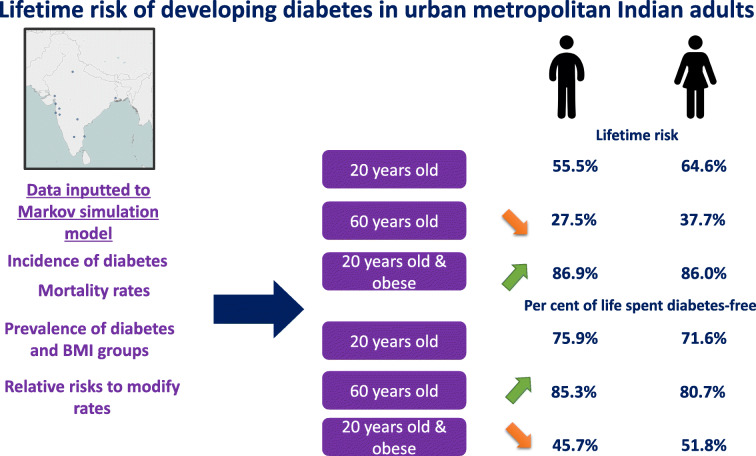
Results: Lifetime risk (95% CI) of diabetes in 20-year-old men and women was 55.5 (51.6, 59.7)% and 64.6 (60.0, 69.5)%, respectively. Women generally had a higher lifetime risk across the lifespan. Remaining lifetime risk (95% CI) declined with age to 37.7 (30.1, 46.7)% at age 60 years among women and 27.5 (23.1, 32.4)% in men. Lifetime risk (95% CI) was highest among obese Indians: 86.0 (76.6, 91.5)% among 20-year-old women and 86.9 (75.4, 93.8)% among men. We identified considerably higher diabetes-free life expectancy at lower levels of BMI.
Conclusions/interpretation: Lifetime risk of diabetes in metropolitan cities in India is alarming across the spectrum of weight and rises dramatically with higher BMI. Prevention of diabetes among metropolitan Indians of all ages is an urgent national priority, particularly given the rapid increase in urban obesogenic environments across the country. Graphical abstract.
Keywords: Body mass index; Diabetes; Diabetes-free life expectancy; India; Lifetime risk; Metropolitan cities; Urban.
References
-
- International Diabetes Federation, editor. IDF Diabetes Atlas. 9. Brussels, Belgium: International Diabetes Federation; 2019. - PubMed
-
- Ligthart S, van Herpt TTW, Leening MJG, Kavousi M, Hofman A, Stricker BHC, et al. Lifetime risk of developing impaired glucose metabolism and eventual progression from prediabetes to type 2 diabetes: a prospective cohort study. Lancet Diabetes Endocrinol. 2016;4:44–51. doi: 10.1016/S2213-8587(15)00362-9. - DOI - PubMed
Publication types
MeSH terms
Grants and funding
LinkOut - more resources
Full Text Sources
Medical
