


Clinical trials in critical care: can a Bayesian approach enhance clinical and scientific decision making?
- PMID: 33227237
- PMCID: PMC8439199
- DOI: 10.1016/S2213-2600(20)30471-9
Clinical trials in critical care: can a Bayesian approach enhance clinical and scientific decision making?
Abstract
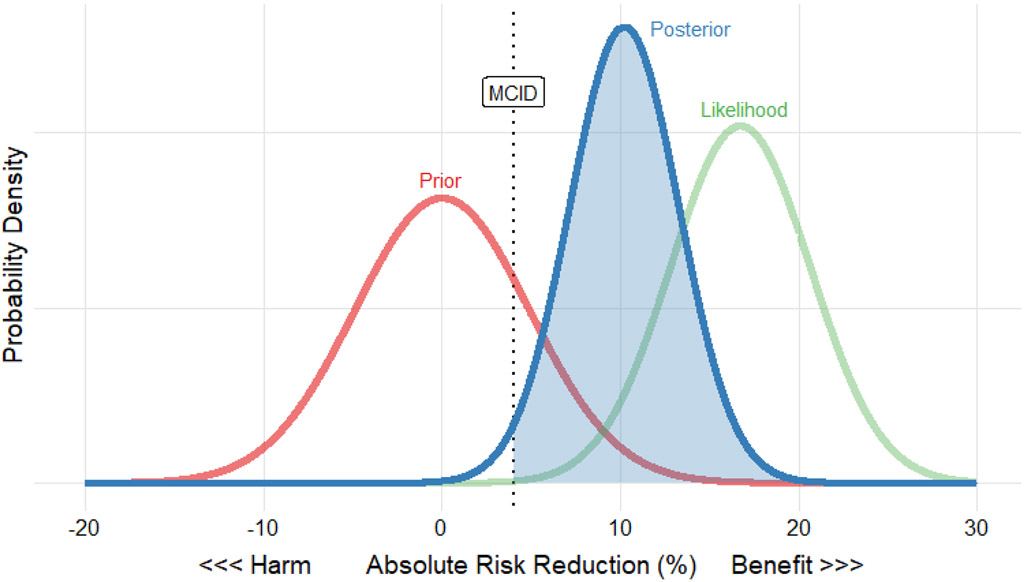
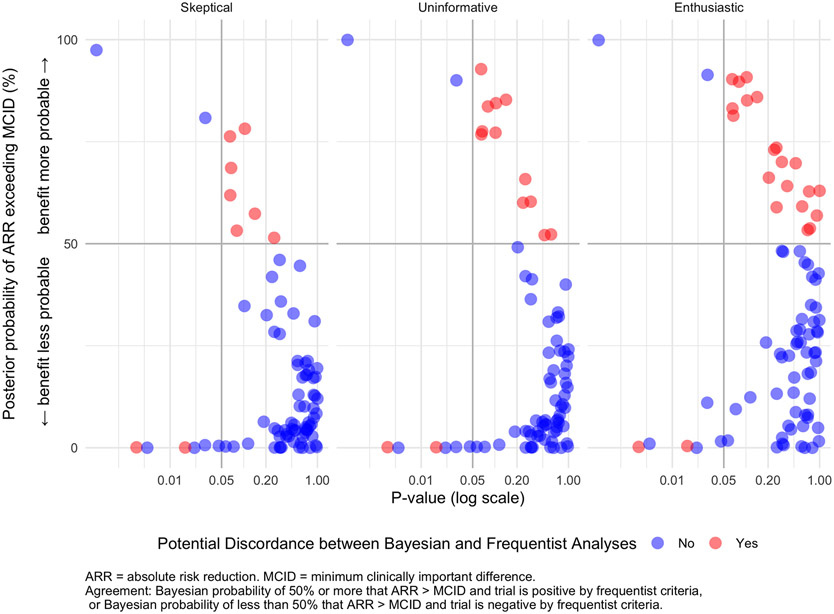
Recent Bayesian reanalyses of prominent trials in critical illness have generated controversy by contradicting the initial conclusions based on conventional frequentist analyses. Many clinicians might be sceptical that Bayesian analysis, a philosophical and statistical approach that combines prior beliefs with data to generate probabilities, provides more useful information about clinical trials than the frequentist approach. In this Personal View, we introduce clinicians to the rationale, process, and interpretation of Bayesian analysis through a systematic review and reanalysis of interventional trials in critical illness. In the majority of cases, Bayesian and frequentist analyses agreed. In the remainder, Bayesian analysis identified interventions where benefit was probable despite the absence of statistical significance, where interpretation depended substantially on choice of prior distribution, and where benefit was improbable despite statistical significance. Bayesian analysis in critical care medicine can help to distinguish harm from uncertainty and establish the probability of clinically important benefit for clinicians, policy makers, and patients.
Copyright © 2021 Elsevier Ltd. All rights reserved.
Conflict of interest statement
Declarations of interest
Dr. Brodie reports grants from ALung Technologies, personal fees from Baxter, personal fees from Xenios, personal fees from BREETHE, other from Hemovent, outside the submitted work. Dr. Beitler reports speaking fees from Hamilton Medical and consulting fees from Sedana Medical outside the scope of this work. Dr. Slutsky reports being on the medical advisory board for Baxter and for Novalung/Xenios, outside the scope of this work. Outside the submitted work, Dr. McAuley reports personal fees from consultancy for GlaxoSmithKline, Boehringer Ingelheim and Bayer. In addition, Dr. McAuley has a patent issued to his institution for a treatment for ARDS. DFM is a Director of Research for the Intensive Care Society and NIHR EME Programme Director. Dr. Goligher reports personal fees and non-financial support from Getinge, non-financial support from Timpel, outside the submitted work. Dr. Tomlinson reports personal fees from Spectral Medical Inc., outside the submitted work. Dr. Ferguson reports personal fees from XENIOS, personal fees from GETINGE, outside the submitted work. Dr. Fan reports personal fees from ALung Technologies, personal fees from Fresenius Medical Care, personal fees from MC3 Cardiopulmonary, outside the submitted work. All other authors declare no conflicts of interest.
Figures
References
-
- Greenland S Statistical tests, P values, confidence intervals, and power: a guide to misinterpretations. Eur J Epidemiol. 2016;31(4). http://resolver.scholarsportal.info/resolve/03932990/v31i0004/337_stpvci....Accessed June 6, 2019. - PMC - PubMed
-
- Wasserstein RL, Lazar NA. The ASA’s Statement on p -Values: Context, Process, and Purpose. Am Stat. 2016;70(2):129–133. doi: 10.1080/00031305.2016.1154108 - DOI
Publication types
MeSH terms
Grants and funding
LinkOut - more resources
Full Text Sources
Other Literature Sources
Medical
