


Economic evaluation of programs against COVID-19: A systematic review
- PMID: 33227532
- PMCID: PMC7679235
- DOI: 10.1016/j.ijsu.2020.11.015
Economic evaluation of programs against COVID-19: A systematic review
Abstract
Background: The COVID-19 pandemic has become a public health emergency and raised global concerns in about 213 countries without vaccines and with limited medical capacity to treat the disease. The COVID-19 has prompted an urgent search for effective interventions, and there is little information about the money value of treatments. The present study aimed to summarize economic evaluation evidence of preventing strategies, programs, and treatments of COVID-19.
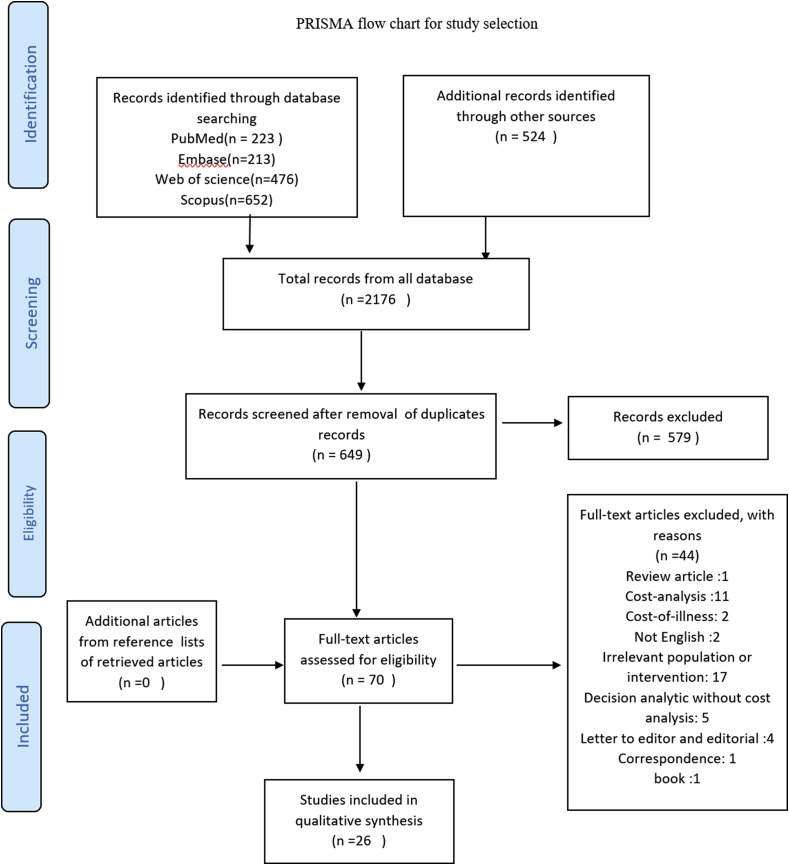
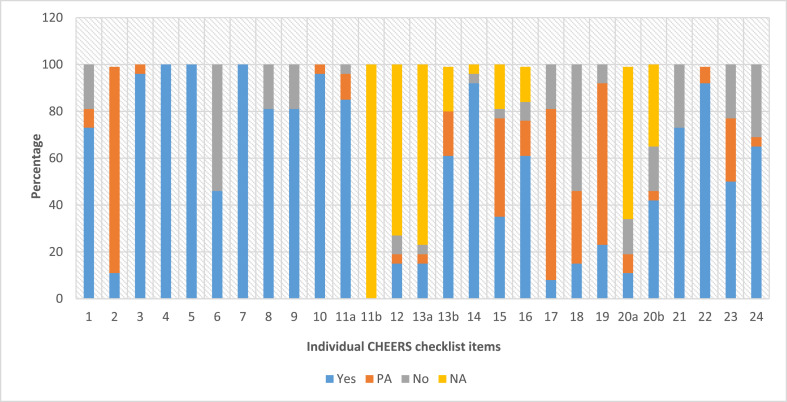
Material and methods: We searched Medline/PubMed, Cochrane Library, Web of Science Core Collection, Embase, Scopus, Google Scholar, and specialized databases of economic evaluation from December 2019 to July 2020 to identify relevant literature to economic evaluation of programs against COVID-19. Two researchers screened titles and abstracts, extracted data from full-text articles, and did their quality assessment by the Consolidated Health Economic Evaluation Reporting Standards (CHEERS) checklist. Then, quality synthesis of results was done.
Results: Twenty-six studies of economic evaluations met our inclusion criteria. The CHEERS scores for most studies (n = 9) were 85 or higher (excellent quality). Eight studies scored 70 to 85 (good quality), eight studies scored 55 to 70 (average quality), and one study < %55 (poor quality). The decision-analytic modeling was applied to twenty-three studies (88%) to evaluate their services. Most studies utilized the SIR model for outcomes. In studies with long-time horizons, social distancing was more cost-effective than quarantine, non-intervention, and herd immunity. Personal protective equipment was more cost-effective in the short-term than non-intervention. Screening tests were cost-effective in all studies.
Conclusion: The results suggested screening tests and social distancing to be cost-effective alternatives in preventing and controlling COVID-19 on a long-time horizon. However, evidence is still insufficient and too heterogeneous to allow any definite conclusions regarding costs of interventions. Further research as are required in the future.
Keywords: COVID-19; Economic evaluation; Isolation; Lockdown; SARS-COV-2; Screening.
Copyright © 2020 IJS Publishing Group Ltd. Published by Elsevier Ltd. All rights reserved.
Conflict of interest statement
The authors declare that they have no conflict of interest.
Figures
Comment in
-
A commentary on "Economic evaluation of programs against COVID-19: A systematic review".Int J Surg. 2021 Feb;86:48-49. doi: 10.1016/j.ijsu.2021.01.008. Epub 2021 Jan 27. Int J Surg. 2021. PMID: 33515716 Free PMC article. No abstract available.
-
A commentary on "Economic evaluation of programs against COVID-19: A systematic review".Int J Surg. 2021 Mar;87:105890. doi: 10.1016/j.ijsu.2021.01.015. Epub 2021 Feb 10. Int J Surg. 2021. PMID: 33577929 Free PMC article. No abstract available.
References
-
- Li Y., Mutchler J.E. Older adults and the economic impact of the COVID-19 pandemic. J. Aging Soc. Pol. 2020;32(4–5):477–487. - PubMed
-
- Zhao J., Jin H., Li X., Jia J., Zhang C., Zhao H., et al. Disease burden attributable to the first wave of COVID-19 in China, and the effect of timing on the cost-effectiveness of movement restriction policies. https://ssrncom/abstract=3605199. 2020 Available at: SSRN: - PMC - PubMed
Publication types
MeSH terms
LinkOut - more resources
Full Text Sources
Other Literature Sources
Medical
Miscellaneous