Review
. 2021 Jan:133:111008.
doi: 10.1016/j.biopha.2020.111008. Epub 2020 Nov 11.

Prevention and treatment of COVID-19: Focus on interferons, chloroquine/hydroxychloroquine, azithromycin, and vaccine

Affiliations
Review

Prevention and treatment of COVID-19: Focus on interferons, chloroquine/hydroxychloroquine, azithromycin, and vaccine

Bianza Moise Bakadia et al. Biomed Pharmacother. 2021 Jan.

Abstract

The ongoing pandemic caused by the severe acute respiratory syndrome coronavirus 2 (SARS-CoV-2) has drawn the attention of researchers and clinicians from several disciplines and sectors who are trying to find durable solutions both at preventive and treatment levels. To date, there is no approved effective treatment or vaccine available to control the coronavirus disease-2019 (COVID-19). The preliminary in vitro studies on viral infection models showed potential antiviral activities of type I and III interferons (IFNs), chloroquine (CQ)/hydroxychloroquine (HCQ), and azithromycin (AZM); however, the clinical studies on COVID-19 patients treated with CQ/HCQ and AZM led to controversies in different regions due to their adverse side effects, as well as their combined treatment could prolong the QT interval. Interestingly, the treatment with type I IFNs showed encouraging results. Moreover, the different preliminary reports of COVID-19 candidate vaccines showcase promising results by inducing the production of a high level of neutralizing antibodies (NAbs) and specific T cell-mediated immune response in almost all participants. The present review aims to summarize and analyze the recent progress evidence concerning the use of IFNs, CQ/HCQ, and AZM for the treatment of COVID-19. The available data on immunization options to prevent the COVID-19 are also analyzed with the aim to present the promising options which could be investigated in future for sustainable control of the pandemic.

Keywords: Azithromycin; COVID-19; Chloroquine/hydroxychloroquine; Interferons; Treatment; Vaccine.


Conflict of interest statement

The authors declare that there is no conflict of interest associated with the publication of this manuscript.

Figures

None
Graphical abstract
Fig. 1
Fig. 1
Illustration of replication mechanism and potential drug targets of SARS-CoV-2. The SARS-CoV-2 infects the host cell in two ways: either through the plasma membrane or endosomes or through the interaction between its spike protein (S) and cell receptor, ACE2. The SARS-CoV-2 may also enter the host cell through the interaction between its S protein and sialic acid receptors. The TMPRSS2 close to the ACE receptor activates the S protein in the endosome via followed by initiating the fusion of the SARS-CoV-2 membrane with the plasma membrane. The viral RNA is released and translated in the viral polyprotein followed by proteolysis to produce non-structural proteins (NSPs) and form a replication-transcription complex (RTC). The RTC drives the synthesis of (-) RNA. The full length (-) RNA copies of the genome provide the templates for full-length (+) RNA genomes. The transcription further produces a subset of subgenomic RNAs, including those encoding the accessory and structural proteins. The translated structural proteins (M, N, E, and S) and the genomic RNA are assembled into the viral nucleocapsid and envelope in the ER-Golgi intermediate compartment, which is subsequently released via exocytosis. The potential drug targets are shown in red such as inhibitors of viral entry to human cells: chloroquine (CQ)/hydroxychloroquine (HCQ), umifenovir; viral protease inhibitor: lopinavir/ritonavir, ivermectin; RNA-dependent RNA polymerase inhibitor: remdesivir, favipiravir; interleukin (IL)-6 inhibitor; IL-1 inhibitor: anakinra; Janus kinases inhibitor: baricitinib, ruxolitinib, upadacitinib; corticosteroid: dexamethasone; an inhibitor of the cellular serine protease TMPRSS2: camostat mesylate; antimicrobial/antibiotics: azithromycin (AZM); immunoglobulins: convalescent plasma; interferons (IFNs); angiotensin-converting enzyme inhibitor (ACEI); angiotensin II receptor blocker (ARB). Abbreviations: ACE2, angiotensin-converting enzyme 2; TMPRSS2, transmembrane protease serine 2; AT1R, angiotensin II type 1 receptor; SARS-CoV-2, severe acute respiratory syndrome coronavirus 2; RNA, ribonucleic acid; (+) RNA, Positive-strand (5′-to-3′) RNA; (-) RNA, negative-strand (3′-to-5′) RNA; N, nucleocapsid protein; M, matrix protein; E, envelope protein; S, spike protein.
Fig. 2
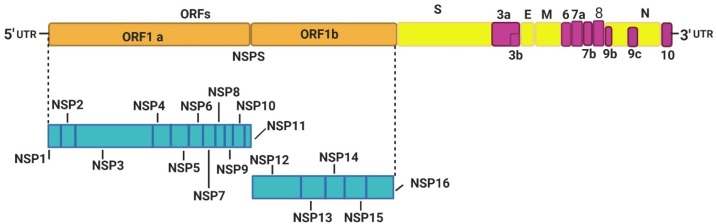
Fig. 2
The SARS-CoV-2 genome and encoded proteins. ORF1a and ORF1b encode the nonstructural proteins (NSP1-16), structural proteins (S, E, M, and N), and accessory proteins (ORF3a, 3b, 6, 7a, 7b, 8, 9b, 9c, and 10). The 5′-UTR and 3′-UTR are untranslated extremities of the genome. NSP, non-structural protein; ORF, open reading frame; UTR, untranslated region.
Fig. 3
Fig. 3
Schematic illustration of the innate immune response to human coronavirus infection. The HCoVs infect the host cell through interaction between its spike protein (S) and the cell receptor, ACE2. Upon viral RNA recognition, the PRRs activate the innate cellular response reactions that normally lead to the production of pro-inflammatory cytokines and IFNs through NF-kB and IRF3/IRF7 (A). IFNs, secreted in an autocrine and paracrine behavior, induce the expression of ISGs via the JAK-STAT signaling pathway involved in antiviral response (B). Some viral proteins such as SARS-CoV’s NSP1, PLP, NSP10, NSP13, NSP14, NSP15, ORF3b, and ORF9b proteins and the MERS-CoV’s NS4a, NS4b, ORF4a, ORF4b, and ORF5 proteins inhibit this natural response at several levels. See Table 1 for detailed mechanisms at each level. HCoVs, human coronavirus; PRRs, pattern-recognition receptors; TLRs, toll-like receptors; RIG-I, retinoic acid-inducible gene I; MAVS, mitochondrial antiviral signaling protein; NSP, non-structural protein; IRF, IFNs regulatory factor; STAT, signal transducer and activator of transcription; ORF, open reading frame; PLP, papain-like protease; ISG, IFN-stimulated genes; N, nucleocapsid protein; M, matrix protein; E, envelope protein; TBK1, TANK-binding kinase-1; MyD88, myeloid differentiation primary response 88; TRIF, TIR domain-containing adapter-inducing IFN-β; PKR, protein kinase R; RIG-I, retinoic acid-inducible gene 1; RLRs, RIG-I-like receptors; STING, stimulator of interferon genes; MDA-5, melanoma differentiation-associated protein 5; IkB, inhibitor of nuclear factor kB; IKK-ε, IκB kinase-ε; NLRP3, NOD-like receptor family pyrin domain containing 3; IFNAR, interferon alpha and beta receptor; IFNLR, interferon lambda receptor; TRIMs, tripartate motif proteins; P, phosphate; GBPs, guanylate binding proteins; OASs, oligo adenylate synthases; NOS2, nitric oxide synthase 2; IFITMs, IFN-induced transmembrane proteins.
Fig. 4
Fig. 4
The immunological response to SARS-CoV-2 infection showing the release of ROS by phagocytes. pDS, plasmacytoid dendritic cells; IL, interleukin; TNF-α, tumor necrosis factor-alpha; IFN-γ, interferon-gamma; Inflamm: inflammatory; Eosino, eosinophils; Mono, monocytes; Macs, macrophages; Neutro, neutrophils; NK cell, Natural killer cell; Abs, antibodies; ADCC, Antibody-dependent cell-mediated cytotoxicity; ROS, reactive oxygen species.
Fig. 5
Fig. 5
Schematic representation of ADCC and ADP induced by neutralizing antibodies (NAbs). A cell infected with SARS-CoV-2 expresses viral antigens on its surface, that allows certain NAbs to attach to the plasma membrane. The NK (natural killer) cells (A) and phagocytes (B) are then activated via the receptor for the Fc fragment of immunoglobulins. The NK cells then release cytolytic granules (granzymes and perforins), and phagocytes internalize the virus-infected cell in the phagolysosome. Both cytolytic granules and phagolysosome destroy the infected cell recognized by the NAbs. ADCC, antibody-dependent cellular cytotoxicity; ADP, antibody-dependent phagocytosis (ADP).

References

    1. 2020. Coronavirus Cases.https://www.worldometers.info/coronavirus/ (accessed October 31, 2020)
    1. Salvi R., Patankar P. Emerging pharmacotherapies for COVID-19. Biomed. Pharmacother. 2020;128:110267. doi: 10.1016/j.biopha.2020.110267. - DOI - PMC - PubMed
    1. Martinez M.A. Compounds with therapeutic potential against novel respiratory 2019 coronavirus. Antimicrob. Agents Chemother. 2020;64:1–7. doi: 10.1128/AAC.00399-20. - DOI - PMC - PubMed
    1. Colson P., Rolain J.M., Lagier J.C., Brouqui P., Raoult D. Chloroquine and hydroxychloroquine as available weapons to fight COVID-19. Int. J. Antimicrob. Agents. 2020;55 doi: 10.1016/j.ijantimicag.2020.105932. - DOI - PMC - PubMed
    1. Zhao M. Cytokine storm and immunomodulatory therapy in COVID-19: role of chloroquine and anti-IL-6 monoclonal antibodies. Int. J. Antimicrob. Agents. 2020;55:105982. doi: 10.1016/j.ijantimicag.2020.105982. - DOI - PMC - PubMed

MeSH terms