


The Acquisition of Multidrug-Resistant Bacteria in Patients Admitted to COVID-19 Intensive Care Units: A Monocentric Retrospective Case Control Study
- PMID: 33227956
- PMCID: PMC7699265
- DOI: 10.3390/microorganisms8111821
The Acquisition of Multidrug-Resistant Bacteria in Patients Admitted to COVID-19 Intensive Care Units: A Monocentric Retrospective Case Control Study
Abstract
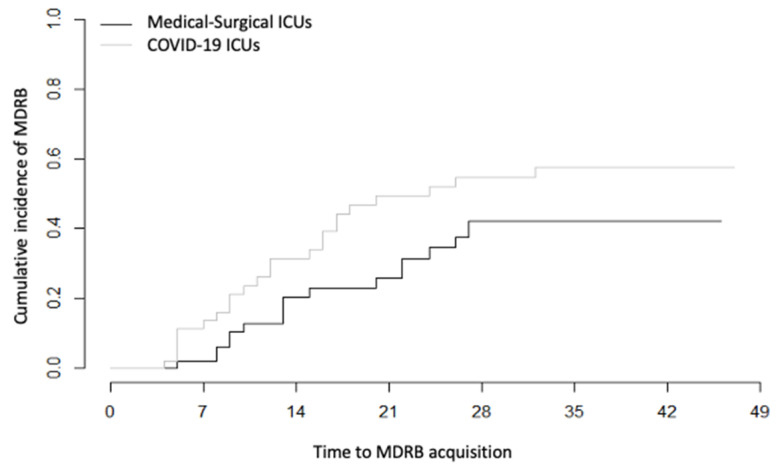
Whether the risk of multidrug-resistant bacteria (MDRB) acquisition in the intensive care unit (ICU) is modified by the COVID-19 crisis is unknown. In this single center case control study, we measured the rate of MDRB acquisition in patients admitted in COVID-19 ICU and compared it with patients admitted in the same ICU for subarachnoid hemorrhage (controls) matched 1:1 on length of ICU stay and mechanical ventilation. All patients were systematically and repeatedly screened for MDRB carriage. We compared the rate of MDRB acquisition in COVID-19 patients and in control using a competing risk analysis. Of note, although we tried to match COVID-19 patients with septic shock patients, we were unable due to the longer stay of COVID-19 patients. Among 72 patients admitted to the COVID-19 ICUs, 33% acquired 31 MDRB during ICU stay. The incidence density of MDRB acquisition was 30/1000 patient days. Antimicrobial therapy and exposure time were associated with higher rate of MDRB acquisition. Among the 72 SAH patients, 21% acquired MDRB, with an incidence density was 18/1000 patient days. The septic patients had more comorbidities and a greater number of previous hospitalizations than the COVID-19 patients. The incidence density of MDRB acquisition was 30/1000 patient days. The association between COVID-19 and MDRB acquisition (compared to control) risk did not reach statistical significance in the multivariable competing risk analysis (sHR 1.71 (CI 95% 0.93-3.21)). Thus, we conclude that, despite strong physical isolation, acquisition rate of MDRB in ICU patients was at least similar during the COVID-19 first wave compared to previous period.
Keywords: Enterobacteriaceae; SARS-CoV-2; antimicrobial resistance; critically illness; infection control; subarachnoid hemorrhage; viral pandemic.
Conflict of interest statement
The authors declare no conflict of interest.
Figures

References
-
- World Health Organization . Coronavirus Disease (COVID-2019) Situation Reports. World Health Organization; Geneva, Switzerland: 2020.
-
- Li R., Rivers C., Tan Q., Murray M.B., Toner E., Lipsitch M. Estimated Demand for US Hospital Inpatient and Intensive Care Unit Beds for Patients With COVID-19 Based on Comparisons With Wuhan and Guangzhou, China. JAMA Netw. Open. 2020;3:e208297. doi: 10.1001/jamanetworkopen.2020.8297. - DOI - PMC - PubMed
-
- Rawson T.M., Moore L.S.P., Zhu N., Ranganathan N., Skolimowska K., Gilchrist M., Satta G., Cooke G., Holmes A. Bacterial and fungal co-infection in individuals with coronavirus: A rapid review to support COVID-19 antimicrobial prescribing. Clin. Infect. Dis. 2020 doi: 10.1093/cid/ciaa530. - DOI - PMC - PubMed
LinkOut - more resources
Full Text Sources
Medical
Miscellaneous
