


Trends in cesarean delivery rates in primipara and the associated factors
- PMID: 33228631
- PMCID: PMC7684937
- DOI: 10.1186/s12884-020-03398-6
Trends in cesarean delivery rates in primipara and the associated factors
Abstract
Background: Few studies have focused on cesarean delivery (CD) trends among primipara under the one-child and the two-child policies. This study aimed to explore the trends in CD rates among primipara during 1995-2019 and the associated factors with CD risk.
Methods: This study obtained clinical data on primiparous mothers and newborns from 1995 to 2019 at a large tertiary hospital in Wuhan, China. Trends in CD rates were calculated using the joinpoint regression analysis. The Chi-square tests and log-binomial regression analyses were used to evaluate the associations between primary variables and CD risk.
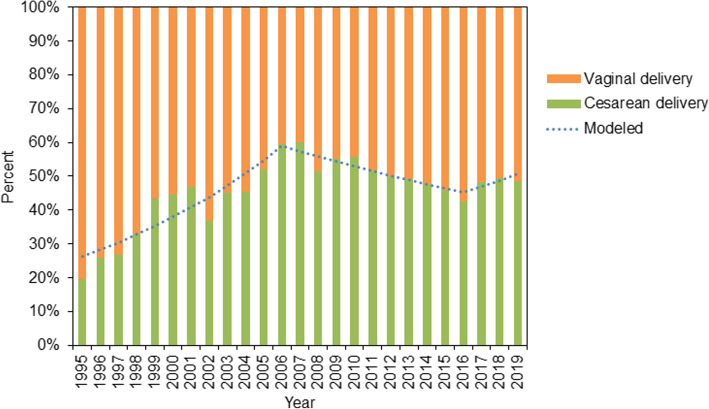
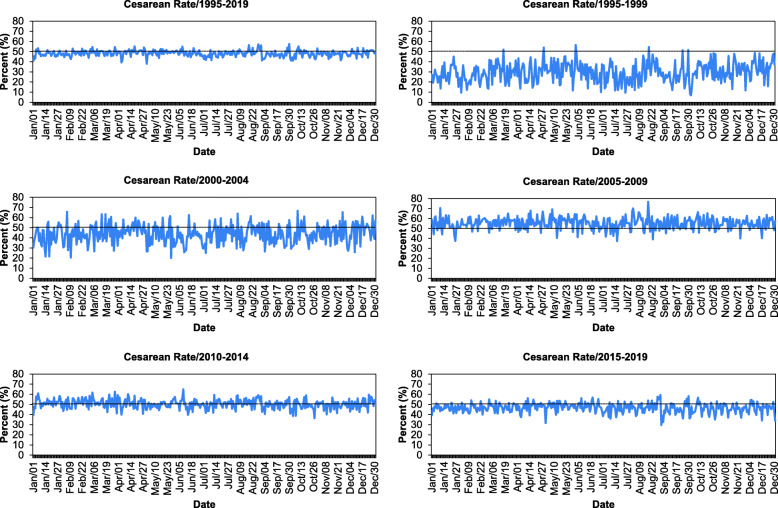
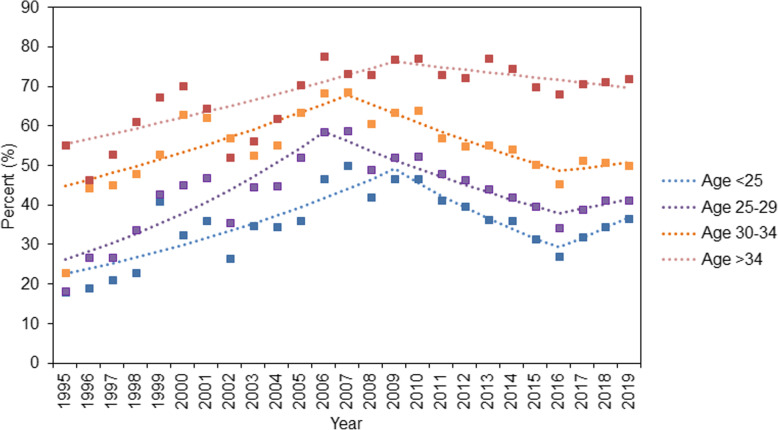
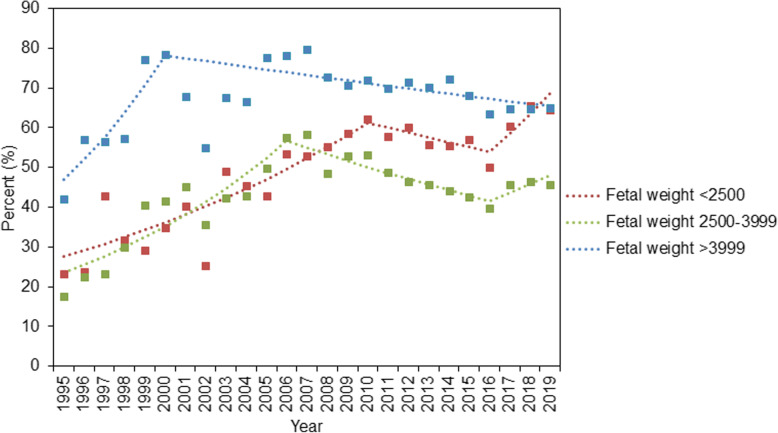
Results: CD rates showed a significant upward trend with an average annual percentage change (APC) of 2.2% (95% CI: 0.6, 3.8%) during the study period. In 1995-2006, the CD rates continued to increase with an APC of 7.8% (95% CI: 4.8, 10.9%). After 2006, the CD rates started to decline by an APC of - 4.1% (95% CI: - 5.5, - 2.6%). The CD rates non-significantly increased from 36.2% in 2016 to 43.2% in 2019. Moreover, the highest CD rate during 2015-2019 was observed on August 30 (59.2%) and the lowest on September 1 (29.7%). Primipara of older age and those with >3pregnancies had higher risks of CD. Furthermore, primipara who gave birth to newborns with low birth weight and macrosomia had higher risks of CD.
Conclusions: Maternal and fetal as well as social and cultural factors may contribute to the rising trend of CD rates. Effective measures should be taken to control CD under the two-child policy, especially for primipara.
Keywords: Annual percentage change; Average annual percentage changes; Cesarean delivery; Child policy; Primipara.
Conflict of interest statement
The authors declare no potential conflict of interests.
Figures
References
-
- Harrison MS, Saleem S, Ali S, Pasha O, Chomba E, Carlo WA, et al. A prospective, population-based study of trends in operative vaginal delivery compared to cesarean delivery rates in low- and middle-income countries, 2010-2016. Am J Perinatol. 2019;36:730–736. doi: 10.1055/s-0038-1673656. - DOI - PMC - PubMed
MeSH terms
LinkOut - more resources
Full Text Sources
Medical
