Review
. 2020 Nov 23;13(1):157.
doi: 10.1186/s13045-020-00994-z.

Molecular and cellular mechanisms of aging in hematopoietic stem cells and their niches

Affiliations
Review

Molecular and cellular mechanisms of aging in hematopoietic stem cells and their niches

Lei Zhang et al. J Hematol Oncol. .

Abstract

Aging drives the genetic and epigenetic changes that result in a decline in hematopoietic stem cell (HSC) functioning. Such changes lead to aging-related hematopoietic/immune impairments and hematopoietic disorders. Understanding how such changes are initiated and how they progress will help in the development of medications that could improve the quality life for the elderly and to treat and possibly prevent aging-related hematopoietic diseases. Here, we review the most recent advances in research into HSC aging and discuss the role of HSC-intrinsic events, as well as those that relate to the aging bone marrow niche microenvironment in the overall processes of HSC aging. In addition, we discuss the potential mechanisms by which HSC aging is regulated.

Keywords: Aging; HSCs; Replication stress.


Conflict of interest statement

The authors declare that they have no competing financial or professional interests.

Figures
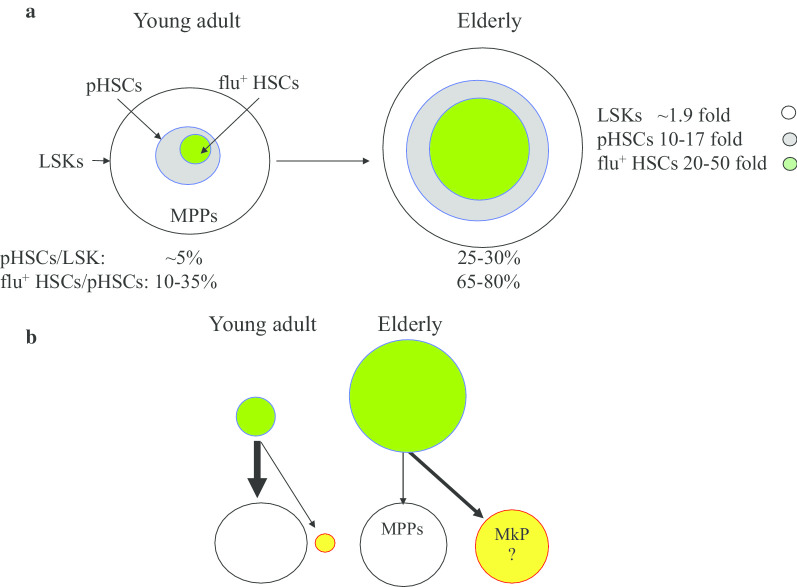
Fig. 1
Fig. 1
Aging-related changes in pHSCs and flu+ HSCs. a Compared to young mice, LSK cells are increased by 1.9-fold in BM of old mouse pHSCs. However, HSCs and flu+HSCs in BM of old mice are expanded by 10–17-fold and 20–50-fold, respectively, owing to the dramatically increased ratios of pHSCs/LSK and flu+HSCs/pHSCs. b The reduction in ratios of pHSCs/LSK and flu+HSCs/pHSCs in old mice might be due to the reduced production of MPPs and/or increased production of MKPs or other committed progenitors which bypass the MPP stage
Fig. 2
Fig. 2
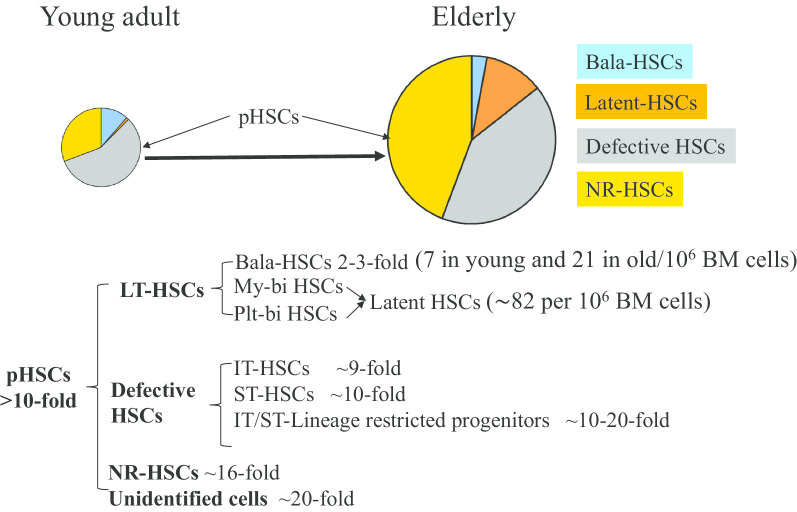
Aging-related changes in fHSCs. Single-cell transplantation studies demonstrate a 2–3-fold expansion of Bala-HSCs, suggesting that functionally normal HSCs exist in aged mice. A significant number of latent HSCs can be detected only in elderly. In addition, more defective HSCs and NR-HSCs can be detected in older mice
Fig. 3
Fig. 3
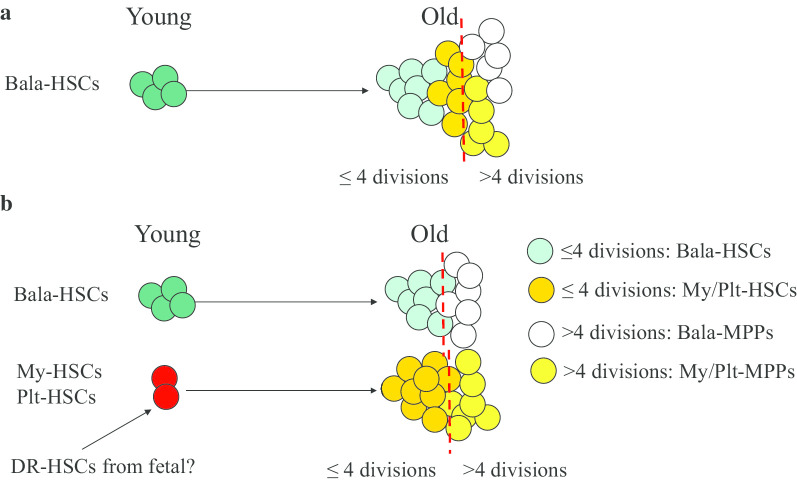
Models for aging-driven expansion of Plt/My-bi HSCs. Two models were proposed to explain the origin of Plt/My-bi HSCs. a. The Plt/My-bi HSCs are generated during the Bala-HSC proliferation. b Plt/My-bi HSCs are expanded from pre-existing Plt/My-bi HSCs in young adults
Fig. 4
Fig. 4
Models for aging-related changes in symmetric and asymmetric division in HSCs. a Asymmetric division of HSCs helps to maintain functional HSC numbers by distributing stemness factors to one of the daughter cells and differentiation factors to the other. b Symmetric division of HSCs leads to a gradual dilution of their stemness during each division until it is practically absent. c More HSCs in young mice undergo asymmetric division; they switch to symmetric division during aging
Fig. 5
Fig. 5
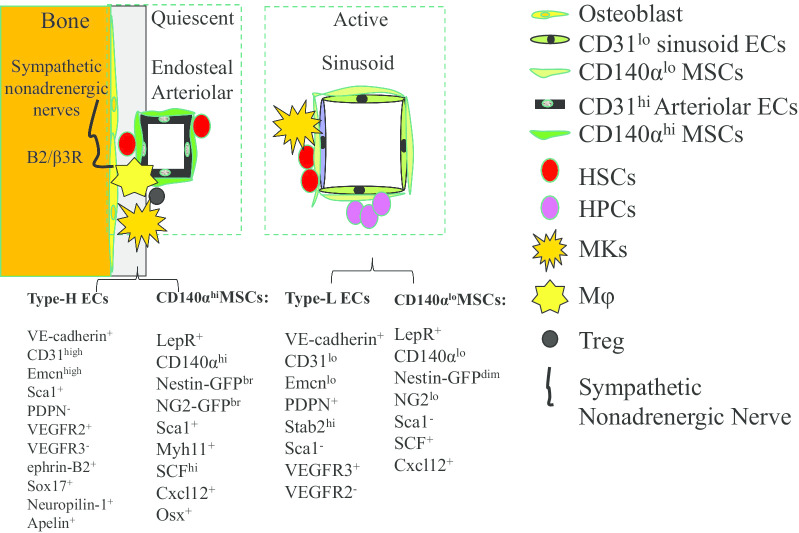
BM HSC niches. Endosteal/arteriolar niches are localized close to the endosteal region of BM, which are populated by CD31hiEmcnhi type-H ECs and osteogenic-biased MSC-SCs in the arteriolar capillaries at the distal end of the arterial network (transition zone vessels have substantial branching). Sinusoid niches are localized to the central region of BM and are composed of type-L ECs and adipogenic-biased MSC-SCs. In addition, MKs, Mφ and Treg cells also function as niche cells to maintain HSC quiescence, retain HSCs within their BM niche, and to protect HSCs from immune attack. In addition, the adrenergic sympathetic nerve also functions as niche component for HSCs by regulating HSC relocation between niches
Fig. 6
Fig. 6
HSC niche regeneration. Type-H ECs in arteriolar niches are stimulated by Dll4-Notch signaling to produce angiocrine factors. Such factors stimulate angiogenesis and osteogenesis to generate endosteal/arteriolar niches during early development and maintain these niches into adulthood. In response to irradiation or chemically induced BM damage, HSCs produce angiopoietin I/VEGF and ECs express Jag2. Such factors collaboratively induce the regeneration of sinusoid niches by stimulating the production of angiocrine factors by type-H ECs. In old mouse BM, the endosteal/arteriolar niches are significantly restricted while the sinusoid niches show minimal changes
Fig. 7
Fig. 7
Mechanism of HSC aging. HSCs undergo niche-driven and proliferation-associated changes during aging. Proliferation induces multiple stresses on HSCs including replication, ribosome biosynthesis, DNA damage, as well as metabolic and epigenetic stresses. Such stresses attenuate the self-renewal capacity of HSCs by inducing p53-dependent/independent senescence/apoptosis and promote lineage-biased differentiation by inducing platelet/myeloid genes and repressing lymphoid genes. Aging of HSC niches promotes the switch from asymmetric division to symmetric division in HSCs and impairs the self-renewal of HSCs due to a reduction in key niche factors including SCF, Cxcl12, IL7, and Notch ligands. In addition, the accumulation of MKs, M, plasma cells (PCs), aging-associated B cells, and MDSCs, which is primed by inflammatory mediators, promotes the Plt/My-biased phenotype in HSCs through the production of inflammatory cytokines such as CCL5, IL1β, TNFα, IFN-γ, Wnt5 and TGFβ

References

    1. Kaushansky K. Lineage-specific hematopoietic growth factors. N Engl J Med. 2006;354:2034–2045. doi: 10.1056/NEJMra052706. - DOI - PubMed
    1. Ferretti G, Papaldo P, Cognetti F. Lineage-specific hematopoietic growth factors. N Engl J Med. 2006;355:526. doi: 10.1056/NEJMc061587. - DOI - PubMed
    1. Dale DC, Rosenberg PS, Alter BP. Lineage-specific hematopoietic growth factors. N Engl J Med. 2006;355:526–527. doi: 10.1056/NEJMc061587. - DOI - PubMed
    1. Sun J, et al. Clonal dynamics of native haematopoiesis. Nature. 2014;514:322–327. doi: 10.1038/nature13824. - DOI - PMC - PubMed
    1. Busch K, et al. Fundamental properties of unperturbed haematopoiesis from stem cells in vivo. Nature. 2015;518:542–546. doi: 10.1038/nature14242. - DOI - PubMed

Publication types