. 2021 Jun;218(6):334-343.
doi: 10.1192/bjp.2020.242.

Mental health before and during the COVID-19 pandemic in two longitudinal UK population cohorts

Affiliations

Mental health before and during the COVID-19 pandemic in two longitudinal UK population cohorts

Alex S F Kwong et al. Br J Psychiatry. 2021 Jun.

Abstract

Background: The COVID-19 pandemic and mitigation measures are likely to have a marked effect on mental health. It is important to use longitudinal data to improve inferences.

Aims: To quantify the prevalence of depression, anxiety and mental well-being before and during the COVID-19 pandemic. Also, to identify groups at risk of depression and/or anxiety during the pandemic.

Method: Data were from the Avon Longitudinal Study of Parents and Children (ALSPAC) index generation (n = 2850, mean age 28 years) and parent generation (n = 3720, mean age 59 years), and Generation Scotland (n = 4233, mean age 59 years). Depression was measured with the Short Mood and Feelings Questionnaire in ALSPAC and the Patient Health Questionnaire-9 in Generation Scotland. Anxiety and mental well-being were measured with the Generalised Anxiety Disorder Assessment-7 and the Short Warwick Edinburgh Mental Wellbeing Scale.

Results: Depression during the pandemic was similar to pre-pandemic levels in the ALSPAC index generation, but those experiencing anxiety had almost doubled, at 24% (95% CI 23-26%) compared with a pre-pandemic level of 13% (95% CI 12-14%). In both studies, anxiety and depression during the pandemic was greater in younger members, women, those with pre-existing mental/physical health conditions and individuals in socioeconomic adversity, even when controlling for pre-pandemic anxiety and depression.

Conclusions: These results provide evidence for increased anxiety in young people that is coincident with the pandemic. Specific groups are at elevated risk of depression and anxiety during the COVID-19 pandemic. This is important for planning current mental health provisions and for long-term impact beyond this pandemic.

Keywords: ALSPAC; COVID-19; anxiety disorders; depressive disorders; generation Scotland.


Conflict of interest statement

D.A.L. declares receiving research support from several national and international government and charity funders and Roche Diagnostics and Medtronic Ltd for research unrelated to that presented here. All other authors declare no competing interests.

Figures
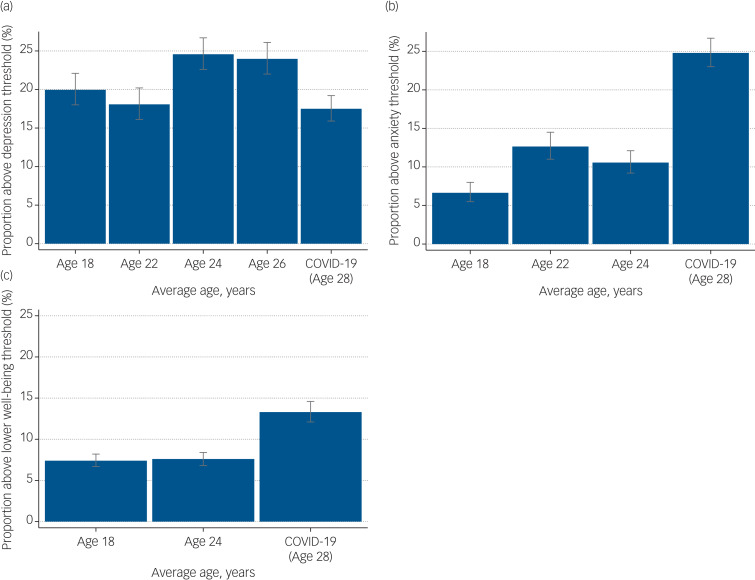
Fig. 1
Fig. 1
Changes in mental health from pre-pandemic to during the COVID-19 pandemic in the ALSPAC-young cohort. (a) Changes in probable depression, as assessed by the SMFQ. (b) Changes in probable generalised anxiety disorder, as assessed by the GAD-7 at age 22 years and the CISR GAD at ages 18 and 24 years. (c) Changes in lower well-being, as assessed by the SWEMWBS. ALSPAC-young, original children in the Avon Longitduinal Study of Parents and Children; CISR GAD, Clinical Interview Schedule – Revised, Generalised Anxiety Disorder; GAD-7, Generalised Anixety Disorder Assessment; SMFQ, Short Mood and Feelings Questionnaire; SWEMWBS, Short Warwick Edinburgh Mental Wellbeing Scale.
Fig. 2
Fig. 2
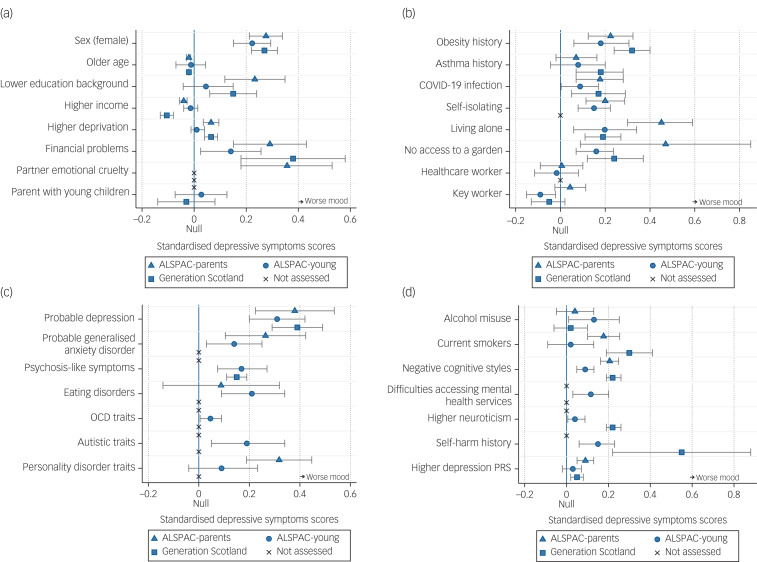
Associations between pre-pandemic and COVID-19-specific factors and depression during the COVID-19 pandemic, adjusted for the most recent pre-pandemic assessment of depression, sex, age and when the COVID-19 questionnaire was completed, using imputed data (estimates match Supplementary Table 8). Estimates refer to an s.d. increase in depression, over and above pre-pandemic depression. (a) Associations between pre-pandemic sociodemographic factors and depression during the COVID-19 pandemic. (b) Associations between pre-pandemic physical health and COVID-19-specific factors and depression during the COVID-19 pandemic. (c and d) Associations between pre-pandemic mental health factors and depression during the COVID-19 pandemic. ALSPAC-parents, original parents in the Avon Longitudinal Study of Parents and Children; ALSPAC-young, original children in the Avon Longitudinal Study of Parents and Children; OCD, obsessive compulsive disorder; PRS, polygenic risk score.
Fig. 3
Fig. 3
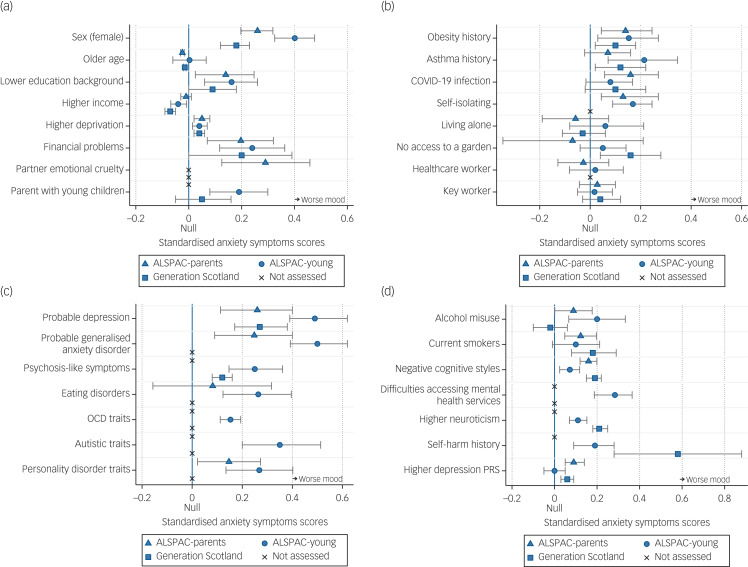
Associations between pre-pandemic and COVID-19-specific factors and anxiety during the COVID-19 pandemic, adjusted for the most recent pre-pandemic assessments of anxiety, sex, age and when the COVID-19 questionnaire was completed, using imputed data (estimates match Supplementary Table 8). Estimates refer to an s.d. increase in anxiety, over and above pre-pandemic anxiety. (a) Associations between pre-pandemic sociodemographic factors and anxiety during the COVID-19 pandemic. (b) Associations between pre-pandemic physical health and COVID-19-specific factors and anxiety during the COVID-19 pandemic. (c and d) Associations between pre-pandemic mental health factors and anxiety during the COVID-19 pandemic. ALSPAC-parents, original parents in the Avon Longitudinal Study of Parents and Children; ALSPAC-young, orignal children in the Avon Longitudinal Study of Parents and Children; OCD, obsessive compulsive disorder; PRS, polygenic risk score.

References

    1. Holmes EA, O'Connor RC, Perry VH, Tracey I, Wessely S, Arseneault L, et al. Multidisciplinary research priorities for the COVID-19 pandemic: a call for action for mental health science. Lancet Psychiatry 2020; 7: 547–60. - PMC - PubMed
    1. Rogers JP, Chesney E, Oliver D, Pollak TA, McGuire P, Fusar-Poli P, et al. Psychiatric and neuropsychiatric presentations associated with severe coronavirus infections: a systematic review and meta-analysis with comparison to the COVID-19 pandemic. Lancet Psychiatry 2020; 7: 611–27. - PMC - PubMed
    1. Brooks SK, Webster RK, Smith LE, Woodland L, Wessely S, Greenberg N, et al. The psychological impact of quarantine and how to reduce it: rapid review of the evidence. Lancet 2020; 395(10227): 912–20. - PMC - PubMed
    1. Lam MH, Wing Y, Yu W, Leung C, Ma RCW, Kong APS, et al. Mental morbidities and chronic fatigue in severe acute respiratory syndrome survivors: long-term follow-up. Arch Intern Med 2009; 169(22): 2142–7. - PubMed
    1. Cheung YT, Chau PH, Yip PS. A revisit on older adults suicides and severe acute respiratory syndrome (SARS) epidemic in Hong Kong. Int J Geriatr Psychiatry 2008; 23(12): 1231–8. - PubMed

Publication types