Mortality among patients with frequent emergency department use for alcohol-related reasons in Ontario: a population-based cohort study
- PMID: 33229348
- PMCID: PMC7721258
- DOI: 10.1503/cmaj.191730
Mortality among patients with frequent emergency department use for alcohol-related reasons in Ontario: a population-based cohort study
Abstract
Background: Little is known about the risk of death among people who visit emergency departments frequently for alcohol-related reasons, including whether mortality risk increases with increasing frequency of visits. Our primary objective was to describe the sociodemographic and clinical characteristics of this high-risk population and examine their 1-year overall mortality, premature mortality and cause of death as a function of emergency department visit frequency in Ontario, Canada.
Methods: We conducted a population-based retrospective cohort study using linked health administrative data (Jan. 1, 2010, to Dec. 31, 2016) in Ontario for people aged 16-105 years who made at least 2 emergency department visits for mental or behavioural disorders due to alcohol within 1 year. We subdivided the cohort based on visit frequency (2, 3 or 4, or ≥ 5). The primary outcome was 1-year mortality, adjusted for age, sex, income, rural residence and presence of comorbidities. We examined premature mortality using years of potential life lost (YPLL).
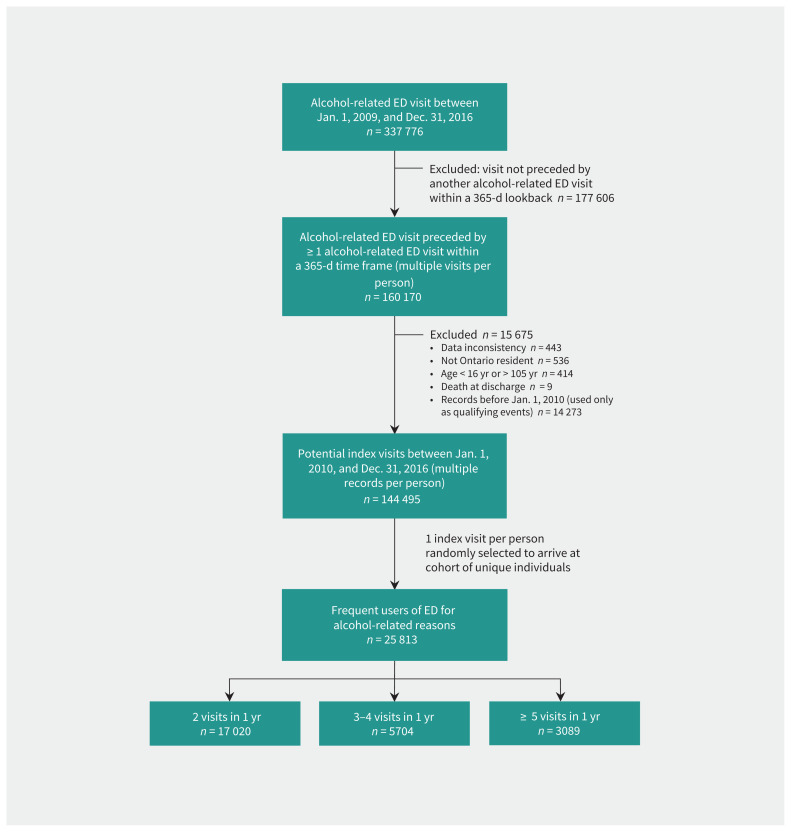
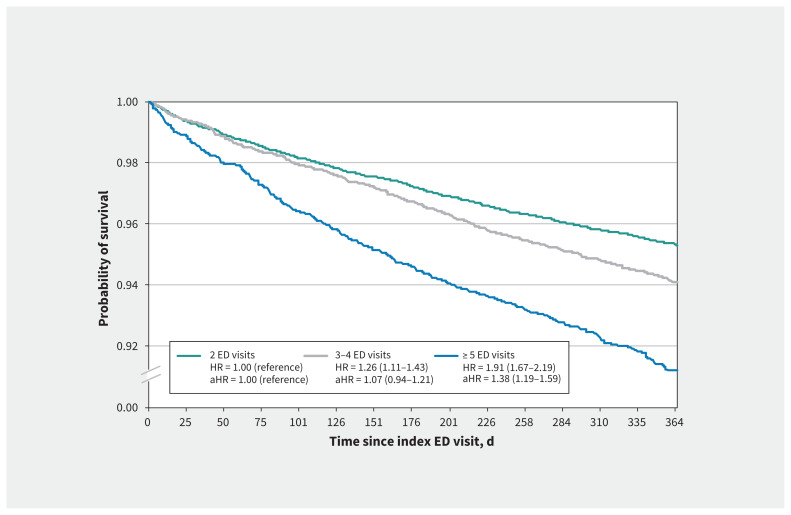
Results: Of the 25 813 people included in the cohort, 17 020 (65.9%) had 2 emergency department visits within 1 year, 5704 (22.1%) had 3 or 4 visits, and 3089 (12.0%) had 5 or more visits. Males, people aged 45-64 years, and those living in urban centres and lower-income neighbourhoods were more likely to have 3 or 4 visits, or 5 or more visits. The all-cause 1-year mortality rate was 5.4% overall, ranging from 4.7% among patients with 2 visits to 8.8% among those with 5 or more visits. Death due to external causes (e.g., suicide, accidents) was most common. The adjusted mortality rate was 38% higher for patients with 5 or more visits than for those with 2 visits (adjusted hazard ratio 1.38, 95% confidence interval 1.19-1.59). Among 25 298 people aged 16-74 years, this represented 30 607 YPLL.
Interpretation: We observed a high mortality rate among relatively young, mostly urban, lower-income people with frequent emergency department visits for alcohol-related reasons. These visits are opportunities for intervention in a high-risk population to reduce a substantial mortality burden.
© 2020 Joule Inc. or its licensors.
Conflict of interest statement
Competing interests: None declared.
Figures
References
-
- Rehm J, Mathers C, Popova S, et al. Global burden of disease and injury and economic cost attributable to alcohol use and alcohol-use disorders. Lancet 2009;373:2223–33. - PubMed
-
- Global status report on alcohol and health 2018. Geneva: World Health Organization; 2018.
-
- GBD 2016 Risk Factors Collaborators. Global, regional, and national comparative risk assessment of 84 behavioural, environmental and occupational, and metabolic risks or clusters of risks, 1990–2016: a systematic analysis for the Global Burden of Disease Study 2016. Lancet 2017;390:1345–422. - PMC - PubMed
-
- Alcohol harm in Canada: examining hospitalizations entirely caused by alcohol and strategies to reduce alcohol harm. Ottawa: Canadian Institute for Health Information; 2017.
-
- Rehm JBD, Brochu S, Fischer B, et al. The costs of substance abuse in Canada 2002. Ottawa: Canadian Centre on Substance Abuse; 2006.
MeSH terms
LinkOut - more resources
Full Text Sources
Medical
Research Materials