Review
. 2021 Mar;56(3):552-566.
doi: 10.1038/s41409-020-01134-4. Epub 2020 Nov 24.

Taming the beast: CRS and ICANS after CAR T-cell therapy for ALL

Affiliations
Review

Taming the beast: CRS and ICANS after CAR T-cell therapy for ALL

Vipul S Sheth et al. Bone Marrow Transplant. 2021 Mar.

Abstract

Treatment with CD19 or CD22-targeted chimeric antigen receptor-engineered T (CD19/CD22 CAR-T) cells achieve complete responses in 60-90% of adults and children with refractory or relapsed (R/R) acute lymphoblastic leukemia (ALL). This led to the approval of tisagenlecleucel (Kymriah) by the FDA and several European regulatory agencies in ALL patients up to 25 years of age. Although CAR T-cell therapy is likely to transform the ALL therapeutic landscape, its development and wide dissemination have been impacted by the occurrence of significant toxicities; namely, cytokine release syndrome (CRS) and Immune effector cell-Associated Neurotoxicity Syndrome (ICANS) have been reported at higher rates in ALL patients compared to other B cell malignancies, particularly in the adult population. Here, we review recent data suggesting a significant proportion of ALL patients are at risk of developing severe, sometimes life-threatening, CRS, and ICANS after CD19 and CD22 CAR T-cell therapy. After describing the key clinical and laboratory features of severe CRS and ICANS, we explore the disease and treatment-related factors that may predict the severity of these toxicities. Last, we review strategies under investigation in the prophylactic and therapeutic settings to improve the safety of CAR T-cells for ALL.


Conflict of interest statement

No conflicts of interest to declare

Figures
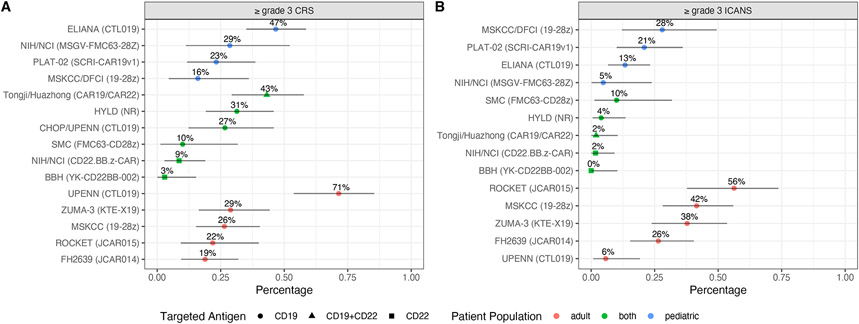
Figure 1.
Figure 1.. Grade ≥3 CRS (A) and ICANS (B) in ALL patients receiving CD19 CAR T-cell therapy
Dots, observed proportions; grey horizontal lines, 95% confidence intervals using the Clopper-Pearson method. CRS grading systems differ across clinical trials. ICANS was graded using the Common Terminology Criteria for Adverse Events (CTCAE). Abbreviations: AE, adverse event; BBH, Beijin Boren Hospital; CAR, chimeric antigen receptor; CRS, cytokine release syndrome; CHOP, Children’s Hospital of Pennsylvania; DFCI, Dana Farber Cancer Institute; FHCRC, Fred Hutchinson Cancer Research Center; Flu, fludarabine; HYLD, Hebei Yanda Lu Daopei Hospital; ICANS, immune effector cell-associated neurotoxicity syndrome; MSKCC, Memorial Sloan Kettering Cancer Center; MRD; minimal residual disease; NCI, National Cancer Institute; NIH, National Institute of Health; NR, not reported; SMC, Sheba Medical Center; UPENN, University of Pennsylvania.
Figure 2.
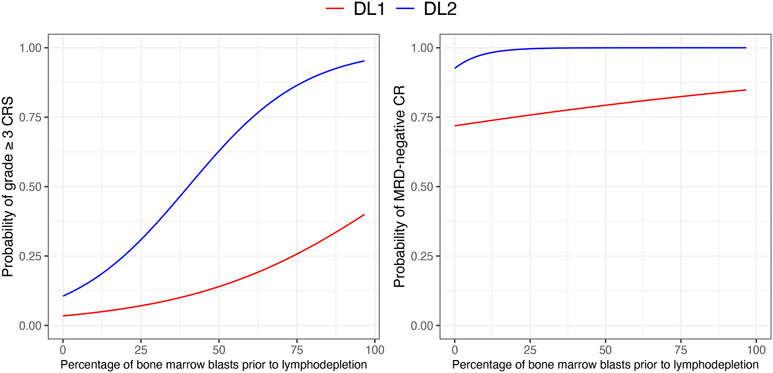
Figure 2.. Prediction of dose-outcomes relationships after CD19 CAR T cell therapy (adapted from Hay et al, Blood 2017)
Left panel, probabilities of developing grade ≥3 CRS from a proportional odds model adjusting for Cy-Flu lymphodepletion and including two interaction terms (CAR T cell dose level [DL] and the pre-lymphodepletion bone marrow blast percentage; Cy-Flu lymphodepletion and the pre-lymphodepletion bone marrow blast percentage). Right panel, probabilities of achieving an MRD-negative CR from a logistic regression model. Abbreviations: CAR, chimeric antigen receptor, CR, complete remission; DL, dose level, CRS, cytokine release syndrome, ICANS, immune effector cell-associated neurotoxicity syndrome; MRD, minimal residual disease.

References

    1. Maude SL, Frey N, Shaw PA, Aplenc R, Barrett DM, Bunin NJ et al. Chimeric Antigen Receptor T Cells for Sustained Remissions in Leukemia. The New England Journal of Medicine 2014; 371: 1507–1517. - PMC - PubMed
    1. Lee DW, Kochenderfer JN, Stetler-Stevenson M, Cui YK, Delbrook C, Feldman SA et al. T cells expressing CD19 chimeric antigen receptors for acute lymphoblastic leukaemia in children and young adults: a phase 1 dose-escalation trial. Lancet (London, England) 2015; 385: 517–28. - PMC - PubMed
    1. Turtle CJ, Hanafi L-A, Berger C, Gooley TA, Cherian S, Hudecek M et al. CD19 CAR–T cells of defined CD4+:CD8+ composition in adult B cell ALL patients. Journal of Clinical Investigation 2016; 126: 2123–2138. - PMC - PubMed
    1. Pan J, Yang J, Deng B, Zhao X, Zhang X, Lin Y et al. High efficacy and safety of low-dose CD19-directed CAR-T cell therapy in 51 refractory or relapsed B acute lymphoblastic leukemia patients. Leukemia 2017; 31: 2587. - PubMed
    1. Gardner RA, Finney O, Annesley C, Brakke H, Summers C, Leger K et al. Intent to treat leukemia remission by CD19CAR T cells of defined formulation and dose in children and young adults. Blood 2017; 129: blood-2017-02-769208. - PMC - PubMed

Publication types