. 2020 Nov;8(22):e14646.
doi: 10.14814/phy2.14646.

Sex differences and effects of the estrous stage on hippocampal-prefrontal theta communications

Affiliations

Sex differences and effects of the estrous stage on hippocampal-prefrontal theta communications

Kristin J Schoepfer et al. Physiol Rep. 2020 Nov.

Abstract

Effective communication between the mammalian hippocampus and neocortex is essential to certain cognitive-behavioral tasks critical to survival in a changing environment. Notably, functional synchrony between local field potentials (LFPs) of the ventral hippocampus (vHPC) and the medial prefrontal cortex (mPFC) within the theta band (4-12 Hz) underlies innate avoidance behavior during approach-avoidance conflict tasks in male rodents. However, the physiology of vHPC-mPFC communications in females remains unestablished. Furthermore, little is known about how mPFC subdivisions functionally interact in the theta band with hippocampal subdivisions in both sexes in the absence of task demand. Given the established roles of biological sex and gonadal hormone status on innate avoidance behaviors and neuronal excitability, here, we characterize the effects of biological sex and female estrous stage on hippocampal-prefrontal (HPC-mPFC) theta signaling in freely moving female and male rats. LFPs from vHPC, dorsal hippocampus (dHPC), mPFC-prelimbic (PrL), and mPFC-infralimbic (IL) were simultaneously recorded during spontaneous exploration of a familiar arena. Data suggest that theta phase and power in vHPC preferentially synchronize with PrL; conversely, dHPC and IL preferentially synchronize. Males displayed greater vHPC-PrL theta synchrony than females, despite similar regional frequency band power and inter-regional coherence. Additionally, several significant estrous-linked changes in HPC-mPFC theta dynamics were observed. These findings support the hypothesis that HPC-mPFC theta signaling is sensitive to both biological sex and female estrous stage. These findings establish novel research avenues concerning sex as a biological variable and effects of gonadal hormone status on HPC-mPFC network activity as it pertains to threat evaluation biomarkers.

Keywords: estrous; sex differences; theta oscillations.


Conflict of interest statement

Authors declare no conflicts of interest.

Figures
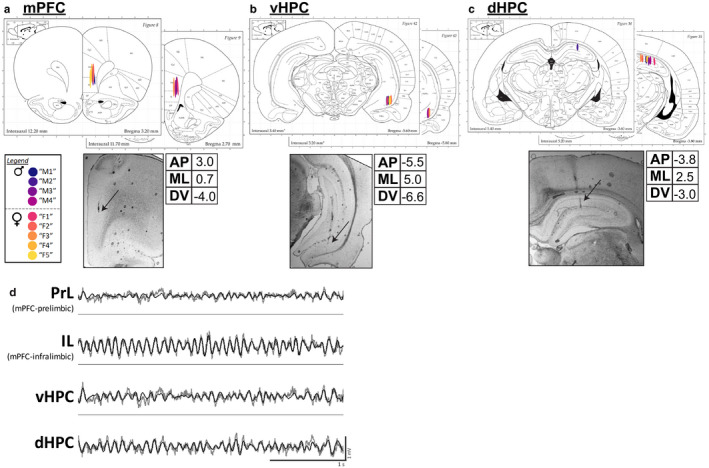
Figure 1
Figure 1
Electrode implant sites and representative LFP traces. (a) Medial prefrontal cortex (mPFC). Four‐electrode bundles with a total vertical spread of 3mm were implanted targeting mPFC‐Infralimbic (IL), such that the two dorsal‐most channels targeted mPFC‐Prelimbic (PrL). (b) Ventral hippocampus (vHPC). Six‐electrode bundles with a total vertical spread of 1mm were implanted targeting vHPC CA1. (c) Dorsal hippocampus (dHPC). Six‐electrode bundles with a total vertical spread of 1mm were implanted targeting dHPC CA1. Male and female implant locations are matched. Tables list stereotaxic coordinates (AP: anterior‐posterior; ML: medial‐lateral; DV: dorsal‐ventral).Below: Example of photographs of electrode lesion sites, 5× objective. Black arrows indicate tissue lesions. Brain atlas images are adapted from Paxinos and Watson (Paxinos & Watson, 2006). (d) Representative traces of simultaneously‐recorded LFPs from PrL, IL, vHPC, and dHPC during active exploration in a familiar arena. Raw traces are plotted in gray and theta‐filtered traces are overlaid in black
Figure 2
Figure 2
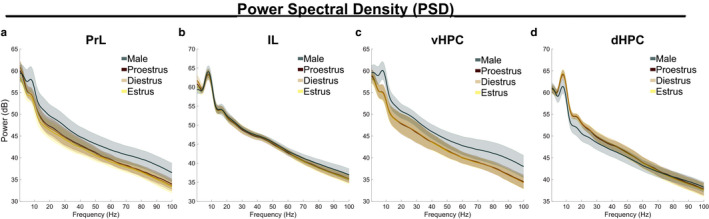
Power spectral density estimates in prefrontal and hippocampal subregions are similar between the sexes and across estrous stages. The shape of PSD estimates (0.5–100 Hz) did not statistically differ between the sexes or between females estrous stages in (a) PrL (sexF = 1.4291,p = .2745; estrousF = 6.6482 × 1012,p = .55955), (b) IL (sexF = 0.19711p = .73540; estrousF = 3.5331 × 1012,p = .97006), (c) vHPC (sexF = 3.0069,p = .10962; estrousF = 1.2988 × 1011,p = .97776), or (d) dHPC (sexF = 1.7919,p = .20312; estrousF = 2.1148 × 1011,p = .99954). Data represent epochs of movement 5–15 cm/s and are plotted as mean ± SEM; shaded error represents subjects. Female‐male comparisons were analyzed by functional two‐sampleF‐tests; estrous stage comparisons were analyzed by functional ANOVAs. Sample sizes are found in Table 1
Figure 3
Figure 3
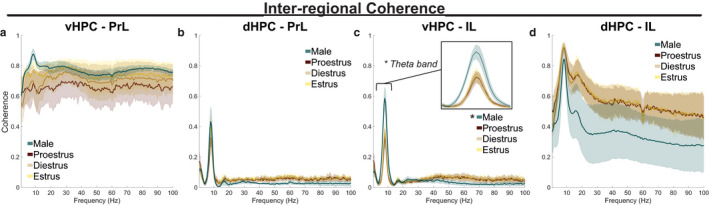
Sex‐associated difference in inter‐regional coherence. (a) The shape of 0.5–100 Hz coherence between vHPC and PrL did not statistically differ between the sexes (F = 0.52483,p = .57435) or between female estrous stages (F = 4.0243,p = .89905). (b) dHPC‐PrL coherence did not statistically differ between the sexes (F = 1.39414,p = .26884) or between female estrous stages (F = 0.18512,p = .94449). (c) While vHPC‐IL coherence was similar between female estrous stages (F = 0.18512,p = .94449), a statistical difference between males and females was observed (F = 3.7873, *p = .02094), an effect driven specifically by the theta band (4–12 Hz), shown in inset (F = 7.9277, *p = .01818). (d) dHPC‐IL coherence did not statistically differ between the sexes (F = 1.2212,p = .31942) or between female estrous stages (F = 0.36527,p = .99707). Data represent epochs of movement 5–15 cm/s and are plotted as mean ± SEM; shaded error represents subjects. Coherence functions were analyzed between 0.5 and 100 Hz first, then frequency bands of interest were analyzed post‐hoc. Female‐male comparisons were analyzed by functional two‐sampleF‐tests; estrous stage comparisons were analyzed by functional ANOVAs. Sample sizes are found in Table 1
Figure 4
Figure 4
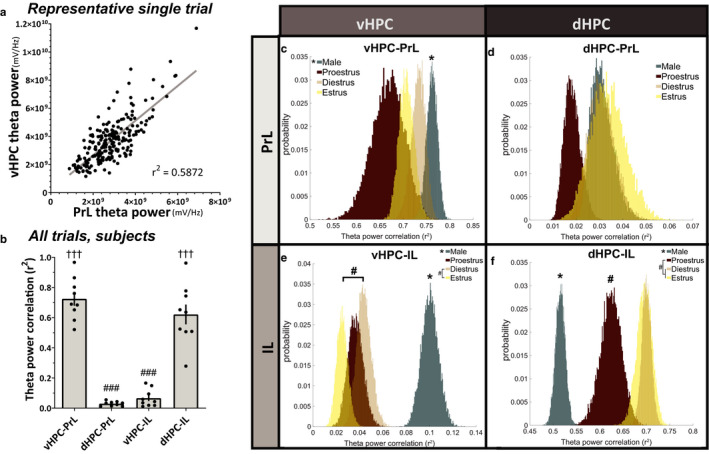
Hippocampal‐prefrontal theta band power correlations differ by sex and estrous stage. (a) Representative example of one trial's theta power correlation between vHPC and PrL in the familiar arena. Each data point represents the sum of theta band power in a 2.6s window. (b) Subject‐averaged theta power correlations between vHPC‐PrL and dHPC‐IL were significantly greater than those between dHPC‐PrL or vHPC‐IL (RM ANOVA, F3,24 = 76.82, ***p < .0001; Tukey's multiple comparison test,### p < .0001 versus vHPC‐PrL,††† p < .0001 versus dHPC‐PrL;n = 9 subjects). (c) vHPC‐PrL theta power correlations were significantly greater for males than females (*p = .002194). Female estrous stage did not have a statistically significant effect on vHPC‐PrL theta power correlations (diestrus/proestrusp = .0768; diestrus/estrusp = .2564; proestrus/estrusp = .27368). (d) dHPC‐PrL theta power correlations were not statistically different between the sexes (p = .6584) or between female estrous stages (diestrus/proestrusp = .05152; diestrus/estrusp = .74699; proestrus/estrusp = .0476). (e) vHPC‐IL theta power correlations were significantly greater for males than females (*p < 1.0 × 10−15). For females, estrus statistically decreased vHPC‐IL theta power correlations as compared to diestrus stage (# p = .01471), but no other statistical differences were observed (diestrus/proestrusp = .43622; proestrus/estrusp = .17021). (f) dHPC‐IL theta power correlations were statistically greater for females than males (*p = 1.3323 × 10−15). While female diestrus and estrus stages were comparable (p = .84095), proestrus reduced dHPC‐IL theta power correlations in females (diestrus/proestrus# p = .00115; proestrus/estrus# p = .0081206). Data were analyzed via direct probability estimates on hierarchically‐bootstrapped samples; pbootvalues were converted to two‐tailedp‐values. Sample size inputs for hierarchical bootstrapping are found in Table 1
Figure 5
Figure 5
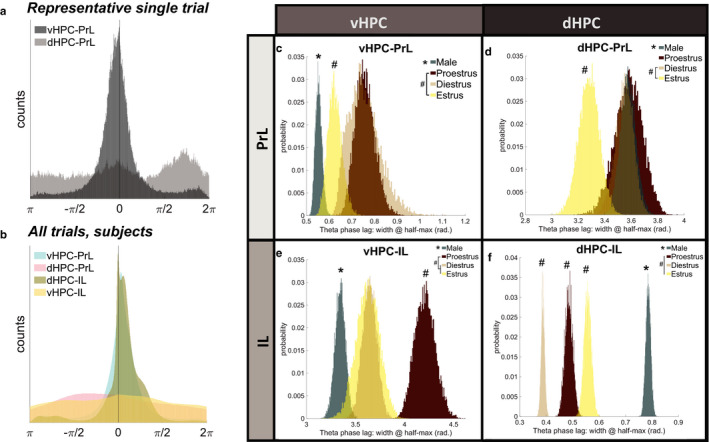
Hippocampal‐prefrontal theta phase lags differ by sex and estrous stage. (a) Representative distributions of hippocampal‐prefrontal theta phase lags from one trial: reliable theta phase synchrony from vHPC to PrL, but unreliable phase synchrony from dHPC to PrL. (b) Combining all trials, theta phase lags from vHPC to PrL (0.6193 rad.) and dHPC to IL (0.5194 rad.) were more reliably distributed than those from dHPC to PrL (5.7238 rad.) and vHPC to IL (6.2632 rad.). (c) Males had greater vHPC‐PrL theta phase synchrony (i.e. smaller width at half‐max distribution peak) than females (*p = 3.1086 × 10–15). Estrus enhanced vHPC‐PrL theta phase synchrony versus proestrus stage (*p = .01018). Diestrus female values were statistically comparable to both proestrus and estrus (diestrus/proestrusp = .90953; diestrus/estrusp = .05391). (d) Females had greater phase synchrony than males from dHPC to PrL (*p = 5.987 × 10−4). Female estrus trials enhanced dHPC‐PrL theta phase synchrony as compared to diestrus female trials (# p = .010637) but were not statistically different from proestrus female trials (p = .026184). (e) Males had more reliable vHPC‐IL theta phase synchrony than females (*p = 2.6645 × 10−15). While female diestrus and estrus stages were comparable (p = .94046), proestrus significantly reduced vHPC‐IL theta phase synchrony versus all other groups (proestrus/diestrus# p = 5.0000 × 10−7; proestrus/estrus# p = 5.556 × 10−5). (f) Females had greater dHPC‐IL theta phase synchrony than males (*p < 1.0 × 10−15). Estrous stage statistically modulated dHPC‐IL theta synchrony in females in an order of Diestrus > Proestrus>Estrus (diestrus/proestrus# p = 1.7764 × 10−15; diestrus/estrus# p = 1.7764 × 10−15; proestrus/estrus# p = 3.7229 × 10−4). Data were analyzed via direct probability estimates on hierarchically‐bootstrapped samples; pbootvalues were converted to two‐tailedp‐values. Sample size inputs for hierarchical bootstrapping are found in Table 1
Figure 6
Figure 6
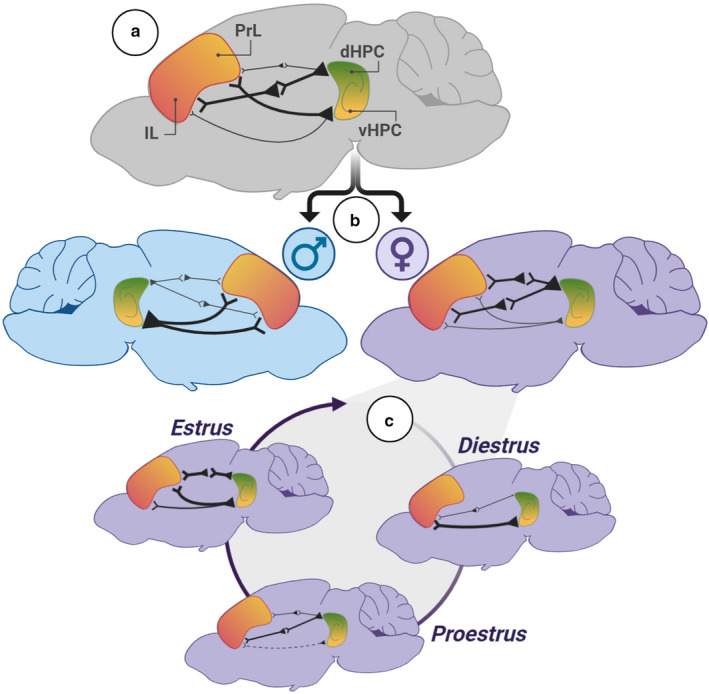
Summary of findings. (a) The strongest theta‐based circuits overall were vHPC‐PL and dHPC‐IL. (b) Sex differences in theta communications. Males had enhanced theta signaling in vHPC‐mPFC circuits as compared to females. Females had enhanced theta signaling in dHPC‐mPFC circuits as compared to males. (c) In females, estrous stage significantly affected the strength of theta‐band communications in HPC‐mPFC circuits in a dynamic fashion

References

    1. Adhikari, A. , Topiwala, M. A. , & Gordon, J. A. (2010). Synchronized activity between the ventral hippocampus and the medial prefrontal cortex during anxiety. Neuron, 65, 257–269. 10.1016/j.neuron.2009.12.002 - DOI - PMC - PubMed
    1. Arélin, K. , Mueller, K. , Barth, C. , Rekkas, P. V. , Kratzsch, J. , Burmann, I. , Villringer, A. , Sacher, J. (2015). Progesterone mediates brain functional connectivity changes during the menstrual cycle‐a pilot resting state MRI study. Frontiers in Neuroscience, 9, 1–11. - PMC - PubMed
    1. Bach, D. R. , Guitart‐Masip, M. , Packard, P. A. , Miró, J. , Falip, M. , Fuentemilla, L. , Dolan, R. J. (2014). Human hippocampus arbitrates approach‐avoidance conflict. Current Biology, 24, 541–547. - PMC - PubMed
    1. Bastos, A. M. , Vezoli, J. , & Fries, P. (2015). Communication through coherence with inter‐areal delays. Current Opinion in Neurobiology, 31, 173–180. 10.1016/j.conb.2014.11.001 - DOI - PubMed
    1. Becker, J. B. , Arnold, A. P. , Berkley, K. J. , Blaustein, J. D. , Eckel, L. A. , Hampson, E. , Herman, J. P. , Marts, S. , Sadee, W. , Steiner, M. , Taylor, J. , & Young, E. (2005). Strategies and methods for research on sex differences in brain and behavior. Endocrinology, 146, 1650–1673. 10.1210/en.2004-1142 - DOI - PubMed

Publication types

LinkOut - more resources