Comparative Study
. 2021 Jan 8;49(D1):D981-D987.
doi: 10.1093/nar/gkaa1083.

Mouse Genome Database (MGD): Knowledgebase for mouse-human comparative biology

Collaborators, Affiliations
Comparative Study

Mouse Genome Database (MGD): Knowledgebase for mouse-human comparative biology

Judith A Blake et al. Nucleic Acids Res. .

Abstract

The Mouse Genome Database (MGD; http://www.informatics.jax.org) is the community model organism knowledgebase for the laboratory mouse, a widely used animal model for comparative studies of the genetic and genomic basis for human health and disease. MGD is the authoritative source for biological reference data related to mouse genes, gene functions, phenotypes and mouse models of human disease. MGD is the primary source for official gene, allele, and mouse strain nomenclature based on the guidelines set by the International Committee on Standardized Nomenclature for Mice. MGD's biocuration scientists curate information from the biomedical literature and from large and small datasets contributed directly by investigators. In this report we describe significant enhancements to the content and interfaces at MGD, including (i) improvements in the Multi Genome Viewer for exploring the genomes of multiple mouse strains, (ii) inclusion of many more mouse strains and new mouse strain pages with extended query options and (iii) integration of extensive data about mouse strain variants. We also describe improvements to the efficiency of literature curation processes and the implementation of an information portal focused on mouse models and genes for the study of COVID-19.


Figures

Figure 1.
Figure 1.
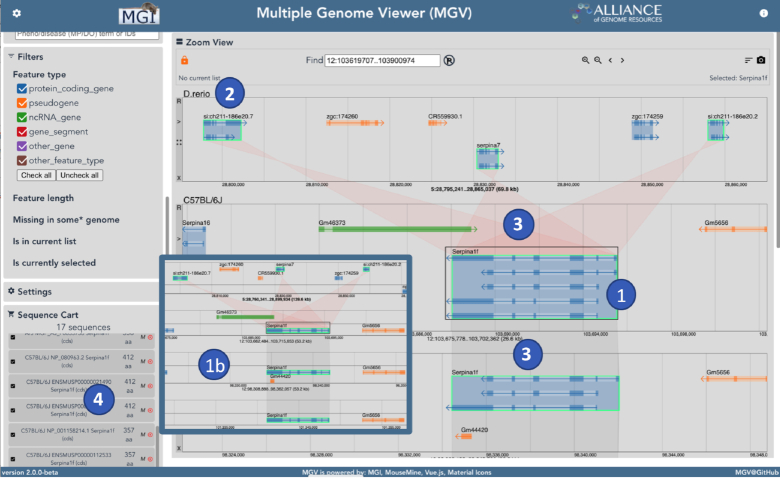
This screenshot shows several recent enhancements to MGV. (1) Intron/exon structure is shown for all transcripts of a gene, although the user can also switch to a compact view (1b) showing only a representative transcript for each gene; (2) organisms from the Alliance of Genome resources have been added, including human, rat, zebrafish (shown), fly, worm and yeast; (3) the Alliance strict orthology data set is used for connecting genes across organisms, while common canonical gene id is used to connect genes across strains and (4) the user can select and download sequences in FASTA format. Here the user has selected ‘all CDS sequences for Serpin1f and its displayed orthologs
Figure 2.
Figure 2.
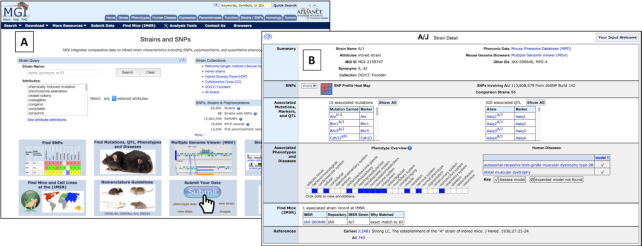
(A) Strain and SNPs home page and search form and (B) strain detail page for the A/J inbred mouse strain.
Figure 3.
Figure 3.
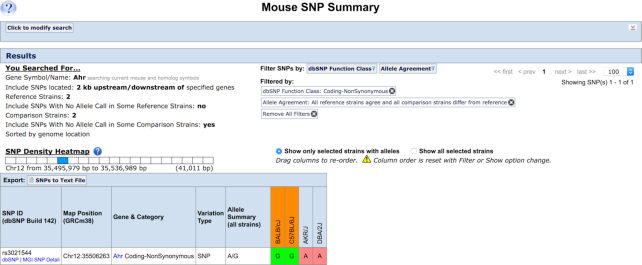
Strain group comparisons of SNPs. Screenshot of the SNP search results page showing the only non-synonymous coding SNP in the Ahr gene were the variant in BALB/cJ and C57BL/6J (strains with high ligand binding affinity) differs from AKR/J and DBA/2J (strains with low ligand binding affinity). This SNP (rs3021544) has been shown to cause a reduction in ligand binding.

References

    1. Bult C.J., Blake J.A., Smith C.M., Kadin J.A., Richardson J.E. the Mouse Genome Database Group . Mouse Genome Database (mgd). Nucleic Acid Res. 2019; 47:801–806.
    1. Wilkinson M.D., Dumontier M., Aalbersberg I.J., Appleton G., Axton M., Baak A., Blomberg N., Boiten J.W., da Silva S.L.B., Bourne P.E. et al.. The FAIR Guiding Principles for scientific data. Sci. Data. 2016; 3:160018. - PMC - PubMed
    1. The Gene Ontology Consortium The Gene Ontology Resources: 20 years and still Going strong. Nucleic Acids Res. 2019; 47:330–338. - PMC - PubMed
    1. Smith C.L., Eppig J.T.. Expanding the mammalian phenotype ontology to support automated exchange of high throughput mouse phenotyping data generated by large-scale mouse knockout screens. J. Biomed. Semantics. 2015; 6:11. - PMC - PubMed
    1. Schriml L.M., Mitraka E., Munro J., Tauber B., Schor M., Nickle L., Felix V., Jeng L., Bearer C., Lichenstein R. et al.. Human Disease Ontology 2018 update: classification, content and workflow expansion. Nucleic Acids Res. 2018; 47:955–962. - PMC - PubMed

Publication types