


Racial Disparities in Recurrence and Overall Survival in Patients With Locoregional Colorectal Cancer
- PMID: 33231683
- PMCID: PMC8168177
- DOI: 10.1093/jnci/djaa182
Racial Disparities in Recurrence and Overall Survival in Patients With Locoregional Colorectal Cancer
Abstract
Background: The purpose of this study was to determine the association between race and long-term cancer outcomes (recurrence and overall survival) within a population of US patients with locoregional colorectal cancer (CRC).
Methods: A cohort study of primary patient data merged with the National Cancer Database as part of a Commission on Cancer Special Study was performed. The study population was a random sample of patients undergoing surgery for stage I to III CRC between years 2006 and 2007 with 5 years of follow-up. Propensity-weighted multivariable Cox regression was performed with pooled results to yield statistical inferences. Prespecified sensitivity analysis was performed only for patients who received guideline concordant care (GCC) of primary CRC. All statistical tests were 2-sided.
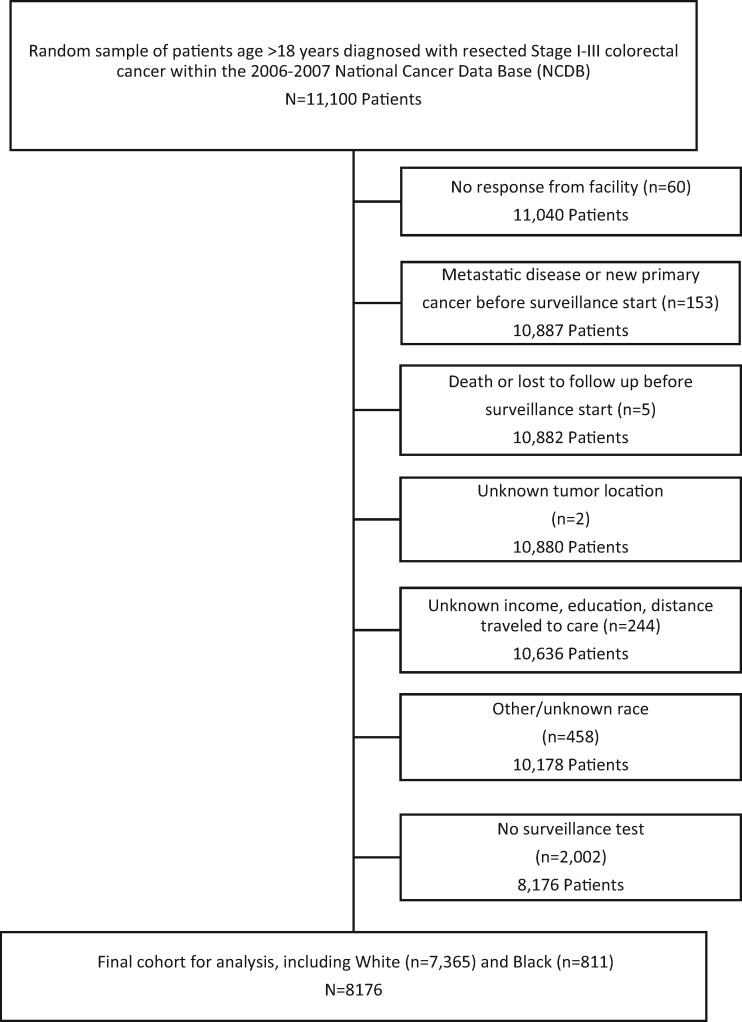
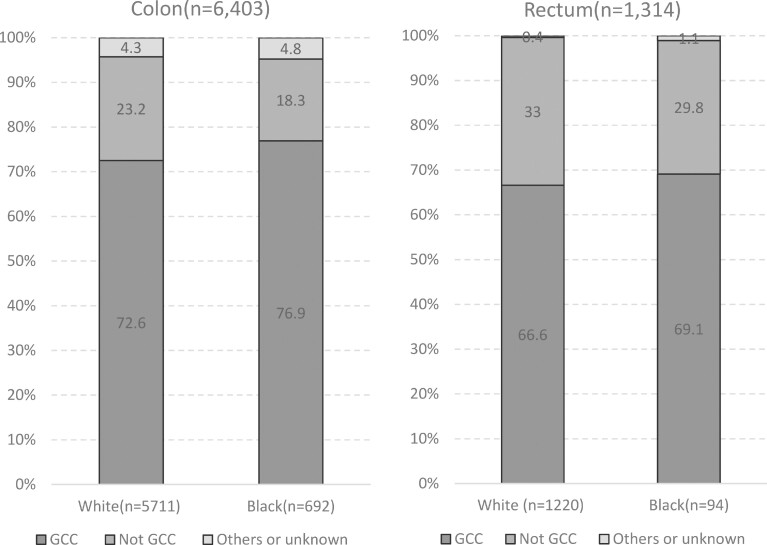
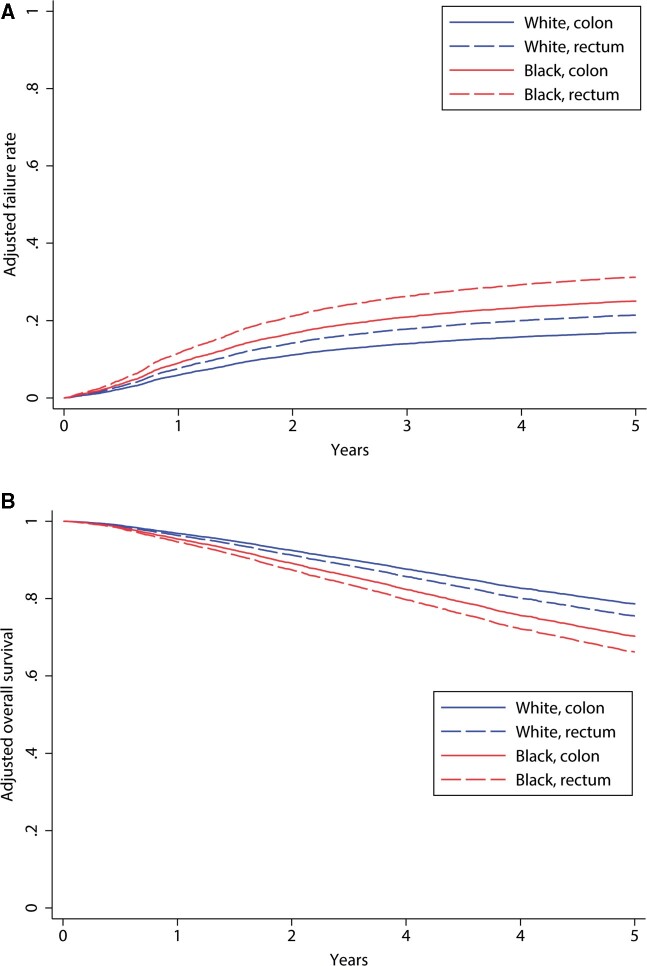
Results: The study population included 8176 patients, 9.9% (n = 811) Black and 90.1% (n = 7365) White. Black patients were more likely to be uninsured or underinsured, have lower household income, and lower educational status (all P < .001). Rates of GCC were higher among Black vs White patients with colon cancer (76.9% vs 72.6%, P = .02), and Black and White patients with rectal cancer were treated with radiation at similar rates (69.1% vs 66.6%, P = .64). Black race was independently associated with increased risk of recurrence (hazard ratio [HR] = 1.48, 95% confidence interval [CI] = 1.26 to 1.73) and mortality (HR = 1.37, 95% CI = 1.18 to 1.59). In sensitivity analysis of only patients who received GCC, observed effects for recurrence (HR = 1.51, 95% CI = 1.27 to 1.79) and overall survival (HR = 1.40, 95% CI = 1.18 to 1.66) persisted.
Conclusions: Despite higher rates of GCC for CRC, Black patients experience a higher risk of recurrence and mortality compared with White patients.
© The Author(s) 2020. Published by Oxford University Press. All rights reserved. For permissions, please email: journals.permissions@oup.com.
Figures
References
-
- Siegel RL, Miller Kd G, Sauer A, et al. Colorectal cancer statistics, 2020. CA Cancer J Clin. 2020; 70(3):145–164. - PubMed
-
- Sargent DJ, Wieand HS, Haller DG, et al. Disease-free survival versus overall survival as a primary end point for adjuvant colon cancer studies: individual patient data from 20,898 patients on 18 randomized trials. J Clin Oncol. 2005;23(34):8664–8670. - PubMed
-
- Snyder RA, Hu CY, Cuddy A, et al. ; for the Alliance for Clinical Trials in Oncology Network Cancer Surveillance Optimization Working Group. Association between intensity of posttreatment surveillance testing and detection of recurrence in patients with colorectal cancer. JAMA. 2018;319(20):2104–2115. - PMC - PubMed
-
- American College of Surgeons. Cancer. Facility oncology registry data standards (FORDS): revised for 2004. http://www.facs.org/∼/media/files/quality%20programs/cancer/coc/fords/fo.... 2005. Accessed April 1, 2020.
-
- American Joint Committee on Cancer. American Joint Committee on Cancer AJCC Cancer Staging Manual. 7th ed. New York: Springer; 2010.
Publication types
MeSH terms
Grants and funding
LinkOut - more resources
Full Text Sources
Medical
