


Brain functional connectivity dynamics at rest in the aftermath of affective and cognitive challenges
- PMID: 33231916
- PMCID: PMC7856644
- DOI: 10.1002/hbm.25277
Brain functional connectivity dynamics at rest in the aftermath of affective and cognitive challenges
Abstract
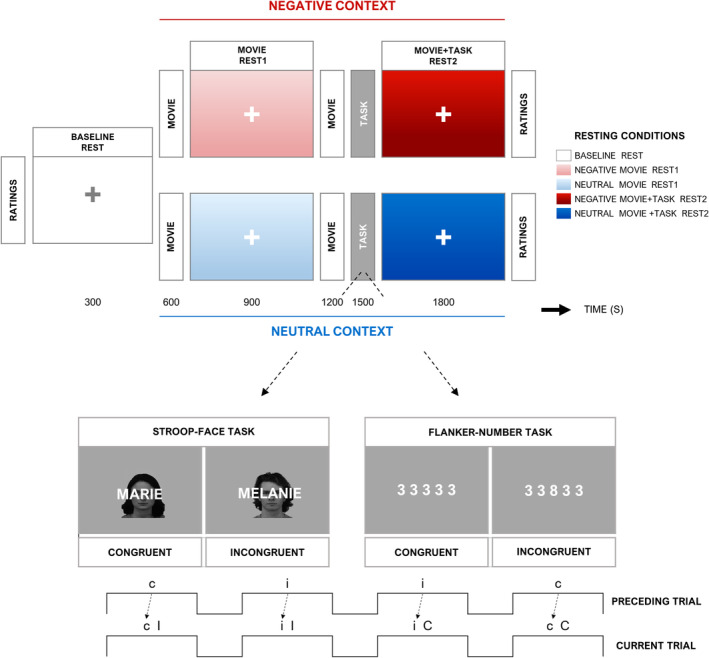
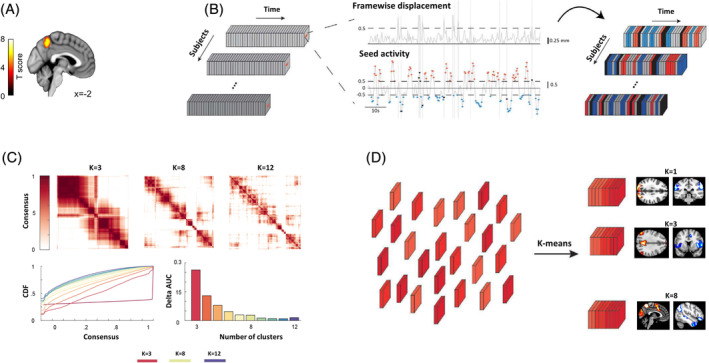
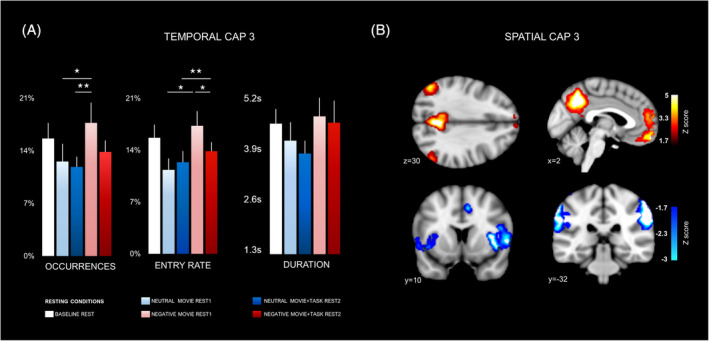
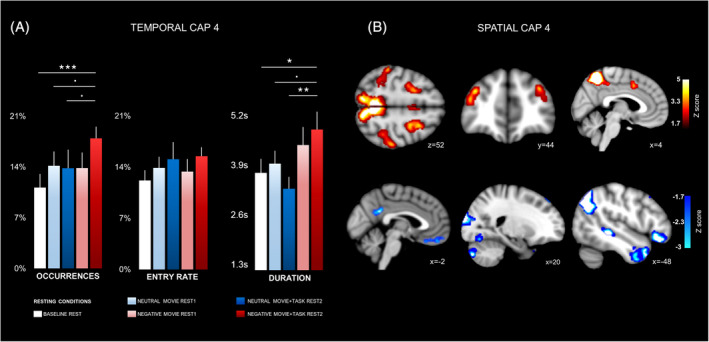
Carry-over effects on brain states have been reported following emotional and cognitive events, persisting even during subsequent rest. Here, we investigated such effects by identifying recurring co-activation patterns (CAPs) in neural networks at rest with functional magnetic resonance imaging (fMRI). We compared carry-over effects on brain-wide CAPs at rest and their modulation after both affective and cognitive challenges. Healthy participants underwent fMRI scanning during emotional induction with negative valence and performed cognitive control tasks, each followed by resting periods. Several CAPs, overlapping with the default-mode (DMN), salience, dorsal attention, and social cognition networks were impacted by both the preceding events (movie or task) and the emotional valence of the experimental contexts (neutral or negative), with differential dynamic fluctuations over time. Temporal metrics of DMN-related CAPs were altered after exposure to negative emotional content (compared to neutral) and predicted changes in subjective affect on self-reported scores. In parallel, duration rates of another attention-related CAP increased with greater task difficulty during the preceding cognitive control condition, specifically in the negative context. These findings provide new insights on the anatomical organization and temporal inertia of functional brain networks, whose expression is differentially shaped by emotional states, presumably mediating adaptive homeostatic processes subsequent to behaviorally challenging events.
Keywords: brain networks; co-activation patterns; cognitive control; dynamic functional connectivity (dFC); emotions; negative affect.
© 2020 The Authors. Human Brain Mapping published by Wiley Periodicals LLC.
Conflict of interest statement
The authors declare no conflict of interest.
Figures
References
-
- Apazoglou, K. , Küng, A.‐L. , Cordera, P. , Aubry, J.‐M. , Dayer, A. , Vuilleumier, P. , & Piguet, C. (2019). Rumination related activity in brain networks mediating attentional switching in euthymic bipolar patients. International Journal of Bipolar Disorders, 7, 3 10.1186/s40345-018-0137-5. - DOI - PMC - PubMed
-
- Barnes, A. , Bullmore, E. T. , & Suckling, J. (2009). Endogenous human brain dynamics recover slowly following cognitive effort. PLoS One, 4, e6626 10.1371/journal.pone.0006626/nhttp://www.plosone.org/article/fetchObject.action?uri=info:doi/10.1371/journal..... - DOI - PMC - PubMed
-
- Baumeister, R. F. (2003). Ego depletion and self‐regulation failure: A resource model of self‐control. Alcoholism, Clinical and Experimental Research, 27, 281–284. - PubMed
Publication types
MeSH terms
LinkOut - more resources
Full Text Sources
Miscellaneous
