


Physician Practice Patterns in Holding Inflammatory Bowel Disease Medications due to COVID-19, in the SECURE-IBD Registry
- PMID: 33232456
- PMCID: PMC7717203
- DOI: 10.1093/ecco-jcc/jjaa243
Physician Practice Patterns in Holding Inflammatory Bowel Disease Medications due to COVID-19, in the SECURE-IBD Registry
Abstract
Background: We aimed to describe physician practice patterns in holding or continuing IBD therapy in the setting of COVID-19 infection, using the Surveillance Epidemiology of Coronavirus Under Research Exclusion for Inflammatory Bowel Disease [SECURE-IBD] registry.
Methods: IBD medications that were stopped due to COVID-19 were recorded in the SECURE-IBD registry in addition to demographic and clinical data. We conducted descriptive analyses to understand characteristics associated with stopping IBD medications in response to active COVID-19 infection.
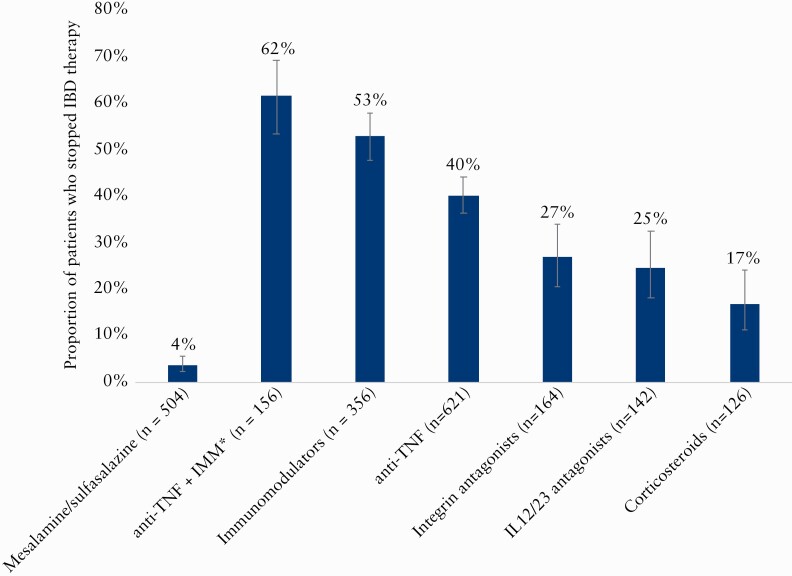
Results: Of 1499 patients, IBD medications were stopped in 518 [34.6%] patients. On bivariate and multivariable analyses, a diagnosis of ulcerative colitis or IBD-unspecified was associated with a lower odds of stopping medication compared with Crohn's disease (adjusted odds ratio [aOR] 0.6, 95% confidence interval [CI] 0.48, 0.75). When evaluating specific medications, 5-aminosalicylic acid was more likely to be continued [p <0.001] whereas anti-tumour necrosis factor therapy and immunomodulator therapy were more likely to be stopped [global p <0.001]. Other demographic and clinical characteristics did not affect prescription patterns.
Conclusions: IBD medications other than immunomodulators were continued in the majority of IBD patients with COVID-19, in the international SECURE-IBD registry. Future studies are needed to understand the impact of stopping or continuing IBD medications on IBD- and COVID-19 related outcomes.
Keywords: Crohn’s disease; IBD therapy; Inflammatory bowel disease; coronavirus disease 2019; ulcerative colitis.
© The Author(s) 2020. Published by Oxford University Press on behalf of European Crohn’s and Colitis Organisation. All rights reserved. For permissions, please email: journals.permissions@oup.com.
Figures
References
MeSH terms
Substances
Grants and funding
LinkOut - more resources
Full Text Sources
Medical
