


Antimicrobial Resistance Patterns in Organic and Conventional Dairy Herds in Sweden
- PMID: 33233471
- PMCID: PMC7700389
- DOI: 10.3390/antibiotics9110834
Antimicrobial Resistance Patterns in Organic and Conventional Dairy Herds in Sweden
Abstract
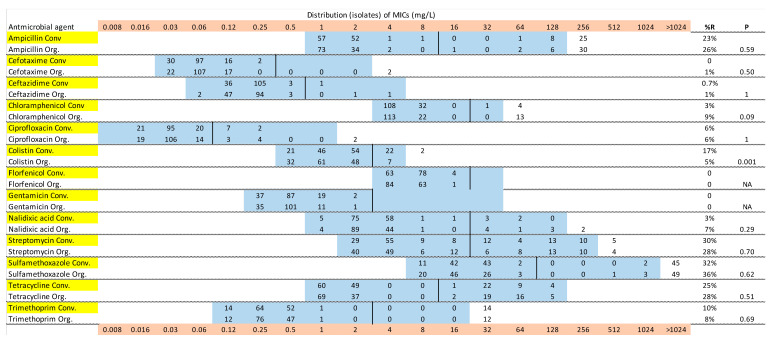
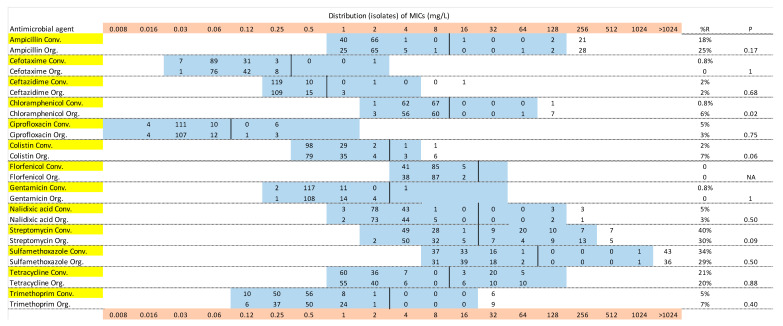
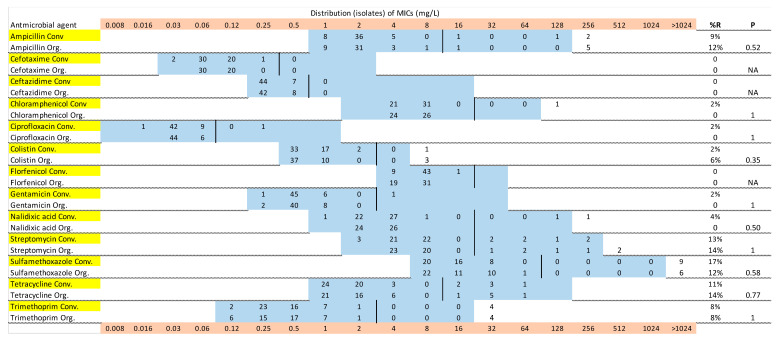
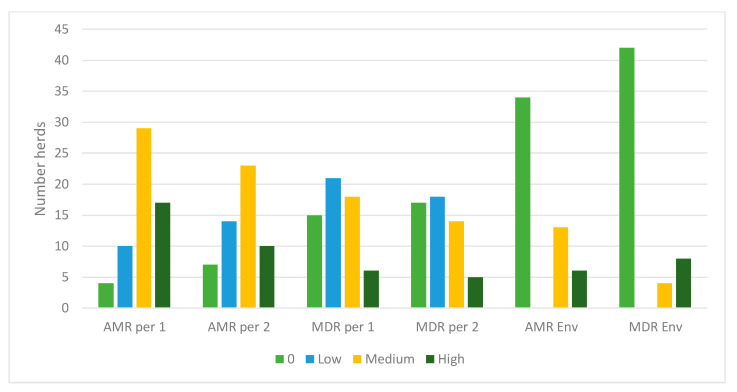
Monitoring antimicrobial resistance (AMR) and use (AMU) is important for control. We used Escherichia coli from healthy young calves as an indicator to evaluate whether AMR patterns differ between Swedish organic and conventional dairy herds and whether the patterns could be related to AMU data. Samples were taken twice, in 30 organic and 30 conventional dairy herds. Selective culturing for Escherichia coli, without antibiotics and with nalidixic acid or tetracycline, was used to estimate the proportions of resistant isolates. Microdilution was used to determine the minimum inhibitory concentrations (MICs) for thirteen antimicrobial substances. AMU data were based on collection of empty drug packages. Less than 8% of the bacterial growth on non-selective plates was also found on selective plates with tetracycline, and 1% on plates with nalidixic acid. Despite some MIC variations, resistance patterns were largely similar in both periods, and between organic and conventional herds. For most substances, only a few isolates were classified as resistant. The most common resistances were against ampicillin, streptomycin, sulfamethoxazole, and tetracycline. No clear association with AMU could be found. The lack of difference between organic and conventional herds is likely due to a generally good animal health status and consequent low AMU in both categories.
Keywords: AMR; MDR; antibiotic; antibiotic resistance; antibiotic use; environment; livestock.
Conflict of interest statement
The authors declare no conflict of interest.
Figures
References
-
- O’Neill J. Wellcome Trust; London, UK: 2016. [(accessed on 1 September 2020)]. Tackling Drug Resistance Globally: Final Report. Available online: https://amr-review.org/sites/default/files/160525_Final%20paper_with%20c....
-
- Mölstad S., Löfmark S., Carlin K., Erntell M., Aspevall O., Blad L., Hanberger H., Hedin K., Hellman J., Norman C., et al. Lessons learnt during 20 years of the Swedish strategic programme against antibiotic resistance. Bull. World Health Organ. 2017;95:764–773. doi: 10.2471/BLT.16.184374. - DOI - PMC - PubMed
-
- Grundin J., Blanco-Penedo I., Fall N., Sternberg-Lewerin S. The Swedish Experience—A Summary of the Swedish Efforts towards a Low and Prudent Use of Antibiotics in Animal Production. SLU Future Animals, Nature and Health Report No. 5. [(accessed on 1 September 2020)];2020 Available online: https://www.slu.se/en/Collaborative-Centres-and-Projects/slu-future-anim...
-
- Swedish Public Health Agency, Swedish Board of Agriculture Swedish Work against Antibiotic Resistance—A One Health Approach. [(accessed on 1 September 2020)];2020 Available online: https://www2.jordbruksverket.se/download/18.693595921700d430c72b254f/158....
-
- OIE Annual Report on Antimicrobial Agents Intended for Use in Animals. [(accessed on 1 September 2020)];2018 Available online: https://rr-africa.oie.int/wp-content/uploads/2019/09/annual_report_amr_3....
Grants and funding
LinkOut - more resources
Full Text Sources
