


Relative Biological Effectiveness of High LET Particles on the Reproductive System and Fetal Development
- PMID: 33233778
- PMCID: PMC7699951
- DOI: 10.3390/life10110298
Relative Biological Effectiveness of High LET Particles on the Reproductive System and Fetal Development
Abstract
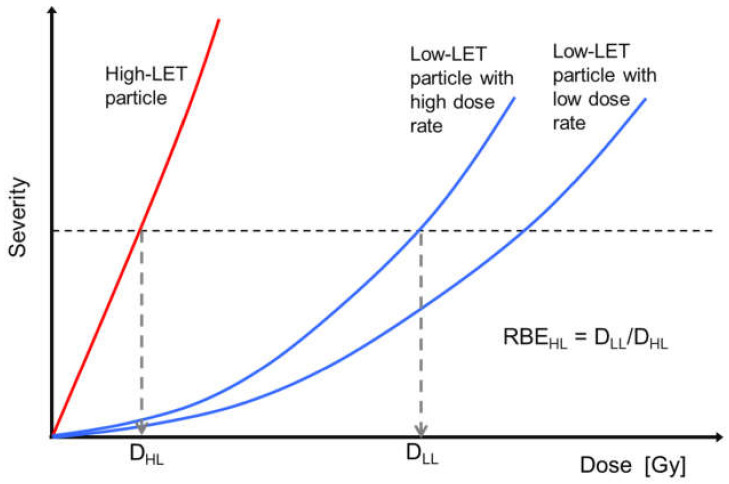
During a space mission, astronauts are inevitably exposed to space radiation, mainly composed of the particles having high values of linear energy transfer (LET), such as protons, helium nuclei, and other heavier ions. Those high-LET particles could induce severer health damages than low-LET particles such as photons and electrons. While it is known that the biological effectiveness of a specified type of radiation depends on the distribution of dose in time, type of the cell, and the biological endpoint in respect, there are still large uncertainties regarding the effects of high-LET particles on the reproductive system, gamete, embryo, and fetal development because of the limitation of relevant data from epidemiological and experimental studies. To safely achieve the planned deep space missions to the moon and Mars that would involve young astronauts having reproductive functions, it is crucial to know exactly the relevant radiological effects, such as infertility of the parent and various diseases of the child, and then to conduct proper countermeasures. Thus, in this review, the authors present currently available information regarding the relative biological effectiveness (RBE) of high-LET particles on the deterministic effects related to the reproductive system and embryonic/fetal development for further discussions about the safety of being pregnant after or during a long-term interplanetary mission.
Keywords: deterministic effect; embryo; fetus; high LET; relative biological effectiveness (RBE); reproductive system; space radiation.
Conflict of interest statement
The authors declare no conflict of interest. The funders had no role in the design of the study; in the collection, analyses, or interpretation of data; in the writing of the manuscript, or in the decision to publish the results.
Figures
References
-
- National Council on Radiation Protection and Measurements (NCRP) Guidance on Radiation Received in Space Activities. NCRP; Bethesda, MD, USA: 1989. NCRP Report No. 98.
-
- National Council on Radiation Protection and Measurements (NCRP) Recommendations of Dose Limits for Low Earth Orbit. NCRP; Bethesda, MD, USA: 2000. NCRP Report No. 132.
-
- National Council on Radiation Protection and Measurements (NCRP) Operational Radiation Safety Program for Astronauts in Low-Earth Orbit: A Basic Framework. NCRP; Bethesda, MD, USA: 2002. NCRP Report No. 142.
-
- National Council on Radiation Protection and Measurements (NCRP) Information Needed to Make Radiation Protection Recommendations for Space Missions beyond Low-Earth Orbit. NCRP; Bethesda, MD, USA: 2006. NCRP Report No. 153.
Publication types
LinkOut - more resources
Full Text Sources
Miscellaneous
