


Feasibility of Four Interventions to Improve Treatment Adherence in Migrants Living with HIV in The Netherlands
- PMID: 33233835
- PMCID: PMC7699853
- DOI: 10.3390/diagnostics10110980
Feasibility of Four Interventions to Improve Treatment Adherence in Migrants Living with HIV in The Netherlands
Abstract
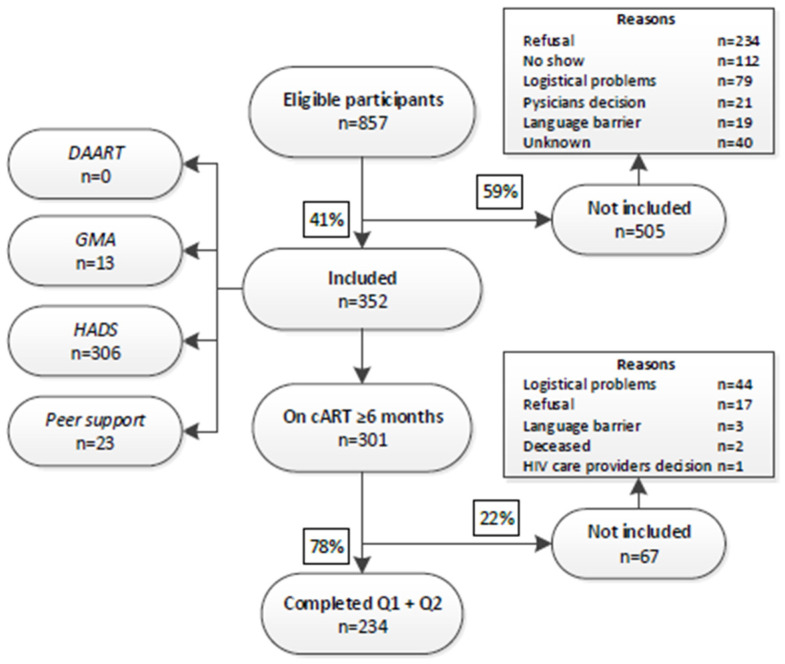
We evaluated the feasibility and efficacy of four existing interventions to improve adherence to them in migrants living with HIV (MLWH): directly administered antiretroviral therapy (DAART), group medical appointments (GMA), early detection and treatment of psychological distress, and peer support by trained MLWH. At baseline and after the interventions, socio-demographic characteristics, psychosocial variables, and data on HIV treatment adherence were collected. The two questionnaires were completed by 234/301 (78%) MLWH included at baseline. Detectable HIV RNA decreased (from 10.3 to 6.8%) as did internalized HIV-related stigma (from 15 to 14 points), and self-reported adherence increased (between 5.5 and 8.3%). DAART and GMA were not feasible interventions. Screening of psychological distress was feasible; however, follow-up diagnostic screening and linkage to psychiatric services were not. Peer support for and by MLWH was feasible. Within this small intervention group, results on HIV RNA < 400 copies/mL (decrease of 23.6%) and outpatient clinic attendance (up to 20.4% kept more appointments) were promising.
Keywords: HIV/AIDS; interventions; migrants; treatment adherence.
Conflict of interest statement
The authors declare no conflict of interest. The institution of A.V. and S.K.B. has received an unrestricted scientific grant from the Dutch Aids Fonds to perform the study.
Figures
References
-
- May M.T., Gompels M., Delpech V., Porter K., Orkin C., Kegg S., Hay P., Johnson M., Palfreeman A., Gilson R., et al. Impact on life expectancy of HIV-1 positive individuals of CD4+ cell count and viral load response to antiretroviral therapy. AIDS. 2014;28:1193–202. doi: 10.1097/QAD.0000000000000243. - DOI - PMC - PubMed
-
- Trickey A., May M.T., Vehreschild J.-J., Obel N., Gill M.J., Crane H.M., Boesecke C., Patterson S., Grabar S., Cazanave C., et al. Survival of HIV-positive patients starting antiretroviral therapy between 1996 and 2013: A collaborative analysis of cohort studies. Lancet HIV. 2017;4:e349–e356. doi: 10.1016/S2352-3018(17)30066-8. - DOI - PMC - PubMed
-
- Langebeek N., Gisolf E.H., Reiss P., Vervoort S.C., Hafsteinsdottir T.B., Richter C., Sprangers M.A.G., Nieuwkerk P.T. Predictors and correlates of adherence to combination antiretroviral therapy (ART) for chronic HIV infection: A meta-analysis. BMC Med. 2014;12:142. doi: 10.1186/s12916-014-0142-1. - DOI - PMC - PubMed
Grants and funding
LinkOut - more resources
Full Text Sources
