. 2020 Nov 24;70(8):1435-1440.
doi: 10.1136/gutjnl-2020-321598. Online ahead of print.

Computational modelling suggests that Barrett's oesophagus may be the precursor of all oesophageal adenocarcinomas

Affiliations

Computational modelling suggests that Barrett's oesophagus may be the precursor of all oesophageal adenocarcinomas

Kit Curtius et al. Gut. .

Abstract

Objective: Barrett's oesophagus (BE) is a known precursor to oesophageal adenocarcinoma (OAC) but current clinical data have not been consolidated to address whether BE is the origin of all incident OAC, which would reinforce evidence for BE screening efforts. We aimed to answer whether all expected prevalent BE, diagnosed and undiagnosed, could account for all incident OACs in the US cancer registry data.

Design: We used a multiscale computational model of OAC that includes the evolutionary process from normal oesophagus through BE in individuals from the US population. The model was previously calibrated to fit Surveillance, Epidemiology and End Results cancer incidence curves. Here, we also utilised age-specific and sex-specific US census data for numbers at-risk. The primary outcome for model validation was the expected number of OAC cases for a given calendar year. Secondary outcomes included the comparisons of resulting model-predicted prevalence of BE and BE-to-OAC progression to the observed prevalence and progression rates.

Results: The model estimated the total number of OAC cases from BE in 2010 was 9970 (95% CI: 9140 to 11 980), which recapitulates nearly all OAC cases from population data. The model simultaneously predicted 8%-9% BE prevalence in high-risk males age 45-55, and 0.1%-0.2% non-dysplastic BE-to-OAC annual progression in males, consistent with clinical studies.

Conclusion: There are likely few additional OAC cases arising in the US population outside those expected from individuals with BE. Effective screening of high-risk patients could capture the majority of population destined for OAC progression and potentially decrease mortality through early detection and curative removal of small (pre)cancers during surveillance.

Keywords: Barrett's carcinoma; Barrett's oesophagus; oesophageal cancer; pre-malignancy - gi tract; screening.


Conflict of interest statement

Competing interests: KC, JHR and JMI declare no potential conflicts of interest. AC has founders shares and stock options in LucidDx, serves as a consultant to LucidDx, has sponsored research with LucidDx and has a royalty interest in patents licensed to LucidDx. He is also a consultant for Interpace Diagnostics and receives research support from C2 Therapeutics/Pentax.

Figures
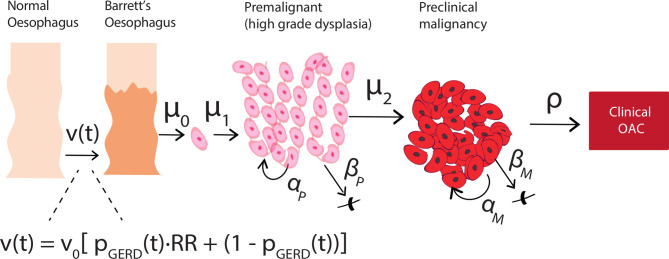
Figure 1
Figure 1
The stochastic, multiscale model for OAC development (MSCE-OAC) includes conversion from normal squamous epithelium in the oesophagus to BE metaplasia with BE onset rate ν(t), which is a function of a baseline rate ν0 and age-dependent prevalence of GERD pGERD(t) (see Methods for details). Two-hit processes with rates μ0, μ1 can initiate a premalignancy (eg, inactivation of tumour suppressor gene TP53 in non-dysplastic BE due to mutation/copy number alteration in a BE daughter cell creates first cell of a high grade dysplasia lesion). Premalignant cell growth rates are defined as αP = division rate, βP = death/differentiation rate per year. Malignant transformation with rate μ2 creates the first cell of a preclinical clone that can grow with rates αM = division rate, βM = death/differentiation rate per year. Size-based probability ρ for detection of preclinical malignant clone can lead to patient-specific time of incident OAC. BE, Barrett’s oesophagus; OAC, oesophageal adenocarcinoma; GERD, gastro-oesophageal reflux disease; MSCE-OAC, multistage clonal expansion for oesophageal adenocarcinoma.
Figure 2
Figure 2
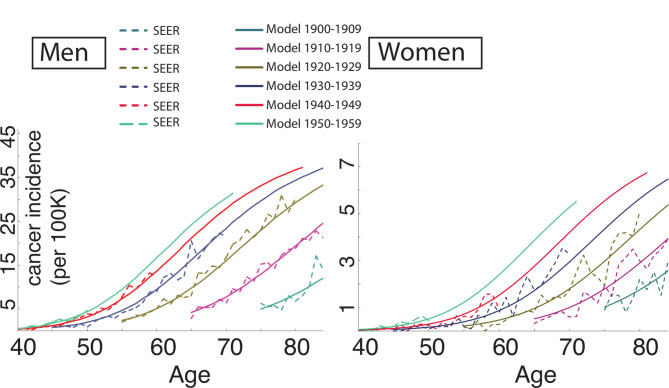
The MSCE-OAC model was previously calibrated to SEER incidence curve data stratified by sex and 10-year grouped birth cohorts from 1900 - 1909 to 1950–1959. The model hazard fits by birth cohort (denoted by colour) represent OAC incidence curves (solid lines) that are consistent with Surveillance, Epidemiology and End Results (SEER) data trends by birth cohort (dashed lines), separately for men (left panel) and women (right panel). MSCE-OAC, multistage clonal expansion for oesophageal adenocarcinoma.
Figure 3
Figure 3
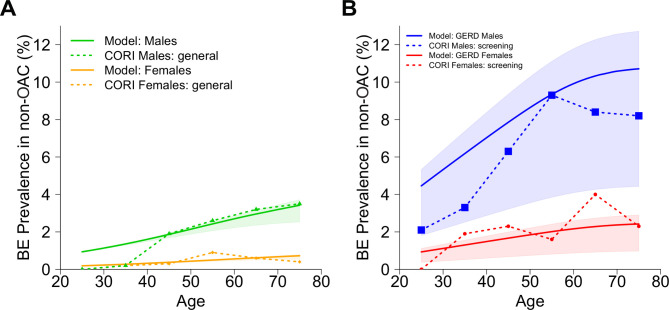
Model predictions for BE-positive yield in a cancer-free population (solid lines) are consistent with observed data (dashed lines) from Clinical Outcomes Research Initiative (CORI). (A) Solid lines show model results for the general US population stratified by sex from the 1950 birth cohort, with contributions of relative risk (RR) of BE from the age-specific, prevalent GERD population assumed to be RR=5 (shaded areas, RR=[2,6]). Dashed lines show consistency with observed BE prevalence data for patients without indication for screening in CORI, which are independent of the model. Model BE prevalence estimates are part of the evolutionary multistage process and thus affect predictions of the total OAC cases predicted (see Results). (B) Solid lines show model results for the symptomatic GERD subpopulation stratified by sex from the 1950 birth cohort with RR for BE set to RR=5. The shaded areas are predicted ranges for GERD subpopulations with fixed RR=2–6 to describe a wide range of increased risks of BE in published estimates, based on factors such as onset age of GERD and BE length. The true GERD-specific BE prevalence contributing to mathematical formulation used in (A) is within this region, where individual contributions are based on GERD onset age and underlying distribution of RR. Dashed lines show BE prevalence data for patients with GERD, and/or another indication for screening, in CORI. BE, Barrett’s oesophagus; GERD, gastro-oesophageal reflux disease; OAC, oesophageal adenocarcinoma.

References

    1. Vaughan TL, Fitzgerald RC. Precision prevention of oesophageal adenocarcinoma. Nat Rev Gastroenterol Hepatol 2015;12:243–8. 10.1038/nrgastro.2015.24 - DOI - PMC - PubMed
    1. Wani S, Qumseya B, Sultan S, et al. . Endoscopic eradication therapy for patients with Barrett's esophagus-associated dysplasia and intramucosal cancer. Gastrointest Endosc 2018;87:907–31. 10.1016/j.gie.2017.10.011 - DOI - PubMed
    1. Sawas T, Killcoyne S, Iyer PG, et al. . Identification of prognostic phenotypes of esophageal adenocarcinoma in 2 independent cohorts. Gastroenterology 2018;155:1720–8. 10.1053/j.gastro.2018.08.036 - DOI - PMC - PubMed
    1. Taylor JB, Rubenstein JH. Meta-Analyses of the effect of symptoms of gastroesophageal reflux on the risk of Barrettʼs esophagus. Am J Gastroenterol 2010;105:1730–7. 10.1038/ajg.2010.194 - DOI - PMC - PubMed
    1. Zagari RM, Fuccio L, Wallander M-A, et al. . Gastro-oesophageal reflux symptoms, oesophagitis and Barrett's oesophagus in the general population: the Loiano-Monghidoro study. Gut 2008;57:1354–9. 10.1136/gut.2007.145177 - DOI - PubMed