


Community psychosocial music intervention (CHIME) to reduce antenatal common mental disorder symptoms in The Gambia: a feasibility trial
- PMID: 33234641
- PMCID: PMC7684808
- DOI: 10.1136/bmjopen-2020-040287
Community psychosocial music intervention (CHIME) to reduce antenatal common mental disorder symptoms in The Gambia: a feasibility trial
Abstract
Objectives: Examine the feasibility of a Community Health Intervention through Musical Engagement (CHIME) in The Gambia to reduce common mental disorder (CMD) symptoms in pregnant women.
Design: Feasibility trial testing a randomised stepped-wedge cluster design.
Setting: Four local antenatal clinics.
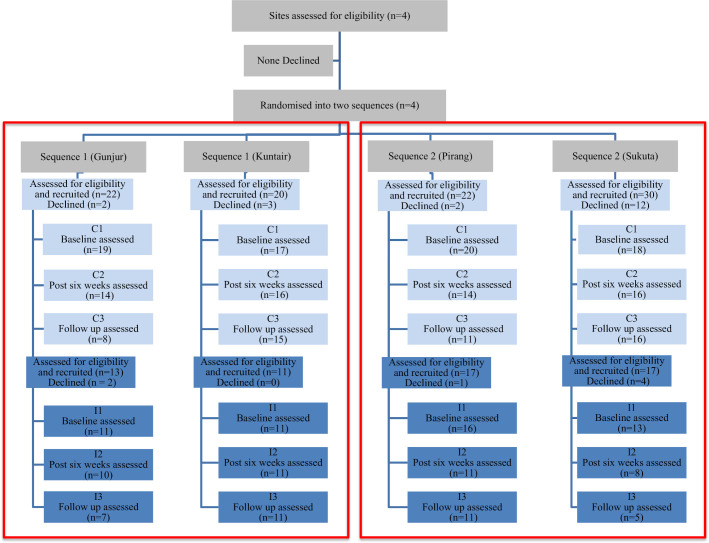
Participants: Women who were 14-24 weeks pregnant and spoke Mandinka or Wolof were recruited into the intervention (n=50) or control group (n=74).
Intervention: Music-based psychosocial support sessions designed and delivered by all-female fertility societies. Sessions lasted 1 hour and were held weekly for 6 weeks. Delivered to groups of women with no preselection. Sessions were designed to lift mood, build social connection and provide health messaging through participatory music making. The control group received standard antenatal care.
Outcomes: Demographic, feasibility, acceptability outcomes and the appropriateness of the study design were assessed. Translated measurement tools (Self-Reporting Questionnaire (SRQ-20); Edinburgh Postnatal Depression Scale (EPDS)) were used to assess CMD symptoms at baseline, post-intervention and 4-week follow-up.
Results: All clinics and 82% of women approached consented to take part. A 33% attrition rate across all time points was observed. 72% in the intervention group attended at least three sessions. Audio and video analysis confirmed fidelity of the intervention and a thematic analysis of participant interviews demonstrated acceptability and positive evaluation. Results showed a potential beneficial effect with a reduction of 2.13 points (95% CI (0.89 to 3.38), p<0.01, n=99) on the SRQ-20 and 1.98 points (95% CI (1.06 to 2.90), p<0.01, n=99) on the EPDS at the post-intervention time point for the intervention group compared with standard care.
Conclusion: Results demonstrate that CHIME is acceptable and feasible in The Gambia. To our knowledge, CHIME is the first example of a music-based psychosocial intervention to be applied to perinatal mental health in a low- and middle-income country context.
Trial registration number: Pan African Clinical Trials Registry (PACTR201901917619299).
Keywords: anxiety disorders; depression & mood disorders; maternal medicine; public health.
© Author(s) (or their employer(s)) 2020. Re-use permitted under CC BY. Published by BMJ.
Conflict of interest statement
Competing interests: None declared.
Figures

References
-
- World Health Organization The International classification of diseases, 10th edition (ICD- 10). Geneva, Swizerland: WHO, 2010. - PubMed
Publication types
MeSH terms
Associated data
Grants and funding
LinkOut - more resources
Full Text Sources
Medical
