. 2020 Nov 24;11(6):e02641-20.
doi: 10.1128/mBio.02641-20.

Potential Rhodopsin- and Bacteriochlorophyll-Based Dual Phototrophy in a High Arctic Glacier

Affiliations

Potential Rhodopsin- and Bacteriochlorophyll-Based Dual Phototrophy in a High Arctic Glacier

Yonghui Zeng et al. mBio. .

Abstract

Conserving additional energy from sunlight through bacteriochlorophyll (BChl)-based reaction center or proton-pumping rhodopsin is a highly successful life strategy in environmental bacteria. BChl and rhodopsin-based systems display contrasting characteristics in the size of coding operon, cost of biosynthesis, ease of expression control, and efficiency of energy production. This raises an intriguing question of whether a single bacterium has evolved the ability to perform these two types of phototrophy complementarily according to energy needs and environmental conditions. Here, we report four Tardiphaga sp. strains (Alphaproteobacteria) of monophyletic origin isolated from a high Arctic glacier in northeast Greenland (81.566° N, 16.363° W) that are at different evolutionary stages concerning phototrophy. Their >99.8% identical genomes contain footprints of horizontal operon transfer (HOT) of the complete gene clusters encoding BChl- and xanthorhodopsin (XR)-based dual phototrophy. Two strains possess only a complete XR operon, while the other two strains have both a photosynthesis gene cluster and an XR operon in their genomes. All XR operons are heavily surrounded by mobile genetic elements and are located close to a tRNA gene, strongly signaling that a HOT event of the XR operon has occurred recently. Mining public genome databases and our high Arctic glacial and soil metagenomes revealed that phylogenetically diverse bacteria have the metabolic potential of performing BChl- and rhodopsin-based dual phototrophy. Our data provide new insights on how bacteria cope with the harsh and energy-deficient environment in surface glacier, possibly by maximizing the capability of exploiting solar energy.IMPORTANCE Over the course of evolution for billions of years, bacteria that are capable of light-driven energy production have occupied every corner of surface Earth where sunlight can reach. Only two general biological systems have evolved in bacteria to be capable of net energy conservation via light harvesting: one is based on the pigment of (bacterio-)chlorophyll and the other is based on proton-pumping rhodopsin. There is emerging genomic evidence that these two rather different systems can coexist in a single bacterium to take advantage of their contrasting characteristics in the number of genes involved, biosynthesis cost, ease of expression control, and efficiency of energy production and thus enhance the capability of exploiting solar energy. Our data provide the first clear-cut evidence that such dual phototrophy potentially exists in glacial bacteria. Further public genome mining suggests this understudied dual phototrophic mechanism is possibly more common than our data alone suggested.

Keywords: bacteriochlorophyll; genome evolution; glacial bacteria; phototrophy; rhodopsin.


Figures

FIG 1
FIG 1
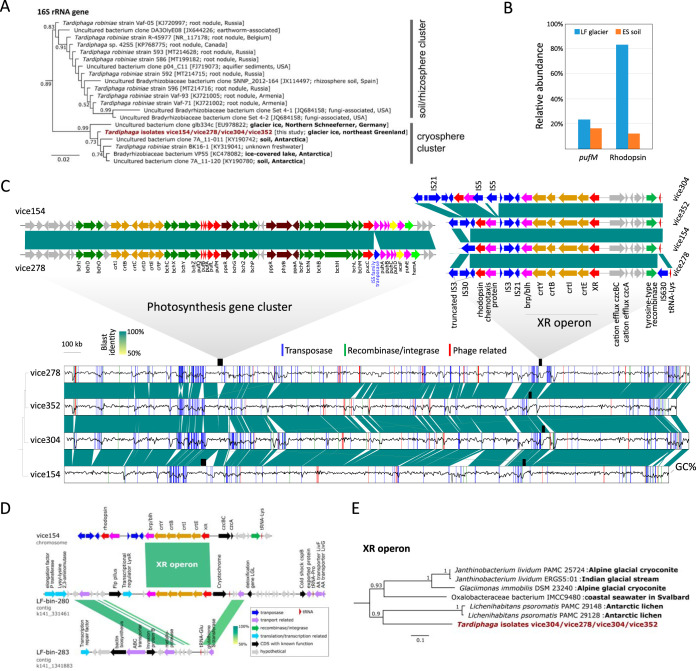
(A) Maximum-likelihood phylogeny of 16S rRNA genes. (B) Abundance of pufM and rhodopsin genes in the “Little Firn” glacier (LF) and nearby exposed soil (ES) metagenomes, calculated as the number of mapped reads normalized to per-kb gene length divided by the normalized number of reads mapped to the housekeeping gene recA. (C) Genome synteny and sequence similarities of Tardiphaga sp. strains vice154, vice278, vice304, and vice352. The GenBank accession number and source environment of each 16S rRNA gene sequence are shown in parentheses on the tree. The architecture of photosynthesis gene cluster and xanthorhodopsin (XR) operon are highlighted. Gaps in the alignment show nonconserved regions caused by mobilome-related activities, including transposase, recombinase, integrase, or phage-related genes, the locations of which are highlighted in the genome. All genomes are complete and start at the replication origin locus. The black wavy line inside each genome (shown as boxes) represents GC content calculated in a window of 1 kb. The relationship between strains was estimated as a distance-based genome tree in the bottom left using MASH (https://github.com/marbl/Mash). Color bar, BLAST identities. (D) Genome synteny between two contigs from the XR-bearing glacial Tardiphaga MAG LF-bin-280 and the nonphototrophic glacial Tardiphaga MAG LF-bin-283 in reference to the genome of strain vice154. MAG, metagenome-assembled genome. (E) Maximum-likelihood phylogeny of the whole XR operon of Tardiphaga isolates and their top tBLASTn hits in NCBI’s genome database; see Fig. S5 for the full version of the tree.
FIG 2
FIG 2
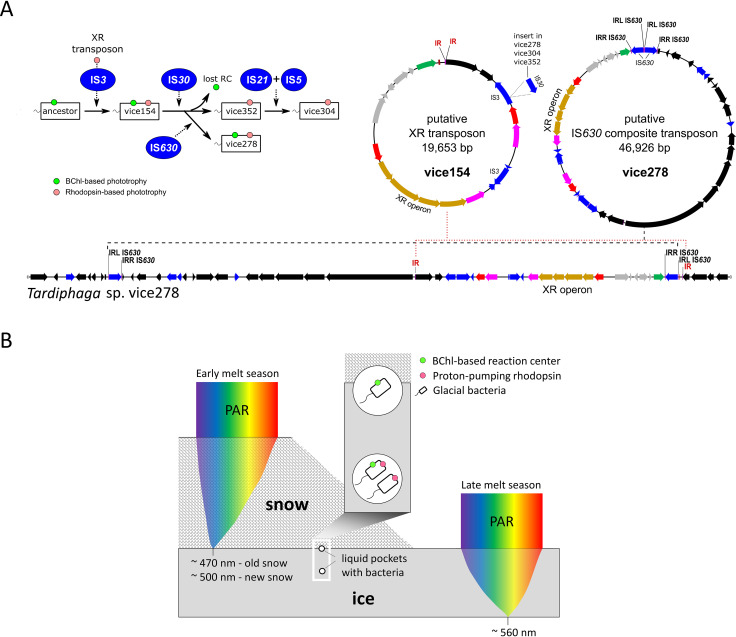
(A) Hypothetical evolutionary path of the Tardiphaga isolates from their common ancestor based on the IS insertion patterns (left) and two transposons proposed to drive the movement of the xanthorhodopsin (XR) operon (right). The genomic region surrounding the XR operon in Tardiphaga strain vice278 was shown to highlight the distribution of direct or inverted repeats that are required to form the putative transposons. RC, reaction center; IR, inverted repeat; DR, direct repeat, IRL, inverted repeat-left; IRR, inverted repeat-right. (B) A model for light availability in snow and ice and hypothesized niche partitioning of BChl- and rhodopsin-based dual phototrophy versus only BChl- or rhodopsin-based single phototrophy. The snowpack and icepack are depicted to be of such an ideal thickness that the light spectrum with the lowest extinction coefficient reaches the exact bottom of snowpack or icepack. PAR, photosynthetically active radiation. Note that new and old snows have different spectral distribution for PAR.

References

    1. Pinhassi J, DeLong EF, Béjà O, González JM, Pedrós-Alió C. 2016. Marine bacterial and archaeal ion-pumping rhodopsins: genetic diversity, physiology, and ecology. Microbiol Mol Biol Rev 80:929–954. doi:10.1128/MMBR.00003-16. - DOI - PMC - PubMed
    1. Sabehi G, Loy A, Jung KH, Partha R, Spudich JL, Isaacson T, Hirschberg J, Wagner M, Béja O. 2005. New insights into metabolic properties of marine bacteria encoding proteorhodopsins. PLoS Biol 3:e273. doi:10.1371/journal.pbio.0030273. - DOI - PMC - PubMed
    1. Kirchman DL, Hanson TE. 2013. Bioenergetics of photoheterotrophic bacteria in the oceans. Environ Microbiol Rep 5:188–199. doi:10.1111/j.1758-2229.2012.00367.x. - DOI - PubMed
    1. Gómez-Consarnau L, Raven JA, Levine NM, Cutter LS, Wang D, Seegers B, Arístegui J, Fuhrman JA, Gasol JM, Sañudo-Wilhelmy SA. 2019. Microbial rhodopsins are major contributors to the solar energy captured in the sea. Sci Adv 5:eaaw8855. doi:10.1126/sciadv.aaw8855. - DOI - PMC - PubMed
    1. Petersen J, Brinkmann H, Bunk B, Michael V, Päuker O, Pradella S. 2012. Think pink: photosynthesis, plasmids and the Roseobacter clade. Environ Microbiol 14:2661–2672. doi:10.1111/j.1462-2920.2012.02806.x. - DOI - PubMed

Publication types

LinkOut - more resources